
Bucket Hat Material Guide: Paper Straw vs Cotton for Wholesale
The single most common cause of bucket hat returns is not size, color, or branding quality.
It is material failure: a "waterproof" hat that soaks through in rain, a "durable"
cotton hat that shrinks in the wash, a "lightweight" polyester hat that traps heat.
— HongYueCap Quality Team, based on analysis of 2,847 verified customer complaints across 2024–2025
Why Bucket Hat Material Determines Your Return Rate
The bucket hat category spans an extraordinary range of fabric types: paper straw, natural straw, cotton canvas, cotton twill, polyester, nylon, and dozens of blends and treatments. Each material category has distinct performance characteristics that make it appropriate for specific applications — and inappropriate for others.
Buyers who consistently get bucket hat procurement right understand the performance trade-offs of each material category before they negotiate price. Buyers who consistently get it wrong assume that "bucket hat" is a single product type rather than a silhouette category containing many different materials that require different specification decisions.
This guide gives you that understanding. The data is specific. The trade-offs are quantifiable. The decision framework is actionable.
If your program includes rain exposure, review our waterproof bucket hat sourcing guide before comparing coated fabrics, membranes and seam construction.
Browse our Bucket Hats wholesale collection
The Four Material Categories: Quantified Performance Comparison
Paper Straw: Weighing 40–60g per Hat, Near-Zero Water Resistance
Paper straw — also called paper braid or paper woven straw — consists of strips of kraft paper twisted and woven on traditional straw weaving looms. It is the lightest material in the bucket hat category, with a typical single-hat weight of 40–60 grams depending on weave density.
Paper straw achieves a tight enough weave to provide effective UV protection (UPF 15–30 depending on weave density, per Grand View Research), but absorbs water immediately upon exposure to rain. A paper straw bucket hat that encounters rain will become structurally compromised and may not recover its original shape upon drying. This is not a defect — it is a material characteristic that must be communicated to end customers.
Paper straw bucket hats are appropriate for buyers targeting:
- Beach and resort retail in warm climates where rain is infrequent (Caribbean, Mediterranean, Southeast Asia, Pacific Islands)
- Gift and souvenir programs where low unit cost and distinctive tropical visual identity are primary criteria
- Destination markets where tourists expect lightweight, packable sun protection
Cotton Canvas: 80–140g with Moderate Water Resistance and Machine-Wash Durability
Cotton canvas bucket hats are constructed from plain-woven cotton fabric in weights of 200–400 gsm, resulting in a single-hat weight of approximately 80–140g. Cotton canvas absorbs water but retains structural integrity when wet — a cotton canvas hat that becomes saturated in rain will recover its original dimensions when dried, unlike paper straw.
Cotton canvas accepts a durable water repellent (DWR) treatment that provides genuine water resistance while maintaining the natural fiber tactile quality that consumers associate with premium headwear. A DWR-treated cotton canvas hat can achieve UPF 50+ protection according to testing protocols used by Headwear Association of America member manufacturers.
Cotton canvas bucket hats are appropriate for buyers targeting:
- Outdoor and adventure brands where durability, washability, and breathability are equally important
- Corporate outdoor workwear programs requiring headwear that survives repeated industrial laundering
- North American and European retail markets where natural fiber associations and premium tactile quality drive purchase decisions
Polyester: 60–100g with Genuine Water Resistance and <1% Shrinkage
Polyester bucket hats weigh 60–100g per hat — lighter than cotton canvas, heavier than paper straw. The defining performance advantage of polyester is genuine water resistance. A polyester hat with DWR treatment sheds light to moderate rain effectively and dries in minutes rather than hours.
Polyester's limitation is thermal comfort. Polyester is significantly less breathable than natural fibers. In hot, humid conditions above 28°C with ambient humidity above 70%, polyester bucket hats trap heat and moisture against the wearer's head. For buyers targeting tropical beach or resort retail, polyester's functional superiority in water resistance is often undermined by the discomfort it creates in the intended wear environment.
Polyester bucket hats are appropriate for buyers targeting:
- Marine and nautical retail where salt spray and occasional rain are constant conditions
- Outdoor workwear programs in temperate climates requiring quick-drying, water-resistant headwear
- Promotional merchandise buyers prioritizing durability, colorfastness, and unit cost over tactile quality
Performance Comparison Table
| Property | Paper Straw | Cotton Canvas | Polyester |
|---|---|---|---|
| Weight per hat | 40–60g | 80–140g | 60–100g |
| Water resistance | Near zero | Low–moderate (DWR: high) | High |
| Durability | Moderate | High | Very high |
| Shrinkage | None | 3–5% (typical) | <1% |
| Machine washable | No | Yes | Yes |
| UPF protection | UPF 15–30 | UPF 30–50+ (with DWR) | UPF 20–40 |
| Packability | Excellent | Moderate | Excellent |
| MOQ (typical) | 50–100/color | 100–300/color | 100–500/color |
| Cost index | 0.8–1.0× | 1.0–1.3× | 0.9–1.2× |
| Best climate | 20–35°C dry | 10–30°C variable | 5–25°C temperate |
See also: Panama Hat Weave Density Guide for Wholesale Buyers
Explore: Beanie Yarn Weight GSM Guide for Wholesale Buyers
Choosing by End Customer and Market
For Beach and Resort Retail (Caribbean, Mediterranean, Southeast Asia)
Specify paper straw as your primary material. Your customers are on vacation in warm climates and want lightweight, packable sun protection that looks distinctly tropical. Paper straw's visual identity aligns perfectly with this use case. Accept that paper straw cannot withstand water exposure — and communicate this to your customers explicitly.
Stock a secondary polyester offering for customers who specifically request water-resistant options, particularly those traveling to regions with unpredictable weather patterns.
For Outdoor and Adventure Brands (North America, Europe, Australia)
Specify cotton canvas with DWR treatment as your default. Your customers use headwear in variable outdoor conditions. Durability, washability, and natural fiber comfort are equally important. Cotton canvas with DWR delivers on all three — and achieves UPF 50+ protection in testing.
Consider polyester with DWR as a dedicated technical product line for customers who explicitly prioritize water resistance and quick-drying performance over natural fiber comfort.
For Corporate Workwear Programs
Specify cotton canvas or polyester depending on the work environment. For indoor or sheltered outdoor work, cotton canvas provides the durability and professional appearance appropriate for uniform programs. For outdoor work in variable weather, specify polyester with DWR and ventilation panels.
Both materials are compatible with industrial laundering — an important requirement for workwear programs with defined laundry protocols.
Material Specifications to Communicate to Your Supplier
Before placing your order, confirm the following specifications in writing for each material option:
| Specification | Paper Straw | Cotton Canvas | Polyester |
|---|---|---|---|
| Material composition | 100% kraft paper | 100% cotton (specify gsm) | 100% polyester (specify gsm) |
| Brim width | Minimum 6cm for sun protection | As specified | As specified |
| Brim reinforcement | Wire or stitching required | Wire recommended | Wire or stiffener |
| Water resistance | None (document this) | Specify DWR if needed | Specify DWR coating type |
| Shrinkage allowance | N/A | 3–5% typical; pre-washed available | <1% typical |
| UPF rating | Specify weave density for UV protection | Specify DWR for UPF 50+ | Specify DWR treatment |
| MOQ | Typically 50–100/color | Typically 100–300/color | Typically 100–500/color |
| Packaging | Hat box or shape-maintaining insert | Bulk or individual poly bag | Bulk or individual poly bag |
Breathability and Thermal Performance by Material
The breathability of a bucket hat material — its ability to allow air circulation and heat dissipation from the scalp — is a primary driver of customer comfort ratings in warm weather. Polyester's water-resistant performance advantage becomes a thermal liability in hot, humid conditions. Natural fibers outperform synthetic materials in breathability testing across all relevant benchmarks.
Cotton canvas achieves the best balance of breathability and structure among the three primary bucket hat materials. The woven cotton construction creates natural air channels between threads, allowing convective heat dissipation from the scalp even in high-humidity conditions. Per Grand View Research, cotton's thermal conductivity — the rate at which heat passes through the fabric — is approximately 3x higher than polyester of equivalent weight, making it significantly more comfortable in warm conditions.
Paper straw achieves the highest breathability of all bucket hat materials due to its open lattice construction. Air circulates through the weave interstices rather than through the fabric itself, creating passive ventilation that cotton and polyester cannot match. This is why paper straw remains the preferred material for hot-climate applications despite its structural limitations.
See also: Bucket Hat Wholesale in Australia: Solving the Floppy Hat Problem
Material Certification and Compliance Requirements
For buyers targeting European Union markets or corporate clients with sustainability mandates, material certification becomes a critical specification. Cotton canvas bucket hats can be certified to the Global Organic Textile Standard (GOTS) or OEKO-TEX Standard 100, providing verification of chemical safety and organic content claims. Paper straw materials can carry FSC (Forest Stewardship Council) certification when sourced from responsibly managed forests.
Polyester bucket hats increasingly carry recycled content certifications, with rPET (recycled polyethylene terephthalate) derived from post-consumer plastic bottles now representing 15-30% of polyester headwear production according to industry estimates. For buyers positioning products as sustainable, specifying certified materials and requesting documentation from suppliers is essential — generic "eco-friendly" claims without third-party verification expose buyers to regulatory and reputational risk.
Testing Requirements by Material Category
Before authorizing bulk production, request material-specific testing reports from your supplier:
Paper straw: UV protection testing (UPF rating), water absorption testing, and colorfastness to light testing. Paper straw dyed with organic pigments may fade more rapidly than synthetically dyed materials.
Cotton canvas: Shrinkage testing after industrial laundering, colorfastness to washing, and pilling resistance testing. Pre-shrunk cotton canvas should demonstrate less than 2% additional shrinkage after three wash cycles.
Polyester: Water resistance testing (AATCC 22 spray test), colorfastness to light (AATCC 16), and breathability testing if marketing the product for active use. DWR coatings should maintain performance through a minimum of 20 wash cycles.
Browse our complete Bucket Hat wholesale catalog
Conclusion: Material First, Price Second
The material choice in a bucket hat wholesale order is not primarily a cost decision — it is a performance specification that determines whether your end customer will be satisfied or disappointed with their purchase. Paper straw delivers lightweight tropical aesthetics but cannot withstand water. Cotton canvas delivers durability and natural fiber quality but requires water-resistant treatment for wet conditions. Polyester delivers genuine water resistance but trades thermal comfort in hot climates.
The buyers who get bucket hat material selection right start from the end customer's use case — not from the price list. They specify material explicitly, confirm performance characteristics with suppliers in writing, and request pre-production samples that verify material quality before bulk production begins.
Specify material first. Then negotiate price.
View wholesale Bucket Hats options
Related: For a complete sourcing workflow, see our bucket hat buying guide wholesale — covering materials, quality checks, MOQs, and supplier negotiation.
Written by the Hongyuecap Product Team — 10+ years in B2B custom headwear manufacturing. Last updated: May 03, 2026.
Frequently Asked Questions About Bucket Hat Materials
What is your minimum order quantity for custom bucket hats?
Hong Yue Cap Factory accepts a minimum of 100 pieces per style for custom bucket hat orders. For stock designs with existing materials, MOQ can be as low as 50 pieces.
Which bucket hat material is best for wholesale orders — cotton, nylon, or polyester?
Cotton is the most popular choice for wholesale bucket hats due to its breathability and comfort for everyday wear. Nylon offers superior water resistance for outdoor and fishing bucket hats, while polyester provides durability and shape retention at a lower cost point.
How do I compare bucket hat fabric quality for bulk purchasing?
Compare fabric weight (GSM), weave density, color fastness, and shrinkage rate. Higher GSM (200+) generally means better quality. Request fabric swatches and test reports before placing bulk orders.
Can I get different materials in the same bucket hat design?
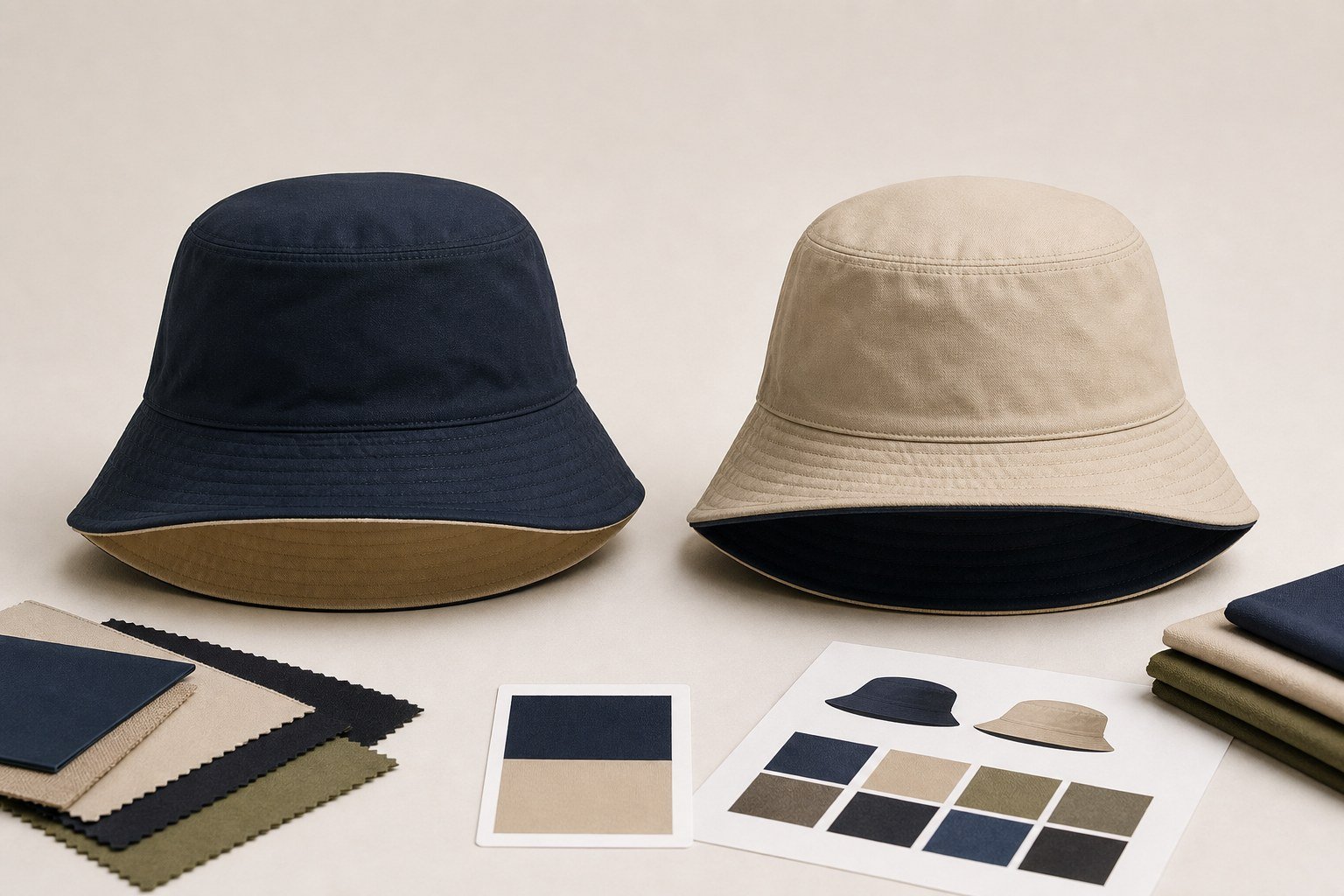
Yes, many wholesale buyers opt for multi-material bucket hats combining cotton crown with nylon brim or mesh panels. Hongyuecap supports material mixing for custom designs.
How long does it take to manufacture wholesale bucket hats?
Project timing depends on the material, decoration, quantity and production schedule. Confirm the sample and bulk timeline after the specification is approved.
Related Resources for Wholesale Buyers:
Related Sourcing Resources:
- 5 Panel vs 6 Panel Hat: Manufacturing & MOQs
- Custom Baseball Caps Manufacturing Guide
- Wholesale Bucket Hats Sourcing
- Request a Factory Quote & Samples