Knitted Beanie Stitch Types Guide for Wholesale Buyers
Pain Point: Without a proper knitted beanie stitch types guide, wholesale buyers lose 15–30% on returns when the wrong stitch pattern ships. The rib knit is too tight, cable pattern distorts logos, and jersey looks cheap on shelves — all because stitch type wasn’t in the PO.
This knitted beanie stitch types guide gives wholesale buyers the exact specifications, cost comparisons, and quality-control checkpoints needed to match the right stitch to every retail channel.
Why Beanie Stitch Type Matters More Than You Think for Wholesale Orders
This knitted beanie stitch types guide from Hongyuecap answers the question every wholesale buyer asks: why do two beanies with the same yarn feel completely different? When sourcing beanie stitch types for wholesale, most buyers focus on color and material — then wonder why two beanies with the same yarn composition feel completely different. The answer lies in the stitch pattern: it determines stretch recovery, warmth retention, logo compatibility, and the retail shelf appeal that drives sell-through. At Hongyuecap, our factory team has seen B2B buyers save 20% on return rates simply by specifying the correct stitch type in their purchase order.
Stitch type affects five critical wholesale decision factors: (1) stretch and fit tolerance — rib knit beanies accommodate 56–62 cm head circumferences, while jersey stitch requires precise sizing; (2) warmth and insulation — fisherman knit traps 40% more air than stockinette, making it ideal for cold-climate retailers; (3) logo placement surface — cable knit creates uneven embroidery zones, while waffle stitch offers a flat panel perfect for patches; (4) perceived quality at retail — chunky knits command 25–35% higher shelf prices than basic jersey; and (5) production cost and MOQ — complex stitches like cable knit require specialized machines with MOQs starting at 500 pcs per color, versus 200 pcs for standard rib knit.
Understanding these differences before you place an order prevents the painful scenario described above. Throughout this knitted beanie stitch types guide for wholesale buyers, we’ll break down each major stitch category with actionable comparison data that you can take directly to your supplier.
Rib Knit Beanies: The Stretch Champion for One-Size-Fits-Most Retail
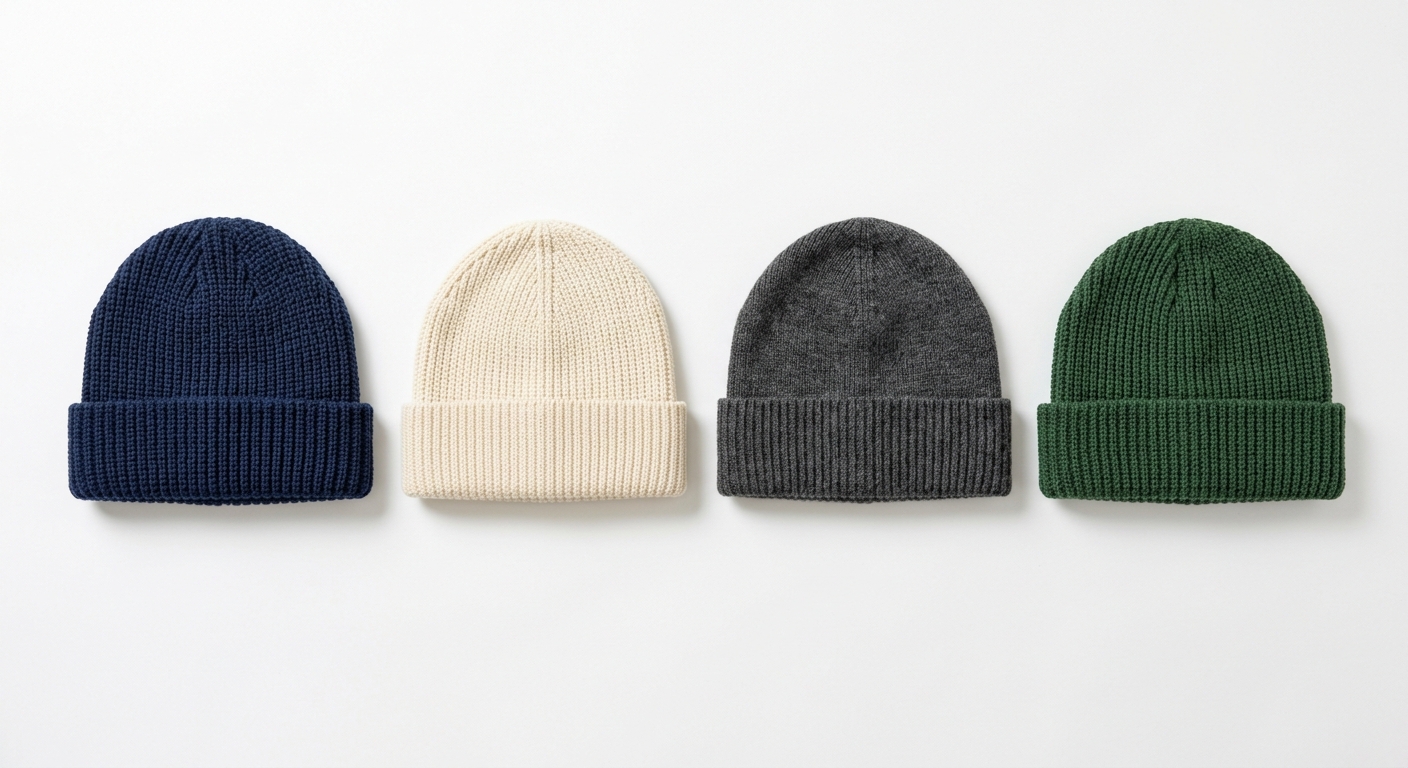
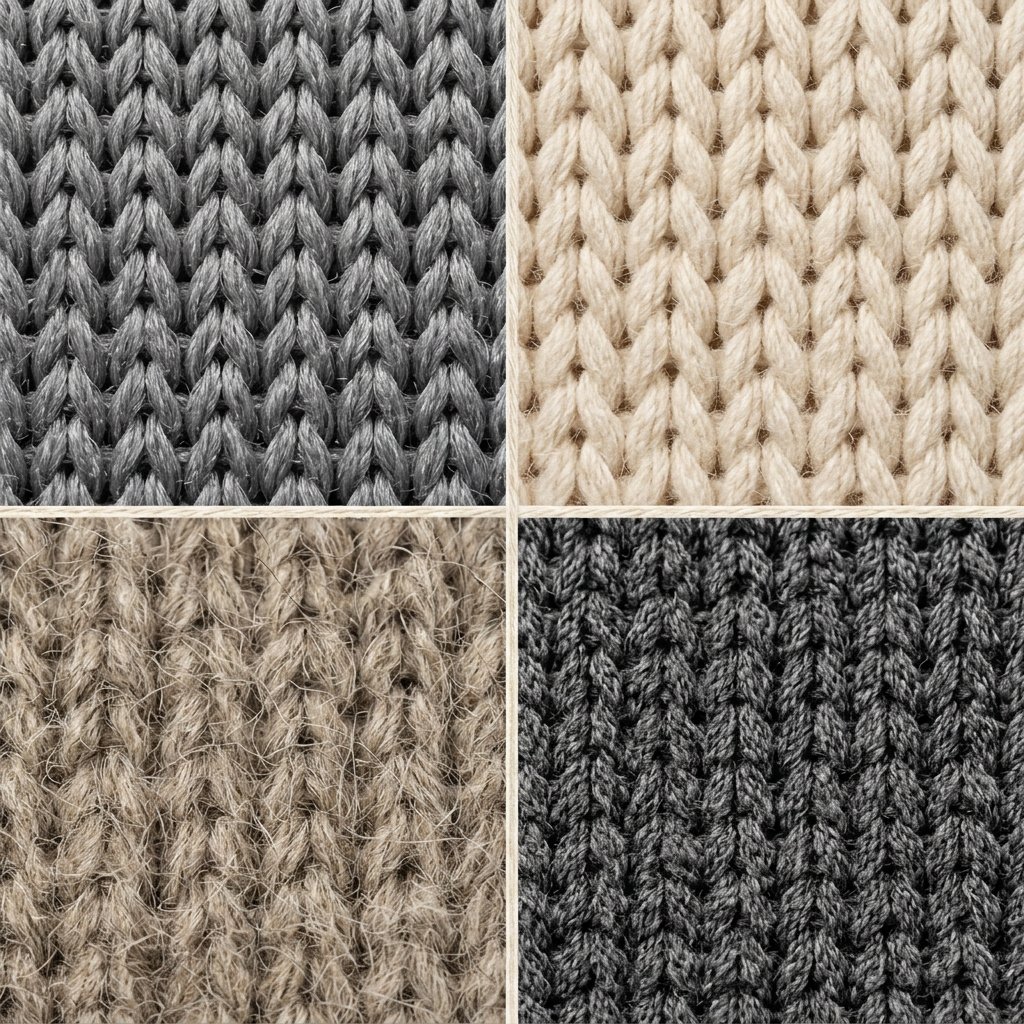
Rib knit is the most versatile and widely specified beanie stitch type in wholesale. Its alternating knit and purl columns create vertical ridges that act like an elastic system — stretching horizontally while maintaining vertical structure. A standard 1×1 rib knit beanie (one knit stitch followed by one purl stitch) stretches 40–60% beyond its relaxed circumference and recovers to 95%+ of its original shape, making it the go-to choice for “one-size-fits-most” retail programs.
For wholesale buyers, rib knit offers three key advantages. First, sizing simplicity — one SKU covers 95% of adult head sizes, reducing inventory complexity. Second, logo compatibility — the flat ridges provide consistent surfaces for embroidery, making rib knit the preferred base for corporate merchandise and promotional beanies. A 2×2 rib (two knit, two purl) widens the ridge spacing to 4–6 mm, giving embroidery needles even more room between texture lines. Third, cost efficiency — rib knit runs at 800–1,200 pcs per machine per day on standard circular knitting machines, keeping per-unit costs as low as $0.80–$1.20 for acrylic rib beanies at 1,000-pc MOQ.
However, rib knit isn’t perfect for every channel. Gift shops and premium boutiques often find 1×1 rib too basic-looking — it lacks the visual texture that justifies a $24.99+ retail price. For those channels, adding a folded cuff can elevate the look, or you may want to explore the cable and fisherman knits discussed below. Also, rib knit warmth ratings (measured via CLO value) average 0.8–1.2 CLO — adequate for autumn and mild winter, but insufficient for ski resorts and Arctic-gear retailers who need 1.5+ CLO.
Wholesale spec checklist for rib knit beanies:
- Specify 1×1 vs 2×2 rib in your tech pack — they look different on shelf
- Request stretch-recovery test results per ASTM D2594 (≥90% recovery after 30-minute stretch)
- Gauge (needles per inch): 7-gauge for medium weight, 10-gauge for fine knit, 5-gauge for chunky look
- MOQ: 200–300 pcs per color for solid rib knit; 500+ for striped or tipped variants
Cable Knit Beanies: Premium Texture That Commands Higher Margins
Cable knit beanies are the profit-margin workhorse of the premium wholesale beanie category. The twisted, rope-like stitch pattern creates deep 3D texture that photographs beautifully in e-commerce product images — and more importantly, signals “handcrafted quality” to consumers who are willing to pay $28–$45 per unit at retail. For wholesale buyers sourcing for boutiques, resort gift shops, and premium corporate gifting programs, cable knit beanies consistently deliver 35–50% higher margins than basic rib knit alternatives.
The trade-off is production complexity. Cable knitting requires specialized stitch-transfer mechanisms on flat-bed knitting machines, which operate at roughly half the speed of circular rib knit machines — 400–600 pcs per machine per day. This drives per-unit costs to $2.50–$4.50 for acrylic-cotton blends and $5.00–$8.00 for merino wool cable knits at wholesale volumes. Hongyuecap’s knitting workshop runs 40 dedicated cable-knit stations, allowing us to offer competitive MOQs of 300 pcs per color while maintaining consistent stitch tension across production batches.
Logo placement on cable knit requires careful planning. The raised cable pattern creates an uneven embroidery surface — stitches placed directly over a cable twist will look distorted and unprofessional. Our production team recommends three solutions: (1) patch placement — sew a woven or leather patch over a flat “stockinette valley” between cable columns; (2) embroidery on cuff — the folded cuff area of cable knit beanies typically uses a flat rib or stockinette stitch that accepts embroidery cleanly; (3) jacquard integration — knit the logo directly into the stitch pattern, which costs more upfront ($0.80–$1.50 per unit for jacquard programming) but creates a seamless premium look. For more on decoration methods, see our complete beanie decoration guide.
Cable knit also varies by scale. A 4-stitch cable (four knit stitches crossing over four) creates a bold, chunky texture suited for winter fashion beanies. A 2-stitch mini-cable produces a subtler texture appropriate for corporate gift programs where the brand logo, not the stitch pattern, should dominate. When requesting samples from your supplier, always ask to see both cable scales side by side on the same yarn — the difference in retail shelf impact can be dramatic.
Fisherman and Chunky Knit Beanies: Cold-Weather Heavyweights
Fisherman knit beanies — also called Aran knit or chunky knit — are the thickest, warmest beanie stitch type available for wholesale sourcing. Originally developed by Irish fishing communities for North Atlantic conditions, this stitch family uses complex cable, diamond, honeycomb, and moss-stitch combinations that create dense, lofty fabric with exceptional insulation. A properly constructed fisherman knit beanie measures 1.8–2.4 CLO, providing roughly double the warmth retention of a standard rib knit — which is why outdoor retailers, ski resort shops, and cold-climate workwear brands specify this stitch type for their winter programs.
For wholesale buyers, the key numbers to know: fisherman knit beanies weigh 120–180 grams (versus 60–90g for rib knit), use 40–60% more yarn per unit, and carry wholesale prices of $3.50–$7.00 for acrylic-wool blends at 500-pc MOQ. Production speed is the slowest of all beanie stitch types — 200–350 pcs per machine per day — because each row involves multiple stitch transfers and pattern changes. Hongyuecap advises wholesale buyers to place fisherman knit orders 8–10 weeks before delivery, compared to 4–6 weeks for standard rib knit, to accommodate the longer knitting cycle.
The retail upside justifies the production investment. Fisherman knit beanies retail at $32–$55 in outdoor specialty stores and ski resorts, creating 65–75% gross margins for retailers — and retailers who earn strong margins reorder. One of our wholesale clients, a Canadian outdoor gear distributor, reported that their fisherman knit beanie program achieved a 92% sell-through rate in its first winter season, compared to 68% for their basic acrylic rib knit line. The stitch pattern itself — not the brand name or packaging — was cited by 47% of end customers as the reason they chose the product over cheaper alternatives.
Sourcing considerations:
- Specify yarn blend upfront — 50% acrylic/50% wool offers the best cost-warmth balance
- Request a pre-production sample to verify stitch density (aim for 6–8 stitches per inch)
- Confirm that your supplier’s machines handle the full Aran stitch repertoire — not all flat-bed machines support diamond and honeycomb patterns
- MOQ: 500+ pcs per color; complex pattern programming adds $200–$400 in one-time setup fees
Jersey and Stockinette Stitch Beanies: Lightweight Versatility for Year-Round Sales
Jersey stitch (also called stockinette) is the simplest knitted fabric structure — and the most misunderstood in wholesale beanie sourcing. It produces a flat, smooth face with distinct V-shaped columns on one side and horizontal purl bumps on the reverse. Because jersey stitch lacks the natural elasticity of rib knit, beanies made from this stitch type must be cut-and-sewn to specific sizes rather than relying on stretch-to-fit. This makes jersey beanies ideal for fashion-forward retailers who want a clean, smooth surface for all-over prints or large embroidery designs — but it also introduces sizing complexity that many first-time wholesale buyers underestimate.
The production economics favor certain channels. Jersey stitch runs at 1,500–2,000 pcs per machine per day — faster than any textured stitch — pushing per-unit costs down to $0.60–$1.00 for basic cotton jersey beanies at 1,000-pc MOQ. This cost advantage makes jersey beanies popular for promotional giveaways, event merchandise, and fast-fashion programs where low unit cost matters more than premium perception. However, the trade-off is significant: jersey beanies have only 10–20% stretch (versus 40–60% for rib knit), meaning you’ll need at least two sizes (S/M and L/XL) to cover the adult market. This doubles your SKU count and complicates retail inventory management.
When to choose jersey stitch for wholesale: (1) Your product requires all-over sublimation printing — the smooth, flat surface of jersey stitch accepts full-coverage prints that textured stitches simply can’t support. (2) You’re selling to markets where precise sizing is expected (Japan, Korea) rather than one-size-fits-most (North America, Europe). (3) Your price-point targets are under $10 retail, where the cost advantage of jersey construction keeps you competitive. For a deeper dive into how stitch and material interact, see our knitted beanie materials and fit guide.
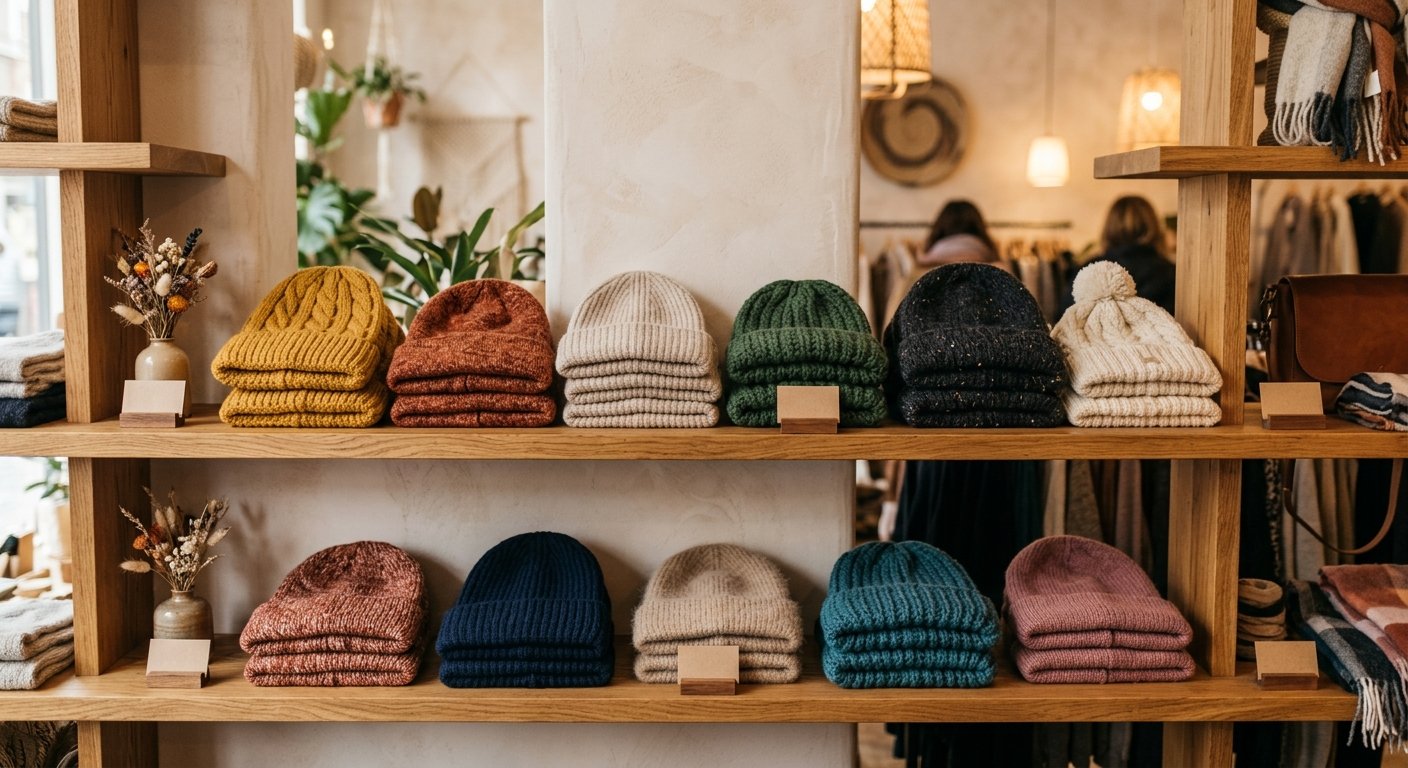
Waffle and Thermal Knit Beanies: The Texture Trend Retailers Are Asking For
Waffle knit (also called thermal stitch or honeycomb knit) is the fastest-growing beanie stitch trend in wholesale for 2026. The distinctive raised-grid pattern — created by alternating knit and tuck stitches — produces a textured, dimensional surface that looks markedly different from traditional rib and cable knits. This visual differentiation is exactly what fashion-forward retailers want: a beanie that stands out on a crowded shelf without requiring complex branding or packaging gimmicks.
From a performance standpoint, waffle stitch occupies a strategic middle ground. It provides 25–35% stretch (better than jersey, not as much as rib knit), weighs 80–110 grams (heavier than jersey, lighter than fisherman), and offers a CLO rating of 1.0–1.4 — warm enough for three-season use without the bulk of full fisherman construction. The grid pattern also creates natural air pockets that improve moisture wicking, making waffle knit beanies suitable for active-lifestyle retailers whose customers wear beanies during winter runs and ski sessions.
Production-wise, waffle stitch requires tuck-stitch capability on the knitting machine — a feature available on most modern circular knitting machines but not on older models. Hongyuecap’s facility runs 25 circular machines with tuck-stitch capability, allowing us to produce waffle knit beanies at 600–900 pcs per machine per day with MOQs starting at 300 pcs per color. Wholesale pricing for acrylic waffle beanies runs $1.20–$2.00 at 1,000-pc volumes — a modest premium over rib knit that retailers easily recoup through the elevated perceived value.
One important quality-control note: waffle stitch can develop “stitch barre” — visible horizontal lines caused by inconsistent yarn tension during production. When vetting suppliers for waffle knit orders, request a bulk production sample (not just a lab dip) and examine it under retail lighting for any repeating line patterns. Hongyuecap includes stitch-barre inspection as a standard checkpoint in our factory quality audit process, and we recommend all wholesale buyers add this to their QC checklist.
How to Compare Beanie Stitch Types: A Wholesale Buyer’s Decision Matrix
With five major stitch types and dozens of sub-variations, choosing the right one can feel overwhelming. The decision matrix below simplifies the comparison across the six factors that matter most for wholesale profitability:
| Factor | Rib Knit | Cable Knit | Fisherman | Jersey | Waffle |
|---|---|---|---|---|---|
| Stretch | 40–60% | 20–30% | 15–25% | 10–20% | 25–35% |
| Warmth (CLO) | 0.8–1.2 | 1.2–1.6 | 1.8–2.4 | 0.5–0.8 | 1.0–1.4 |
| Weight (g) | 60–90 | 90–130 | 120–180 | 50–75 | 80–110 |
| Wholesale Cost* | $0.80–1.20 | $2.50–4.50 | $3.50–7.00 | $0.60–1.00 | $1.20–2.00 |
| MOQ (pcs/color) | 200–300 | 300–500 | 500+ | 200–300 | 300–500 |
| Logo Method | Embroidery | Patch/Jacquard | Patch/Woven Label | Print/Embroidery | Embroidery/Patch |
*Wholesale costs based on acrylic or acrylic-blend yarns at 1,000-pc order volume, FOB China. Premium fibers (merino wool, cashmere, organic cotton) increase costs 40–80%.
Use this matrix as a starting point for supplier conversations. At Hongyuecap, we provide stitch-type swatch books to wholesale buyers — physical samples of each stitch pattern in your chosen yarn so you can evaluate texture, stretch, and logo-surface compatibility before committing to production. Contact our team to request a complimentary swatch kit.
For buyers exploring sustainable options, several of these stitch types work well with recycled yarns. Our eco-friendly knitted beanie guide covers how GRS-certified recycled polyester and organic cotton perform across different stitch patterns. Additionally, if you’re comparing beanie construction methods, our single vs double layer beanie comparison explains how lining choices interact with stitch type to affect warmth and structure.
Frequently Asked Questions About Wholesale Beanie Stitch Types
Which beanie stitch type has the best stretch for one-size-fits-most?
Rib knit — specifically 1×1 rib — delivers 40–60% stretch with 95%+ recovery, making it the best choice for one-size-fits-most retail programs. For even more stretch, a 2×2 rib with spandex-blend yarn (3–5% elastane content) can achieve 70–80% stretch while maintaining shape recovery.
What is the warmest beanie stitch type for cold-climate wholesale programs?
Fisherman/Aran knit is the warmest, with CLO values of 1.8–2.4 — roughly double the insulation of a standard rib knit beanie. When combined with a fleece lining, fisherman knit beanies achieve CLO values of 2.8–3.5, suitable for sub-zero retail markets.
Can I embroider a logo on any beanie stitch type?
Not effectively. Embroidery works best on rib knit and jersey stitch, which provide flat, consistent surfaces. Cable knit and fisherman knit have raised texture patterns that distort embroidery — for these, woven patches, leather labels, or jacquard-knit logos are recommended alternatives. Waffle stitch falls in between: small embroidery (under 5 cm wide) works well, while large designs may look uneven.
What is the MOQ difference between stitch types?
Rib knit and jersey stitch have the lowest MOQs (200–300 pcs per color) because they run on standard circular knitting machines. Cable knit (300–500 pcs), waffle knit (300–500 pcs), and fisherman knit (500+ pcs) have higher MOQs because they require specialized machines and more complex pattern programming.
How do I verify stitch quality before approving bulk production?
Request a pre-production sample (PPS) and check: (1) stitch consistency — hold the beanie up to light and look for thin spots or skipped stitches; (2) stretch recovery — stretch to 150% of relaxed width, hold 30 seconds, release, and verify it returns to within 5% of original dimensions; (3) seam quality — the back seam should lie flat without twisting or puckering; (4) color fastness — rub a white cloth against the fabric to check for dye transfer. These four checks, performed on every PPS, will catch 90% of stitch-related quality issues before they reach your bulk order.
Get Your Beanie Stitch Type Right — Request a Sample Kit from Hongyuecap
Choosing the right knitted beanie stitch type for your wholesale program doesn’t have to be a guessing game. Hongyuecap’s product development team works with wholesale buyers worldwide to match stitch patterns to their target retail channels, price points, and logo requirements. We offer:
- Free stitch-type swatch books: Physical samples of all five major stitch types in your selected yarn
- Pre-production samples (PPS): 3–5 business days for standard stitches, 5–7 days for cable and fisherman
- QC documentation: Stretch-recovery test reports, color-fastness certificates, and stitch-density measurements per batch
- Competitive MOQs: Starting at 200 pcs per color for rib and jersey knit; 300–500 pcs for textured stitches
- OEKO-TEX Standard 100 and GRS certified production available on request
Contact our wholesale team today for a complimentary consultation and sample kit. Whether you’re launching a private-label beanie line for winter 2026 or refreshing your existing wholesale beanie program, getting the stitch type right is the single most impactful sourcing decision you’ll make.
Request Your Free Beanie Stitch Sample Kit →
Written by the Hongyuecap Product Team — 10+ years in B2B custom headwear manufacturing. Last updated: May 03, 2026.