Wholesale straw hats are projected to capture approximately 10% of the global headwear market in 2026, driven by runway adoption and rising demand for natural materials. For wholesale buyers and bulk importers, understanding material differences — raffia versus paper straw versus toquilla — directly impacts landed cost, retail price positioning, and customer satisfaction. This guide unpacks 2026 trend data and compares raw materials at the supplier level. It also walks through OEM customization options, MOQ negotiation tactics, and import quality benchmarks. Use these insights to source smarter and avoid costly supply chain mistakes.
Wholesale Straw Hats: OEM Sourcing for Wholesale Buyers
Straw hat wholesale sourcing in 2026 requires understanding material trade-offs. Raffia costs $3.50–6.80 per unit. Paper straw is $3.08 per unit. Toquilla ranges from $25 to $80+ per unit. Buyers must also consider MOQ strategies, OEM customization options, and import logistics. This guide provides factory-direct sourcing intelligence for bulk buyers making supplier decisions across China and Vietnam manufacturing regions.
The 2026 Straw Hat Market: Trends & Demand Data
Wholesale straw hats have moved beyond basic beach accessories into year-round apparel staples. Google Trends data for early 2026 shows “straw hats for women” reaching a normalized search value of 100 in February. “Wide brim straw hats” hit 68 during the same period. This represents a notably earlier seasonal surge compared to 2025, when peak interest did not build until June. This acceleration signals that wholesale buyers should place orders by February or March to capture pre-season demand rather than waiting for traditional Q2 timelines.
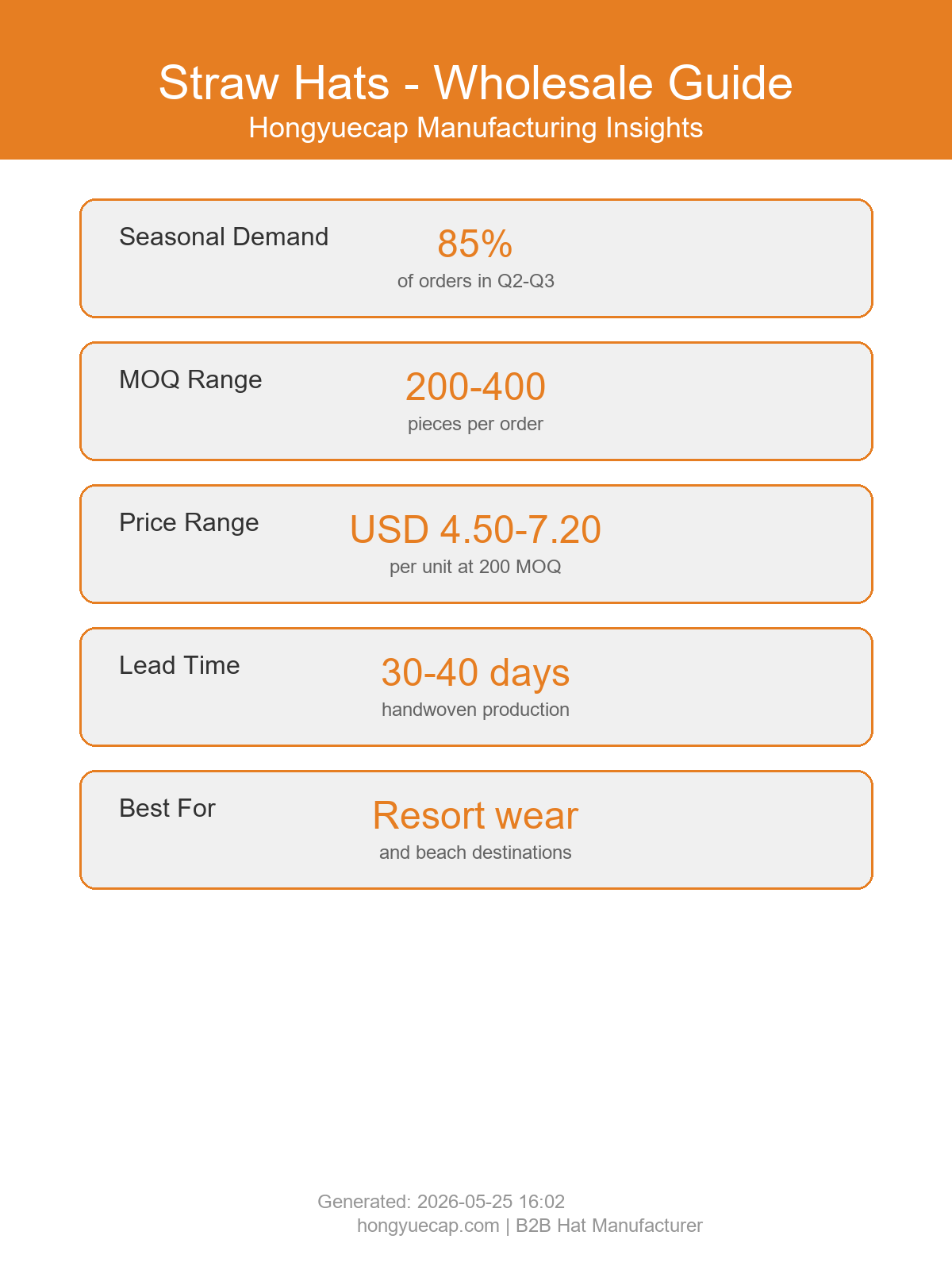
Additionally, Amazon marketplace data reinforces this shift. “Wide Brim UPF50+ Straw Beach Hats for Women” maintained an average sales count of 1,105 units in March 2026 alone. October 2025 peaked at 1,248 units. This data comes from Statista marketplace analytics. This category demonstrates resilience even in off-peak months, suggesting that straw hats are increasingly purchased for year-round travel and resort wear rather than purely seasonal use. For buyers sourcing bulk inventory, this data supports diversifying purchase volumes across quarters instead of concentrating orders into a single summer shipment.
Runway Validation & Designer Adoption
Moreover, the Spring/Summer 2026 menswear season provided critical runway validation. Two major houses led the charge. Armani featured classic woven straw hats with refined silhouettes. Prada introduced a retro conical shape pairing geometric minimalism with traditional weaving. This signals that the category is now treated as a design statement rather than a commodity accessory. Other houses showcased deconstructed straw hats with intentionally frayed brims. This introduces a raw, artisanal aesthetic. The look is expected to filter into commercial collections. Accessible wholesale price points are $3 to $10 per unit.
Meanwhile, the Accio market intelligence platform predicts a 15\u201320% demand increase for straw hats in 2026. This growth stems from three macro factors. First, consumer preference for sustainable natural materials continues to rise. Second, hybrid designs with foldable brims and packable weaves are gaining broader adoption. Third, artisanal craftsmanship narratives carry growing cultural appeal. For bulk buyers, the key takeaway is clear: stocking generic designs is no longer sufficient for wholesale straw hats. Wholesale curation must account for material storytelling and design differentiation.
Raffia vs Paper Straw vs Toquilla: Material Selection for Wholesale Buyers
To begin with, material choice is the single largest determinant of a straw hat’s wholesale price, durability, and target customer segment. Three materials dominate the B2B supply chain: raffia (derived from palm leaves), paper straw (tightly twisted paper fiber), and toquilla (the traditional Panama hat palm). Each carries distinct cost structures, minimum order quantities, and market positioning implications that wholesale buyers must evaluate before committing to bulk production.
Raffia: The Bohemian Premium Option
Specifically, raffia straw, harvested from the raffia palm primarily in Madagascar and parts of Southeast Asia, is prized for its natural golden-beige color, flexibility, and breathable texture. Hats woven from raffia exhibit visible organic fiber variation — a characteristic that brands increasingly market as proof of authenticity rather than a defect. Wholesale pricing for raffia hats from Chinese manufacturers typically ranges from $3.50 to $6.80 per piece at 500+ units, with higher pricing for fully hand-woven constructions. The material’s tendency to absorb moisture makes it ideal for resort and festival markets but requires climate-controlled storage during transit.
Paper Straw: The Uniform Workhorse
In contrast, paper straw — despite its name — is not made from paper pulp but from tightly twisted paper fiber strands that are machine-sewn into a consistent, uniform weave. This material delivers the cleanest visual finish at the lowest cost: wholesale prices from Shandong and Zhejiang factories start at $3.08 per piece for 10,000+ unit orders. Paper straw hats accept dyes more evenly than natural raffia, making them the preferred substrate for brands that require precise color matching across seasonal collections. The material also supports wire-brim reinforcement for shape retention, a feature frequently requested by resort and golf-wear buyers.
Toquilla: The Heritage Investment
Finally, toquilla straw, harvested in Ecuador and hand-woven into what is globally recognized as the Panama hat, occupies the premium tier. Authentic toquilla hats are graded by weave count per square inch, with finer weaves (Montecristi grades above 30×30) commanding wholesale prices of $25 to $80+ per unit. For most B2B buyers, toquilla’s value lies in its brand storytelling potential rather than volume economics. It is best positioned as a flagship SKU within a broader straw hat assortment rather than a volume driver. Hongyuecap’s straw hat product line incorporates both raffia and paper straw options across multiple styles to accommodate different buyer profiles.
Furthermore, according to Textile Exchange, natural plant-based fibers accounted for approximately 6.2% of the global fiber market in 2025, with projections indicating continued growth as retailers phase out synthetic alternatives. Buyers sourcing natural-material hats position themselves favorably for upcoming EU and US sustainability disclosure regulations.
Download the 2026 Straw Hat Sourcing Catalog
Get our free Straw Hat Material Comparison & Pricing Guide with factory-direct quotes for raffia, paper straw, and toquilla hats across project-specific quantity ranges. Includes OEM decoration pricing, lead time benchmarks, and supplier audit checklists. Email us to receive your copy after the brief is reviewed.
OEM & Customization: What Bulk Buyers Need to Know
Moreover, customizing wholesale straw hats for private-label or branded distribution involves far more than slapping a logo on the crown. The OEM process for woven hats spans six distinct decision points. These include brand identity integration, material selection, weave pattern specification, dimensional sizing, trim and decoration, and packaging. Each has cost and lead-time implications that cascade through the supply chain.
Branding Methods & Cost Impact
For example, the most common customization techniques for wholesale straw hats include several options. Heat-transfer logo printing on the brim costs $0.15–$0.35 per unit. Woven label insertion inside the sweatband runs $0.08–$0.20 per unit. Metal pin or badge attachment is $0.30–$0.80 per unit. Custom-printed grosgrain ribbon bands cost $0.25–$0.60 per unit. Embroidery on the brim is technically feasible but requires reinforced backing material to prevent straw fiber tear, adding approximately $0.50–$1.00 per unit over standard decoration methods. Buyers should request pre-production samples that include the exact decoration technique specified for bulk production, as decoration adhesion on natural fibers behaves differently than on synthetic fabric substrates.
Customization MOQ Realities
However, minimum order quantities for customized straw hats vary dramatically by decoration complexity. Simple heat-transfer logo application may carry an MOQ as low as 50–100 pieces per design, while custom weaving patterns that require new mold fabrication typically demand 500–1,000 pieces per style. The sweet spot for most B2B buyers landing their first private-label straw hat is 300–500 units. As detailed in Hongyuecap’s sourcing guides, buyers should spread volume across two to three styles. Use a single material such as raffia or paper straw. Apply heat-transfer logo as the sole decoration. This caps decoration costs at approximately $0.30–$0.50 per hat.
In addition, mixed-model ordering combines fedora, wide-brim, and bucket silhouettes within a single purchase order. This approach is increasingly supported by flexible Chinese manufacturers. However, buyers should expect a 5–10% price premium on orders that split volume across more than three styles. OEKO-TEX Standard 100 certification is verifiable through OEKO-TEX’s official database. Buyers should confirm certification at the material level before committing to bulk production. This is especially important for straw hats destined for European markets where chemical residue regulations are tightening.
MOQ, Pricing & Factory Sourcing Strategy for 2026
As a result, the global straw hat supply chain is concentrated in two primary manufacturing regions. China’s Shandong, Zhejiang, and Guangdong provinces produce mass-market paper straw and raffia hats. Vietnam’s artisanal workshops deliver mid-tier natural fiber hats with SMETA-audited social compliance credentials. Each region presents distinct trade-offs between unit cost, MOQ flexibility, and lead time that wholesale buyers must reconcile with their target retail price point and channel requirements.
China Manufacturing: Volume Economics
In particular, Chinese factories dominate the $3–$8 wholesale price bracket, with facilities in Linyi (Shandong) and Wenling (Zhejiang) offering capacities exceeding 500,000 pieces per month. These manufacturers typically require minimum orders of 300–600 pieces per style for stock designs, scaling down to 100–200 pieces for existing mold-based customizations. Sample lead time averages 7–10 days, with bulk production turnaround at 25–35 days plus 18–28 days ocean freight to US West Coast ports. A representative quote from Shandong Fangdi Trade Co. shows straw hat wholesale pricing tiered at $3.68 (100–499 pcs), $3.48 (500–9,999 pcs), and $3.08 (10,000+ pcs), illustrating the steep volume discounts available at container-scale orders.
Vietnam Manufacturing: Mid-Tier Differentiation
Meanwhile, Vietnam-based manufacturers such as Chata Vietnam position themselves in the mid-tier at $4–9 wholesale. They offer factory-direct supply chains. There is no minimum order quantity for available designs. This is a significant advantage for boutique brands testing new styles. These suppliers hold SMETA 4-Pillar certification, a requirement increasingly demanded by European retail chains and US department stores as part of their ethical sourcing mandates. The trade-off is longer production lead times (4–6 weeks) and higher logistics costs due to consolidation requirements for smaller orders. Hongyuecap’s manufacturer vetting process evaluates both Chinese and Vietnamese partners against a 23-point quality-and-compliance checklist to help buyers navigate regional trade-offs.
Pricing Volatility Factors in 2026
Notably, three factors are influencing straw hat wholesale pricing in 2026. First, US Section 301 tariffs maintaining a 25% rate on Chinese textile and headwear imports continue to impact landed cost calculations; buyers should model tariff-inclusive pricing rather than relying on ex-works quotes. Second, natural raffia raw material costs have experienced 8–12% year-over-year fluctuation due to weather variability in Madagascar growing regions. Third, ocean freight spot rates on Asia–US routes have stabilized at approximately $1,800–$2,400 per 40-foot container as of Q2 2026, down from pandemic-era peaks but still above pre-2020 baselines. For a standard 10,000-piece straw hat order (approximately 12–15 cubic meters of cargo volume), freight cost contributes roughly $0.25–$0.40 per unit to landed cost.
Import Logistics, Quality Control & Packaging for Straw Hats
Consequently, wholesale straw hats present unique logistics challenges that synthetic headwear does not. The crushability of natural fibers, the seasonal urgency of summer delivery windows, and the cost sensitivity of low-ASP products combine to create a narrow operational tolerance band. Buyers who fail to plan for deformation prevention, customs clearance, and quality inspection protocols risk receiving unsellable inventory.
Pack-to-Ship: Preventing In-Transit Deformation
For instance, the most common cause of wholesale straw hat returns in B2B channels is shape deformation during ocean transit. Effective prevention strategies include three key methods. Use nested packing by inserting smaller crown hats into larger ones for internal structural support. Add rigid cardboard crown inserts at approximately $0.08–$0.15 per unit. Apply vacuum compression packaging for paper straw blends that recover shape upon unpacking. Buyers should specify — in their purchase order — that each carton must pass a drop-test equivalent to a 1.2-meter fall, as recommended by the International Safe Transit Association guidelines. Requesting pre-shipment photos of packed cartons is a low-cost risk mitigation practice that takes less than 48 hours from most Chinese and Vietnamese factories.
Quality Inspection Checklist for Bulk Orders
Therefore, a structured incoming quality control protocol at the wholesale level should cover five dimensions. Check weave uniformity for loose strands and skipped stitches across a 10% sample. Measure brim symmetry at four compass points with tolerance ≤ 3mm. Verify decoration adhesion by tape-testing logos and ribbon attachments under ambient and humidity conditions. Require independent lab reports for UPF rating on hats marketed as sun-protective. Test for mold risk with a calibrated moisture meter, targeting ≤ 12% moisture by weight. WRAP certification provides additional assurance of ethical manufacturing practices in the supply chain — a factor that has grown from a nice-to-have to a requirement for buyers serving brand-name retail accounts. Contact Hongyuecap for a downloadable straw hat QC checklist tailored to your product specification.
Tariff Classification & HS Code Guidance
Importantly, straw hats generally fall under HS code heading 6504.00. This covers hats and other headgear plaited or made by assembling strips of any material. The specific subheading depends on material composition and whether the hat contains a lining, sweatband, or decorative elements. US import duty under this heading varies based on country of origin and any applicable trade preference programs (GSP status for qualifying developing countries). Buyers should work with a licensed customs broker to verify HS classification before shipment, as misclassification at the 6-digit level can trigger penalties of 5–20% of the declared value. Refer to ISO standards for supply chain traceability requirements that increasingly apply to textile and headwear imports. For 2026, the average applied tariff rate on woven headwear entering the US is approximately 7.5% for MFN countries. Section 301 additional duties add 25% on Chinese-origin goods. This applies unless an exclusion has been granted.
Product Specifications
- Category Name: Straw Hats
- Description: Natural fiber or synthetic straw hats for summer sun protection
- Milk Straw: soy milk protein fiber, soft texture, packable