
Are Recycled PET Bucket Hats Legit? GRS Certification Guide
Pain Point: Your retail buyers are increasingly demanding sustainable products, but you’re struggling to verify that the “eco-friendly” hats you’re sourcing actually meet international standards. Sourcing recycled PET bucket hat wholesale with genuine GRS certification ensures your sustainability claims are backed by third-party verification — not just marketing language.
1. What Is Recycled PET Fabric and Why It Matters for Bucket Hats
Direct answer: Recycled PET (rPET) fabric is made from post-consumer plastic bottles that are collected, cleaned, shredded into flakes, melted, and extruded into polyester fibers. For bucket hats, rPET offers the same durability and water resistance as virgin polyester but with a 50-70% lower carbon footprint and 90% less water consumption during production.
The environmental math behind recycled PET bucket hat wholesale sourcing is compelling: one standard bucket hat (approximately 150g of fabric) repurposes roughly 6-8 post-consumer plastic bottles. An order of 5,000 rPET bucket hats diverts approximately 30,000-40,000 plastic bottles from landfills or oceans. For brands marketing to environmentally conscious consumers, this is a quantifiable sustainability story.
Performance characteristics of rPET bucket hat fabric:
- Durability: Comparable to virgin polyester — tear strength within 5-10% of virgin PET
- UV Resistance: Excellent, with minimal degradation after 500+ hours of UV exposure testing
- Colorfastness: Grade 4-5 (out of 5) on the AATCC colorfastness scale, matching virgin polyester
- Water Resistance: Naturally hydrophobic — water beads on the surface without chemical treatment
- Hand Feel: Slightly softer than virgin polyester due to the mechanical recycling process breaking down fiber crystallinity
Cost comparison: rPET fabric is typically 10-20% more expensive than virgin polyester at the fabric level. For a standard bucket hat, this translates to a $0.15-0.30 premium per hat. However, retail buyers consistently report being able to charge a 15-25% retail price premium for certified sustainable products — more than offsetting the higher raw material cost.
Related: Bucket Hat Wholesale Sourcing Guide
2. GRS Certification: What It Covers and Why It’s the Gold Standard
Direct answer: The Global Recycled Standard (GRS), administered by Textile Exchange, is the most widely recognized certification for recycled content in textiles. GRS certification verifies: (1) the recycled content percentage in the final product, (2) the chain of custody from recycling facility to finished product, (3) compliance with social and environmental processing requirements, and (4) restrictions on hazardous chemical use.
GRS certification is not just a label — it’s a comprehensive supply chain audit. The certification process involves:
Recycled Content Verification: GRS requires a minimum of 20% recycled content for product labeling, with the exact percentage stated on the label. For Hongyuecap’s recycled PET bucket hat wholesale program, we target 50-100% GRS-certified recycled polyester content. The percentage is calculated by weight: (weight of recycled material / total product weight) × 100. This includes the main fabric, interlining, thread, labels, and trims.
Chain of Custody: Every facility in the supply chain — from the bottle recycling plant to the fiber producer, yarn spinner, fabric weaver, and hat manufacturer — must hold valid GRS certification. This creates an unbroken audit trail. Hongyuecap maintains a current GRS scope certificate and can provide transaction certificates (TCs) for every batch of GRS-certified rPET bucket hats.
Social & Environmental Compliance: GRS-certified facilities must meet ILO core labor standards (no forced labor, no child labor, freedom of association, non-discrimination) and comply with environmental requirements including wastewater treatment, energy use monitoring, and chemical restrictions aligned with ZDHC (Zero Discharge of Hazardous Chemicals) guidelines.
Explore Hongyuecap’s sustainability commitments
3. The Production Process: From Plastic Bottle to Bucket Hat
Direct answer: The journey from a discarded plastic bottle to a finished recycled PET bucket hat wholesale product involves 6 key steps: collection, cleaning, flaking, pelletizing, fiber extrusion, and fabric weaving — followed by standard hat manufacturing processes.
Step 1: Collection & Sorting: Post-consumer PET bottles (primarily water and soda bottles) are collected through municipal recycling programs. Bottles are sorted by color (clear, blue, green) because color affects the final fabric shade. Clear bottles produce white/undyed rPET fiber; colored bottles produce tinted fiber that may require additional dyeing.
Step 2: Cleaning & De-labeling: Bottles are washed in hot water to remove labels, adhesives, and residual contents. This is the most water-intensive step, but it still uses 70-90% less water than producing virgin polyester from petroleum.
Step 3: Shredding into Flakes: Clean bottles are mechanically shredded into small flakes approximately 2-4mm in size. These flakes are the raw material for rPET fiber production.
Step 4: Melting & Pelletizing: Flakes are melted at 260-280°C and extruded into small pellets (rPET chips). These pellets are chemically identical to virgin PET chips and can be processed on the same equipment.
Step 5: Fiber Extrusion: rPET pellets are melted and forced through spinnerets (tiny holes) to create continuous filaments. These filaments are stretched (drawn) to align the polymer molecules, increasing strength. The resulting fibers are cut to the desired staple length for spinning into yarn.
Step 6: Spinning, Weaving, and Hat Manufacturing: rPET staple fibers are spun into yarn, woven into fabric, and cut/sewn into bucket hats following Hongyuecap’s standard manufacturing process. The hat construction — interlining, brim stitching, crown assembly — is identical to virgin polyester bucket hats.
4. Marketing Your rPET Bucket Hats: Compliance and Claims
Direct answer: GRS certification gives you the right to make specific, verifiable sustainability claims on product labels and marketing materials. However, there are strict rules about what you can say. “Made with 100% recycled polyester” requires GRS certification with 100% recycled content; exaggerated or unsubstantiated claims constitute greenwashing and can result in legal penalties.
Permitted claims with GRS certification:
- “Made with [X]% recycled polyester — GRS certified by [certification body]”
- “This product diverts approximately [Y] post-consumer plastic bottles from landfill” (requires substantiation)
- Use of the GRS logo on certified products (subject to logo use guidelines)
Prohibited claims (greenwashing risk):
- “100% sustainable” / “100% eco-friendly” — vague and unsubstantiable
- “Biodegradable” — rPET is not biodegradable
- “Carbon neutral” — requires separate carbon footprint verification
- Use of GRS logo on non-certified products — trademark violation
Key markets for rPET bucket hats: EU (EU Green Deal requirements driving demand), Australia/New Zealand (strong eco-consumer segment), US West Coast (California sustainability mandates), and UK (growing B Corp and sustainable retail movement).
Browse sustainable bucket hat options
5. Quality Control: How to Verify rPET Content and GRS Compliance
Direct answer: The most reliable way to verify recycled PET bucket hat wholesale orders meet GRS requirements is through: (1) transaction certificates (TCs) for each batch, (2) independent lab testing of recycled content (ASTM D6866), and (3) on-site factory audit reports from accredited certification bodies.
Transaction Certificates (TCs): The GRS system operates on a “book and claim” chain-of-custody model using TCs. Each TC documents the quantity, type, and percentage of recycled material in a specific shipment. When you receive GRS-certified rPET bucket hats from Hongyuecap, you should receive TCs covering the entire order quantity. These are legal documents that can be audited by your customers or regulatory bodies.
Lab Testing (ASTM D6866): This radiocarbon dating method measures the biogenic carbon content in a material sample. Since petroleum-based materials contain no carbon-14 (it decayed millions of years ago), the test can distinguish between virgin polyester (0% biogenic) and rPET from post-consumer bottles (measurable carbon-14 from recent organic matter). This provides independent verification independent of the GRS certificate system.
Hongyuecap’s rPET QC Protocol:
- Verify GRS scope certificate validity and scope for every rPET order
- Request TCs from rPET fabric supplier for each batch
- Random sampling: ASTM D6866 testing on 1 sample per 5,000 units
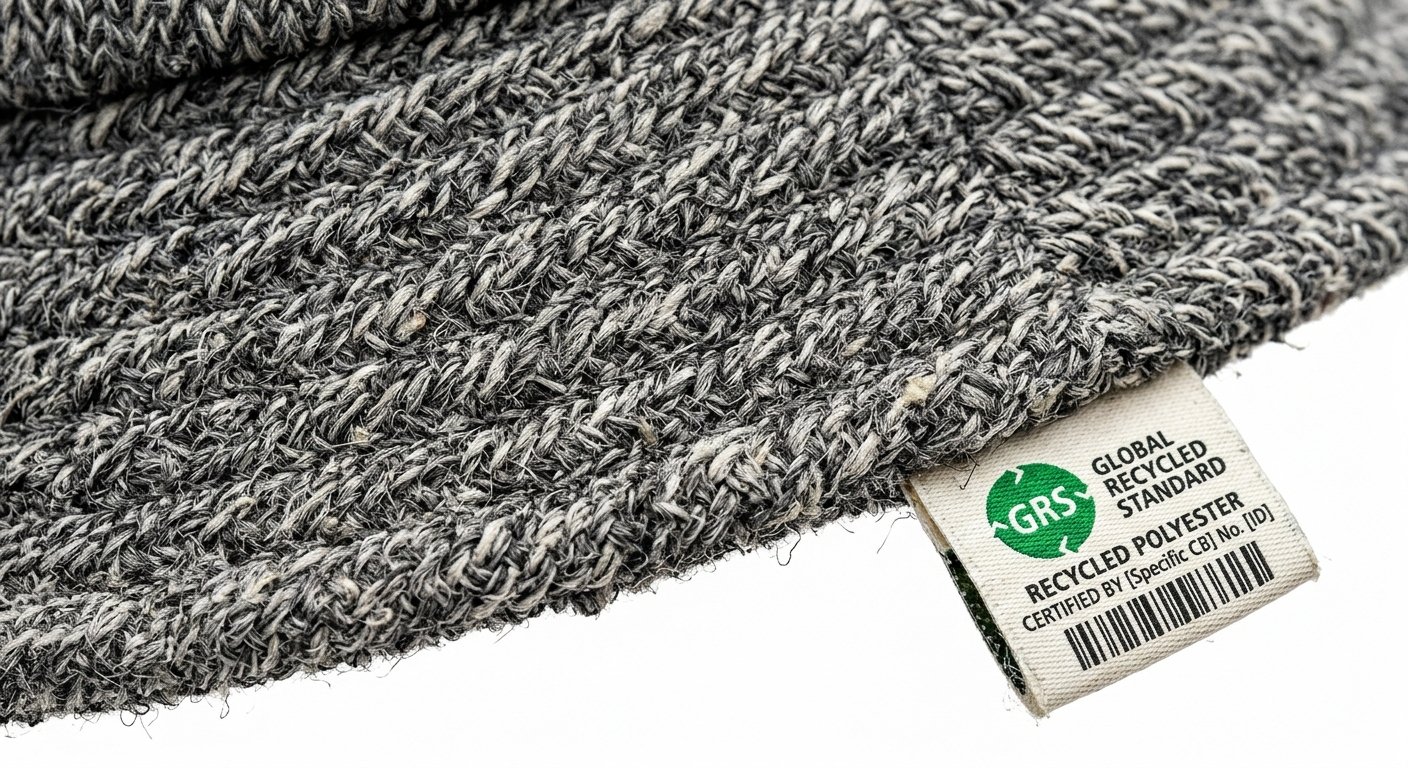
- Visual inspection: rPET fabric should have slight color variation and texture differences vs. virgin polyester (due to recycled content)
- Burn test: rPET melts like virgin polyester (forms hard bead, black smoke, sweet chemical odor)
- Documentation package: includes GRS TCs + lab reports + QC inspection data for buyer records
External References: ASTM D6866 Biobased Content Testing | Textile Exchange GRS Standard | Wikipedia: PET Bottle Recycling
Frequently Asked Questions
What is the price difference between virgin and recycled PET hats?
Recycled PET bucket hats typically carry a 5-15% premium over virgin polyester due to certified supply chain costs. Hongyuecap offers competitive rPET wholesale pricing with GRS documentation included.
Frequently Asked Questions
What is the MOQ for GRS-certified rPET bucket hats?
Hongyuecap’s standard MOQ for GRS-certified recycled PET bucket hats is 300 pieces per color/style. This is higher than our standard bucket hat MOQ (100 pieces) due to the minimum fabric order quantities from GRS-certified fabric mills. For orders over 2,000 units, the MOQ can be split across up to 3 colors.
How much more expensive is GRS certification?
The GRS certification adds approximately $0.20-0.50 per hat to the total cost: $0.10-0.20 for certified rPET fabric premium, $0.05-0.10 for certification and TC documentation, and $0.05-0.20 for additional QC and lab testing. This is typically 10-20% above standard bucket hat pricing.
Can rPET bucket hats be dyed any color?
Yes, but with limitations. rPET accepts disperse dyes just like virgin polyester. However, the slightly different molecular structure of recycled fiber can result in 2-5% color variation compared to virgin polyester dyeing. Hongyuecap recommends requesting a lab dip (color sample) for rPET dye matching, which adds 3-5 days to the sampling process.
Is there a minimum recycled content for GRS labeling?
GRS requires a minimum of 20% recycled content for product-level certification. Products with 50-94% recycled content can be labeled “Made with [X]% recycled materials.” Products with 95-100% recycled content can be labeled “Made with 100% recycled materials” (if applicable). The exact percentage must be stated.
CTA: Ready to source GRS-certified recycled PET bucket hats for your sustainable product line? Contact Hongyuecap for GRS certification documentation, rPET fabric samples, and a free quotation with full sustainability specs.
Written by the Hongyuecap Product Team — 10+ years in B2B custom headwear manufacturing. Last updated: May 03, 2026.