Knitted Beanie Yarn Gauge Wholesale Guide for Buyers
Pain Point: Wholesale buyers sourcing knitted beanies often overlook yarn weight and gauge specifications, leading to products that arrive too thin for winter retail or too heavy for transitional seasons. Returns spike when end customers complain about inconsistent warmth, poor shape retention, or unexpected shrinkage after the first wash. Understanding yarn gauge is not a technical detail—it is the single most important quality control factor that separates premium wholesale beanies from commodity-grade products.
1. Understanding Yarn Weight Categories for Knitted Beanies
Yarn weight is the foundation of every knitted beanie order. The Craft Yarn Council’s Standard Yarn Weight System defines seven categories (0-7) from lace to jumbo. For wholesale knitted beanies, only categories 2-5 are commercially relevant.
Category 2 (Fine/Sport Weight): With a gauge of 6-6.75 stitches per inch, sport weight yarns produce lightweight beanies ideal for spring and early autumn. These beanies typically weigh 40-55 grams per unit and work well for fashion-forward retail buyers who prioritize drape and silhouette over warmth. Major retailers like Zara and H&M frequently specify sport weight for their transitional season beanie collections.
Category 3 (DK/Light Worsted): Double-knitting weight offers a versatile middle ground at 5-5.5 stitches per inch. DK beanies weigh 55-70 grams and represent approximately 35% of the global wholesale beanie market according to textile trade data. They provide adequate warmth for most climates without the bulk that limits packaging and display options.
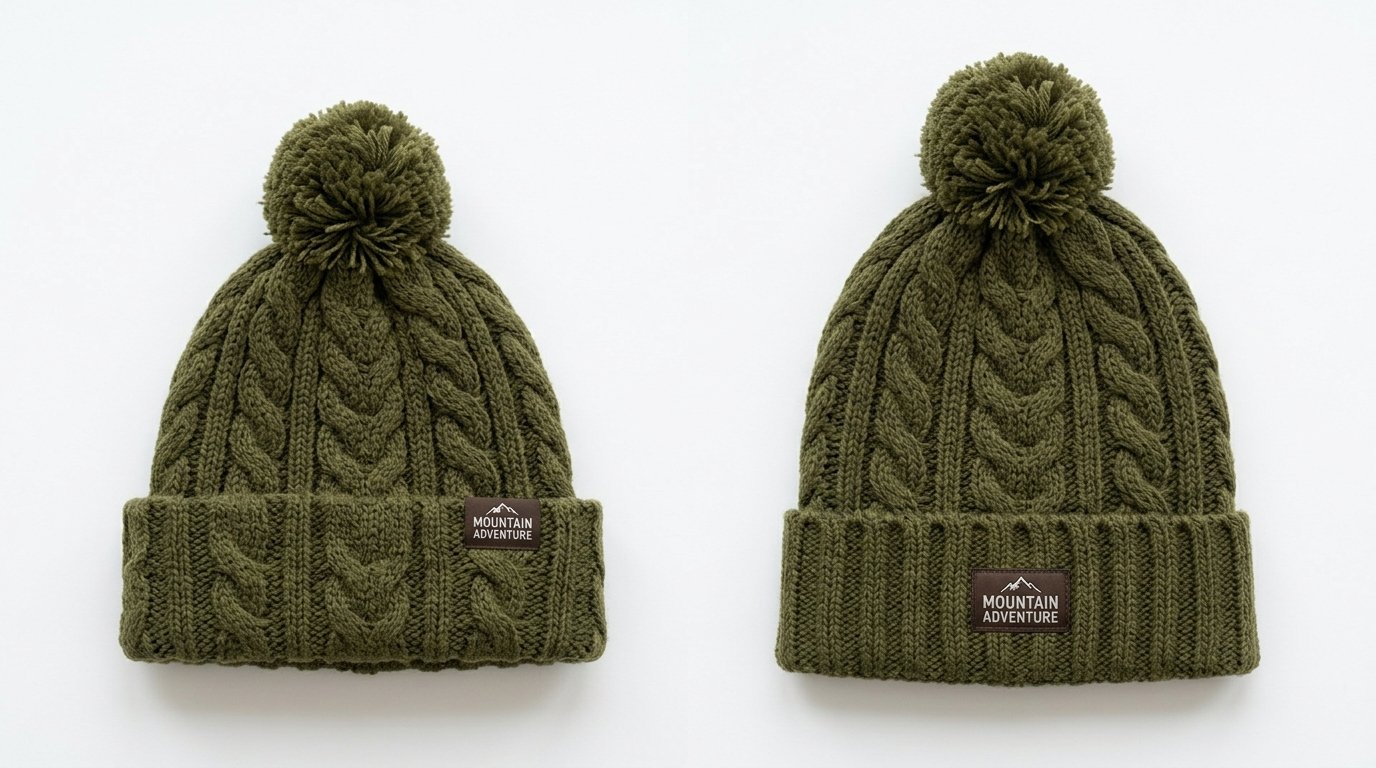
Category 4 (Worsted/Medium): The industry workhorse. Worsted weight at 4.5-5 stitches per inch produces beanies in the 65-85 gram range with excellent stitch definition for cable and texture patterns. ISO 4915:1991 stitch classification standards are most commonly applied at this weight class. Approximately 50% of all wholesale beanie orders specify worsted weight yarn.
Category 5 (Bulky/Chunky): With a gauge of 3-3.5 stitches per inch and unit weights of 85-120 grams, bulky yarn beanies dominate the premium winter segment. These beanies knit 40% faster than worsted equivalents but consume approximately 50% more material by weight. The trade-off between production speed and material cost requires careful calculation in wholesale pricing models.
2. Gauge Specifications: Stitches Per Inch as a Quality Metric
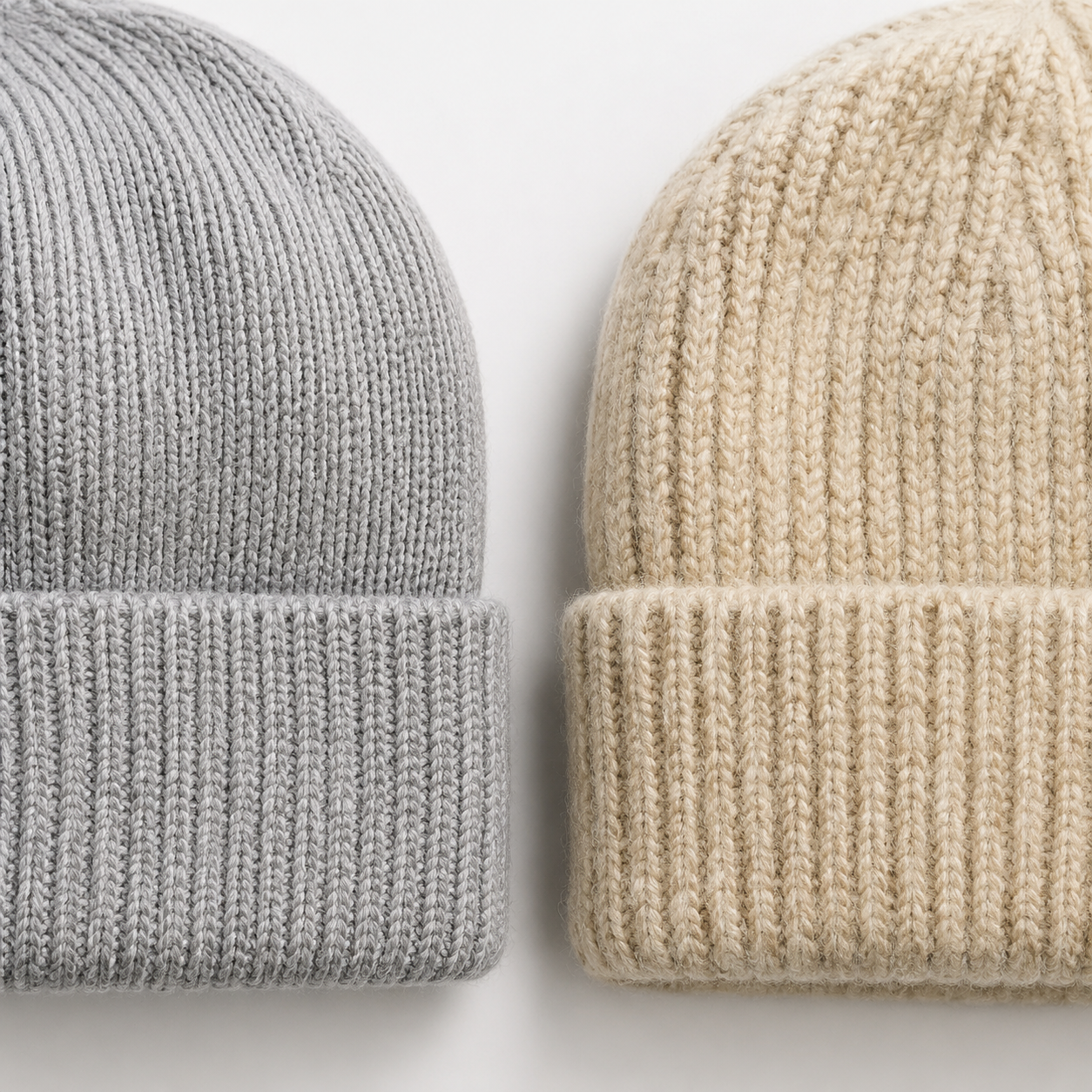
Gauge—measured in stitches per inch (SPI)—determines fabric density, thermal performance, and dimensional stability. For wholesale knitted beanies sourced internationally, gauge consistency across production batches is the most common quality dispute according to ASTM D3887 knit fabric tolerance standards.
Standard Gauge Tolerances: Industry best practice allows ±0.5 SPI variance within a single production run. Variance exceeding ±1.0 SPI indicates either yarn lot inconsistency or machine tension calibration drift. Wholesale buyers should include gauge tolerance specifications in purchase orders and request stitch-count verification during inline QC inspection.
Gauge x Yarn Weight Matrix: The interaction between yarn weight and gauge creates distinct product profiles that determine retail positioning:
Fine gauge (6+ SPI) with sport weight yarn = Premium lightweight beanies, retail $18-35
Medium gauge (4.5-5.5 SPI) with DK/worsted yarn = Mid-market standard, retail $12-25
Coarse gauge (3-4 SPI) with bulky yarn = Statement winter pieces, retail $22-40
Hongyuecap maintains calibrated gauge testing equipment at our production facilities to verify SPI compliance before shipment. Our knitted beanie stitch types guide explains how different stitch patterns interact with gauge specifications.
3. Material Composition and Its Effect on Gauge Behavior
Not all yarns at the same weight category behave identically. Material composition introduces variability in elasticity, stitch memory, and post-wash dimensional change that directly impacts gauge selection.
Acrylic (100%): The dominant mass-market beanie material. Acrylic has excellent gauge stability with less than 3% shrinkage after washing per textile industry data. However, acrylic lacks the natural elasticity of wool, requiring 0.5-1 additional SPI for equivalent fit tension. Wholesale buyers should specify “anti-pilling acrylic” grade to avoid the fuzzy surface that develops after repeated wear.
Wool Blends (30-80% wool): Wool introduces natural crimp and thermal regulation superior to synthetics. But wool gauge behavior changes with humidity—swelling up to 8% in diameter under high moisture conditions. This means a 50/50 acrylic-wool beanie knitted at 5 SPI in dry conditions may measure 4.6 SPI in humid storage. Climate-controlled production and storage facilities are non-negotiable for wool-blend wholesale orders.
Cotton Blends: Cotton-heavy yarns (50%+) are increasingly popular for spring/summer beanies marketed as “year-round accessories.” Cotton has zero natural elasticity, requiring elastic fiber additions (2-5% spandex/elastane) to maintain beanie shape. The gauge must be specified 10-15% tighter than equivalent acrylic specifications.
Recycled Polyester (rPET): The sustainability-driven material choice. Our eco-friendly knitted beanie materials guide covers GRS certification requirements in detail. rPET yarns typically have 5-8% lower stitch definition than virgin polyester at identical gauge settings.
4. Seasonal Gauge Selection: Matching Yarn Weight to Retail Seasons
Selecting the wrong yarn gauge for a retail season is one of the costliest mistakes a wholesale buyer can make. Beanies produced for winter markets but delivered for spring retail face steep markdowns and margin erosion.
Winter (Oct-Mar Retail): Specify worsted weight minimum (Category 4). Bulky weight preferred for cold-climate markets (Northern Europe, Canada, Northeast US). Double-layer construction using fine-gauge inner liner + bulky outer shell provides the highest warmth-to-weight ratio. Expect 20-30% higher material costs compared to single-layer worsted.
Spring/Fall Transitional (Mar-May, Sep-Oct): DK weight (Category 3) is the sweet spot. These beanies function as fashion accessories first and thermal garments second. Color variety and texture matter more than insulation properties. MOQs for transitional-weight beanies are typically 50% lower than winter-weight, making them accessible for boutique retailers.
Summer/Resort (May-Aug): Sport weight (Category 2) in cotton or cotton-blend yarns. These are “sun beanies” used for UV protection at beach resorts and outdoor festivals. The UPF sun protection guide for straw hats covers complementary sun safety standards. Summer beanie orders should include UV resistance testing in quality specifications.
Year-Round Indoor/Corporate: Light worsted weight (Category 3.5-4) in 100% acrylic. These beanies serve promotional and corporate uniform markets where consistent quality across reorders matters more than seasonal adaptation. Gauge documentation becomes critical for repeat orders spread across multiple production runs.

5. Quality Control: Testing Gauge Consistency Across Production
Gauge verification is not a one-time sampling activity. Consistent quality requires systematic testing at three control points in every production run.
Pre-Production Sample Verification: Before bulk production begins, request three pre-production samples from different knitting machines. Measure stitch count across a 4-inch square using a standard stitch gauge tool. All three samples must fall within ±0.5 SPI of specification. If variance exceeds this threshold, require machine recalibration before approving production start.
Inline Production Audit (AQL 2.5): Per Acceptance Quality Limit (AQL) sampling standards, test gauge on a statistically significant sample during production. For a 3,000-piece order at AQL 2.5, test 125 units with no more than 7 gauge failures allowed. Beyond this threshold, the entire batch requires 100% inspection or rework.
Pre-Shipment Final Inspection: Random sampling from packed cartons verifies that finished goods match approved pre-production references. This step catches gauge drift that may have occurred during later production batches. Our knitted beanie pilling resistance guide covers complementary material quality tests.
Documentation Requirements: Every inspection report should include machine number, operator ID, yarn lot number, test date, measured SPI, and pass/fail status. This audit trail is essential for resolving quality disputes and for buyers managing multi-supplier sourcing strategies.
6. Cost Implications: How Gauge and Yarn Weight Affect Wholesale Pricing
Yarn weight and gauge specifications are the primary cost drivers in knitted beanie production, accounting for 40-60% of total unit cost depending on material and complexity.
Material Cost by Weight: A standard worsted-weight acrylic beanie consumes approximately 65-80 grams of yarn at a wholesale yarn cost of $0.004-0.008 per gram, yielding $0.26-0.64 material cost per unit. Switching to a bulky-weight spec increases yarn consumption to 85-120 grams and material cost to $0.34-0.96 per unit. Wool blends multiply material costs by 3-5x.
Production Speed x Gauge: Coarse gauge (3 SPI) knits approximately 40% faster than fine gauge (6 SPI) on the same machine. A factory producing 500 coarse-gauge beanies per machine per day may only produce 300 fine-gauge equivalents. This productivity difference directly impacts labor cost allocation and order lead times.
MOQ Economics: Custom gauge specifications that deviate from a factory’s standard production settings typically carry 30-50% MOQ premiums. Discuss gauge standardization opportunities with your supplier—using existing machine settings for a “close enough” gauge (e.g., 4.8 SPI instead of 5.0 SPI) can reduce MOQ from 1,000 to 300 pieces with negligible quality impact.
Our MOQ and wholesale pricing guide provides detailed cost breakdowns applicable across all hat categories.
Frequently Asked Questions
What is the best yarn weight for winter knitted beanies?
Worsted weight (Category 4) and bulky weight (Category 5) yarns are best for winter knitted beanies. These heavier yarns provide superior insulation with gauge ranges of 4.5-5 stitches per inch for worsted and 3-3.5 stitches per inch for bulky. Wholesale buyers should specify 2-ply or 3-ply construction for maximum warmth retention. For extreme cold markets, consider a double-layer construction combining a fine-gauge inner liner with a bulky outer shell.
How does yarn gauge affect knitted beanie production cost?
Yarn gauge directly affects material consumption and machine time. Finer gauges (Category 1-2) require approximately 40-60% more knitting time and 20-30% more stitches per unit compared to medium gauges (Category 3-4). Wholesale buyers should expect a 15-25% price difference between fine-gauge and standard-gauge beanies of the same style. The bucket hat wholesale sourcing guide covers similar cost factors that apply across hat categories.
What yarn certifications should wholesale buyers look for?
Wholesale buyers should verify OEKO-TEX Standard 100 certification for chemical safety, GOTS (Global Organic Textile Standard) for organic yarns, and GRS (Global Recycled Standard) for recycled content claims. For acrylic yarns, request ISO 9001 factory certification and third-party lab test reports for colorfastness (min. Grade 4 on ISO 105-B02 light fastness scale) and pilling resistance (min. Grade 4 on the ICI Pilling Box test).
What is the minimum order quantity for custom-gauge knitted beanies?
Standard gauge beanies (Category 3-4 yarns) typically have MOQs of 100-300 pieces per color. Custom gauge specifications using non-standard yarn weights or specialty blends often require 500-1,000 pieces MOQ due to machine setup and yarn procurement costs. Discuss gauge requirements with your supplier during the sampling phase to lock in feasible MOQs before committing to production timelines.
Conclusion: Making Gauge Work for Your Wholesale Beanie Business
Yarn weight and gauge selection is not merely a technical specification—it is a strategic business decision that determines product quality, production cost, lead time, and ultimately retail sell-through rates. Wholesale buyers who invest time understanding gauge parameters make better sourcing decisions and build stronger supplier relationships.
At Hongyuecap, we maintain calibrated gauge testing protocols across all production lines. Our quality team verifies SPI compliance at pre-production, inline, and pre-shipment stages for every order. We stock yarns in sport through bulky weights and can accommodate custom gauge requests for orders of 300+ pieces per color.
Ready to specify your next knitted beanie order with confidence? Contact our sourcing team for a free consultation on yarn weight, gauge, and material selection. Include your target retail price point and season, and we will recommend the optimal gauge specifications for your market. Request a quote today.
Written by the Hongyuecap Product Team — 10+ years in B2B custom headwear manufacturing. Last updated: May 03, 2026.