
Custom Straw Hat Bands Wholesale
Pain Point: You receive your bulk custom straw hat bands wholesale order only to discover the hat bands are loose, the trims don’t match your brand colors, and the decorative elements start fraying after a single season. How do you specify custom bands and trims that hold up for retail and keep customers coming back?
1. Straw Hat Band Types: A Wholesale Buyer’s Guide to Materials
Direct answer: When sourcing custom straw hat bands wholesale, the hat band is more than decoration — it determines the hat’s perceived quality, retail price point, and structural integrity. For wholesale buyers, choosing the right band material directly impacts your margins and customer satisfaction.
Custom straw hat bands come in four primary material families, each serving different market segments and price points. Cotton grosgrain ribbon remains the industry standard for mid-market straw hats, offering a balance of durability, color consistency, and cost at approximately $0.15-0.35 per hat in bulk. The ribbed texture provides excellent grip against the straw weave, reducing the risk of the band slipping during wear.
Satin and polyester ribbons dominate the premium and fashion-forward segments. Satin bands offer a lustrous finish that photographs well for e-commerce listings and commands a 15-25% higher retail markup versus plain grosgrain. However, wholesale buyers should note that satin is more susceptible to water staining and friction wear — important considerations if your target market includes outdoor or beach retail.
Leather and faux leather bands serve the western, bohemian, and premium accessories markets. Genuine leather bands (typically cowhide or lambskin) add $2-5 per hat to manufacturing cost but enable retail pricing in the $40-80+ range for straw hats. Faux leather (PU) cuts that cost by 60-70% while maintaining the aesthetic for mid-tier retail. Key specification detail: leather bands require additional stitch reinforcement (minimum double-stitch) due to their weight and stiffness relative to the straw body.
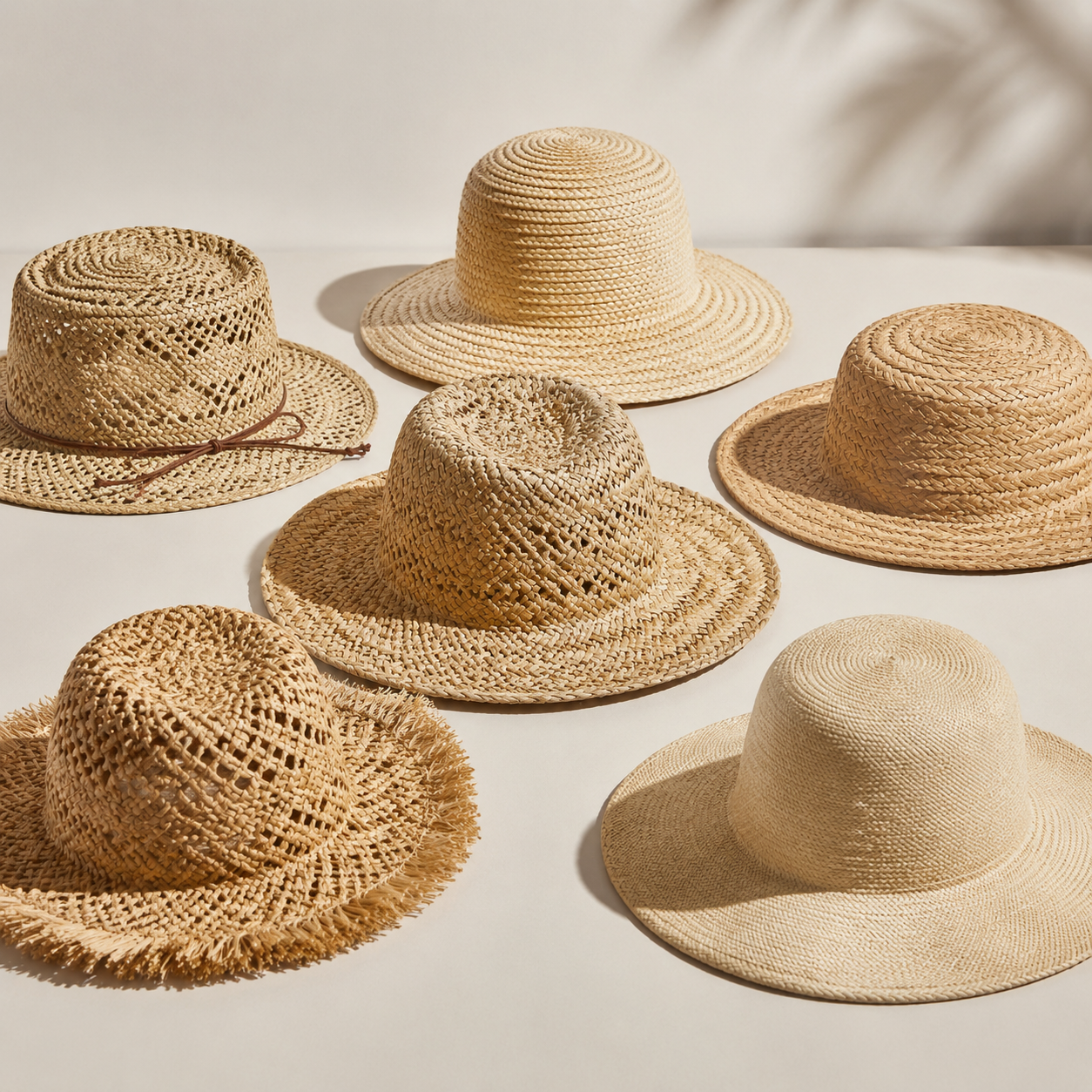
Braided straw and rope bands are growing in popularity for the bohemian and eco-conscious market segments. These integrated bands use the same or similar straw material as the hat body, creating a seamless, natural look. The Hongyuecap factory can match band straw fiber to hat body fiber for a completely cohesive product. Cost is approximately $0.10-0.20 per hat since the material is already in production.
A critical specification that wholesale buyers often overlook: band width. Standard grosgrain bands range from 1″ (25mm) for fedoras and dress hats to 1.5″ (38mm) for wider-brim sun hats. Band width affects both the visual proportion of the hat and the structural support it provides to the crown. A band that is too narrow for the crown height creates an unbalanced, “cheap” appearance that retail customers will notice.
2. Trim Elements: Beads, Feathers, Buckles, and Metal Accents
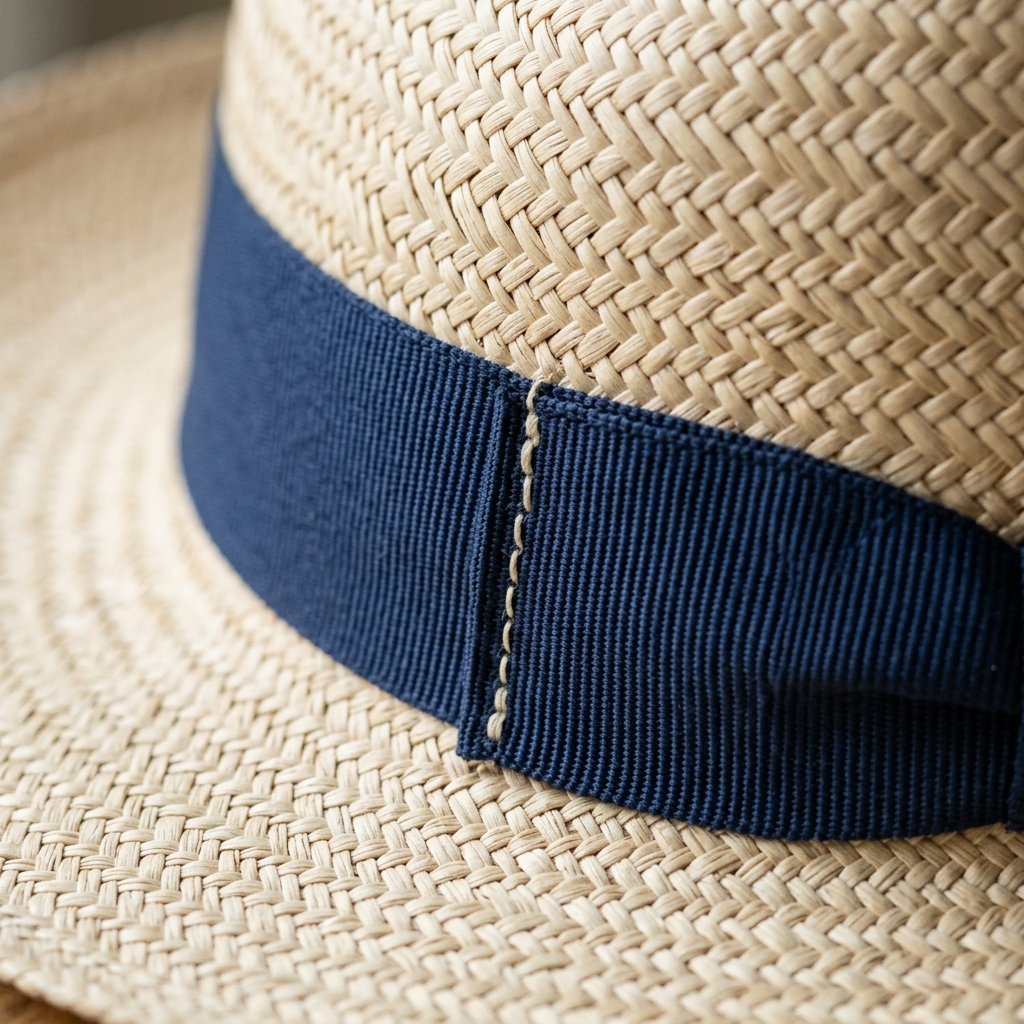
Direct answer: Trim elements are the fastest way to distinguish your straw hat product line from competitors, but they introduce the most quality-control variables. Wholesale buyers must specify attachment methods, material grades, and quantity per hat to avoid inconsistent production.
Decorative trims transform a basic straw hat into a branded retail product. The most commonly requested trims in the B2B market include: wooden beads (strung on the band or as a standalone hatband attachment), metal buckles and sliders (brass, nickel, or antique finishes), feather accents (natural or synthetic), fabric flowers, and custom logo pins.
For wooden beads, the specification must include: bead diameter (typically 8-15mm for hat bands), hole diameter (must accommodate the band material thickness), wood type (bamboo, olive wood, sandalwood are common), and finish (natural, stained, or painted). At Hongyuecap, bead attachment is done via double-strand threading — each bead is threaded onto two parallel band strands, not a single thread, which prevents bead loss during shipping and retail handling.
Metal trims present the most significant quality differentiation opportunity — and the most QC risk. Wholesale buyers should specify: metal type (brass for premium, zinc alloy for mid-market, iron for budget), plating (nickel, gold, antique copper, matte black), and attachment method (sewn-on, riveted, or loop-slide). A critical specification: metal trims on straw hats destined for the EU market must comply with REACH nickel-release regulations (EN 1811:2015). Hongyuecap can provide REACH compliance documentation for all metal trim components.
Feather accents require particular attention in wholesale specification. Natural feathers (rooster, pheasant, ostrich) must be sanitized and dyed with colorfast treatments. Synthetic feathers offer better color consistency and weather resistance but carry a slightly higher unit cost. The attachment method — typically a small metal crimp or sewn fabric pocket — must withstand repeated handling without feather detachment.
Related: Straw Hat Weave Types & Quality Guide for Wholesale
3. Color Matching and Brand Consistency for Wholesale Orders
Direct answer: Color matching is the #1 source of wholesale buyer disputes in custom trim orders. The solution is specifying Pantone codes — not verbal descriptions — and requesting physical color swatches before production begins.
Every wholesale buyer has experienced the frustration of receiving hats with bands that are “close but not quite” the right color. In the B2B hat industry, this typically stems from one root cause: the buyer communicated a color verbally (e.g., “navy blue”) rather than using a standardized color reference system.
Hongyuecap’s recommendation for wholesale buyers: always specify Pantone TPX (Textile Paper eXtended) codes for fabric bands and trims. These codes are the global standard for textile color communication and eliminate ambiguity between buyer expectations and factory production. For example, “Navy Blue” could mean any of 15+ Pantone shades; “Pantone 19-4027 TPX” specifies exactly one.
For multi-color band designs — such as striped grosgrain or ombre-dyed ribbons — the specification should include a Pantone code for each color with its position in the pattern. Hongyuecap’s design team can produce a digital color proof (within 2-3 business days) showing the exact band pattern with Pantone annotations before production begins.
For buyers who don’t have access to Pantone swatches, there is an alternative: physical color reference samples. Send a small fabric swatch, a printed color card, or even a competitor’s hat with the desired band color. Hongyuecap’s color-matching team can reproduce the color with a typical tolerance of ΔE ≤ 1.5 (virtually indistinguishable to the human eye). Note that this method adds 3-5 business days to the sampling process.
| Specification Method | Accuracy | Lead Time Impact | Cost |
|---|---|---|---|
| Pantone TPX Code | Highest (ΔE ≤ 1.0) | No extra time | Free |
| Physical Color Swatch | High (ΔE ≤ 1.5) | +3-5 days | Shipping cost |
| Digital Photo Reference | Medium (screen calibration varies) | +1-2 days for confirmation | Free |
| Verbal Description Only | Low (high risk of mismatch) | Risk of re-production (15-25 days) | Risk of loss |
4. Attachment Methods: How Bands and Trims Are Secured to Straw Hats

Direct answer: The attachment method determines how well the band survives shipping, retail handling, and end-user wear. For wholesale orders, Hongyuecap uses three primary attachment methods: machine stitching, hand stitching, and adhesive bonding — with machine stitching being the default standard for durability.
Machine stitching is the most reliable attachment method for grosgrain, satin, and fabric bands. A lock-stitch machine places stitches at 5-6mm intervals along both the top and bottom edges of the band, securing it to the straw hat body. This method achieves 95-98% retention rate even after repeated handling and wear. For straw hats, Hongyuecap uses a specialized curved-needle machine that can stitch into the straw weave without crushing or breaking the straw fibers.
Hand stitching is reserved for premium products and delicate trim elements. For leather bands, hand stitching with waxed thread (using a saddle stitch technique) creates a stronger bond than machine stitching because each stitch is independently knotted — if one stitch breaks, the rest hold. For bead and feather attachments, hand threading is the only viable method. Hand-stitched bands typically command a $1-3 premium per hat in manufacturing cost but enable significantly higher retail pricing.
Adhesive bonding is used primarily for decorative patches, small metal emblems, and some synthetic trim elements. The adhesive used is a heat-activated polyurethane (HMPUR) that bonds fabric to straw without visible residue. However, wholesale buyers should be aware that adhesive-only attachment has a higher failure rate (2-5% over a product’s retail lifecycle) compared to stitching. Hongyuecap’s standard policy is to use adhesive bonding only as secondary reinforcement alongside stitching, not as the primary attachment method.
5. Quality Control: How to Verify Band and Trim Specifications
Direct answer: A systematic QC checklist prevents 90% of band and trim issues before they reach your warehouse. The most critical checkpoints are: color accuracy, stitch integrity, material grade verification, and stress testing.
Hongyuecap’s internal QC process for custom band and trim work includes a 6-point inspection protocol that every wholesale buyer should understand and can adapt for their own receiving inspection:
- Color Accuracy Check: Compare random sample (5% of order, minimum 20 pieces) against the approved Pantone reference under D65 (daylight) lighting. Acceptable tolerance: ΔE ≤ 2.0 for solid colors.
- Stitch Integrity Test: Apply 2.5kg lateral pull force to the band for 5 seconds. The band should not separate from the hat body by more than 1mm at any attachment point.
- Material Grade Verification: Confirm band material composition matches the specification (e.g., 100% polyester grosgrain, not blended). Burn test or lab analysis for larger orders (>5,000 units).
- Trim Security Inspection: Each bead, buckle, and decorative element must withstand a 1.5kg pull test without detachment. Sampling rate: 10% of order or 100 pieces, whichever is larger.
- Symmetry Check: Band must be positioned within 2mm of the specified distance from the brim edge, measured at 4 points (front, back, left, right).
- Packaging Inspection: Each hat must be packed with acid-free tissue paper between the band and the hat crown to prevent color transfer during shipping.
Browse all custom hat options at Hongyuecap
Frequently Asked Questions
What is the MOQ for custom hat bands and trims?
Hongyuecap’s standard MOQ for custom band and trim specifications is 100 pieces per color/style. For multi-color band designs or complex trim combinations, the MOQ may increase to 200-300 pieces due to setup time for each variation.
Can I supply my own bands or trim materials?
Yes, Hongyuecap accepts buyer-supplied materials (CBM). You ship the bands/trims to our factory, and we handle the attachment. Note that you remain responsible for material quality and color consistency; we will flag visible defects but do not replace buyer-supplied materials.
How long does custom band and trim production take?
Standard custom band production with Hongyuecap takes 15-25 days from order confirmation, including sampling (3-5 days for digital color proof). Complex multi-material trim designs may extend to 25-35 days.
Do you offer eco-friendly band materials?
Yes, Hongyuecap offers recycled polyester grosgrain (GRS-certified), organic cotton ribbon, and natural jute/hemp bands for buyers targeting the sustainable fashion market. Request our eco-material catalog for full specifications.
CTA: Ready to customize your wholesale straw hats with branded bands and premium trims? Contact Hongyuecap for a free consultation and sample kit. Specify your Pantone colors, band width, and trim preferences — we’ll deliver a digital proof within 2-3 business days.
Written by the Hongyuecap Product Team — 10+ years in B2B custom headwear manufacturing. Last updated: May 03, 2026.
Related Resources for Wholesale Buyers: