
Pain point: You’re sourcing knitted beanies in bulk and can’t decide whether to stock cuffed or uncuffed styles. One wrong call on the cuff design — and you could end up with thousands of units your target market won’t buy. The good news? This cuffed vs uncuffed beanies wholesale decision becomes straightforward once you understand how cuff style impacts sizing flexibility, production costs, and regional demand patterns.
Cuffed vs Uncuffed Beanies Wholesale: Sizing & Cost Guide
Cuffed vs Uncuffed Beanies Wholesale: Sizing Cost Guide
What Is the Difference Between Cuffed and Uncuffed Beanies?
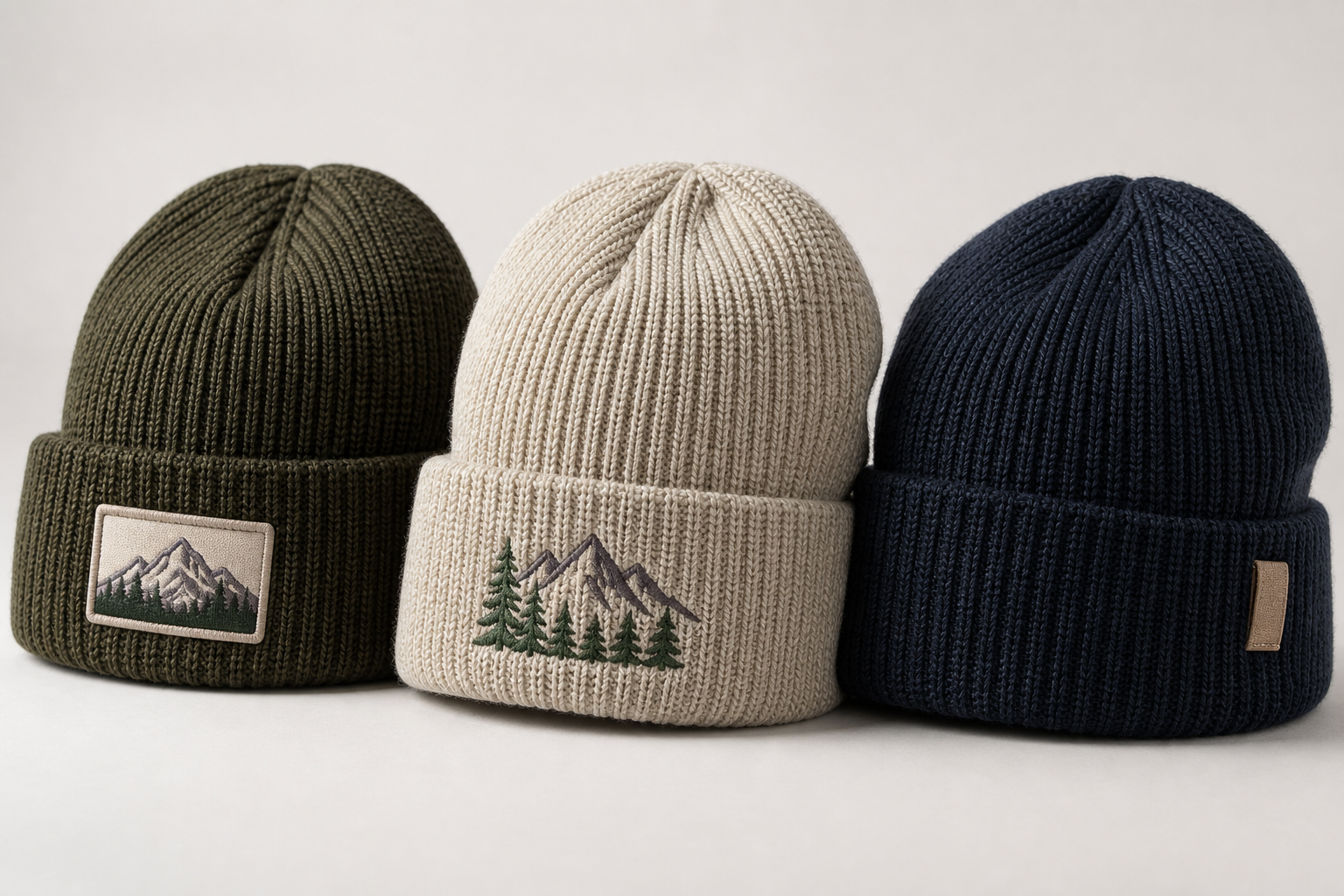
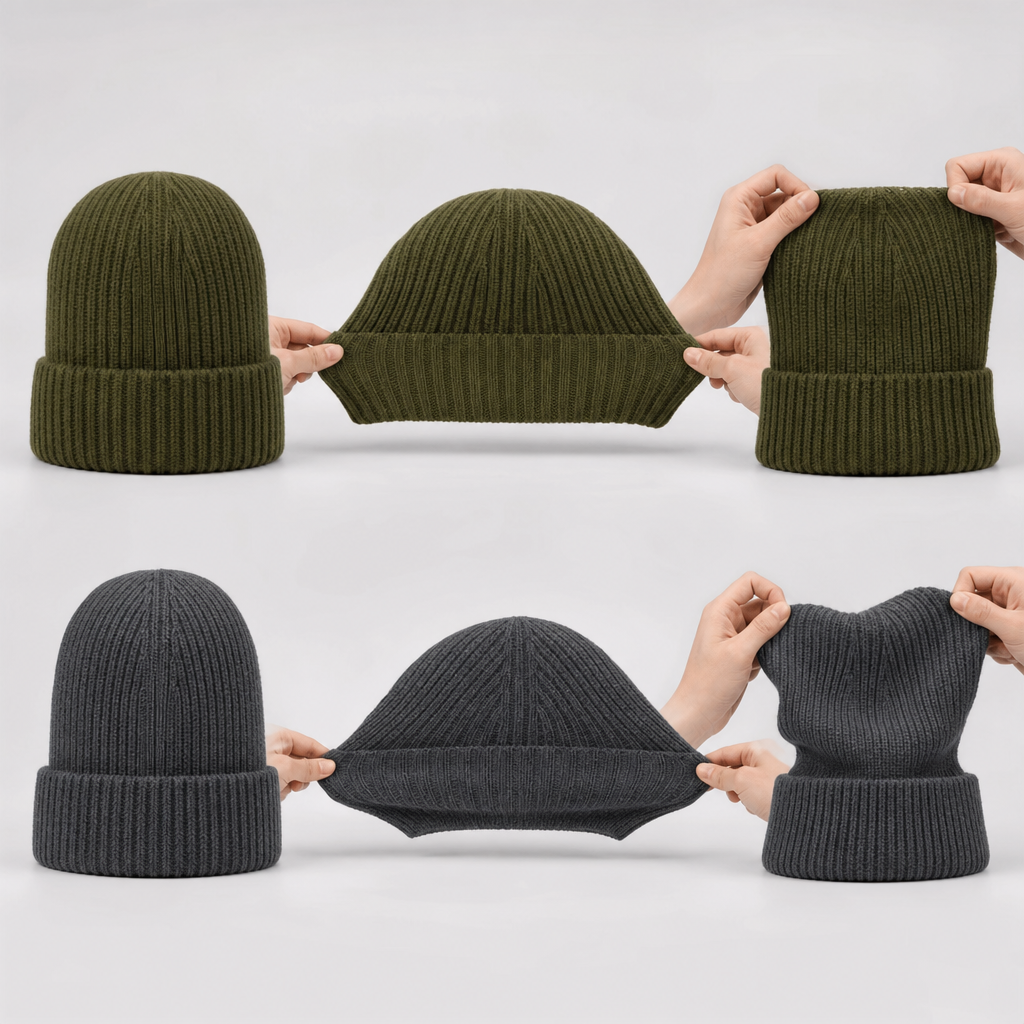
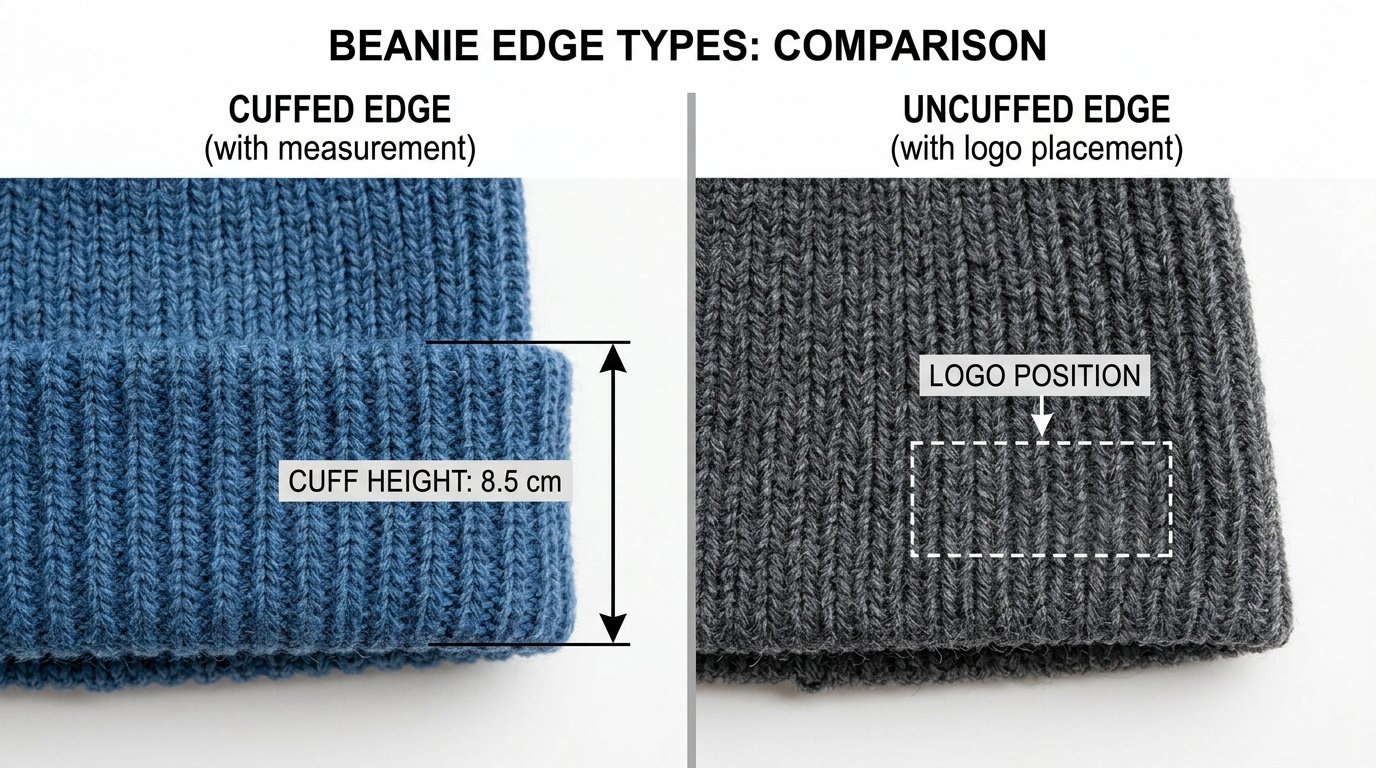
The fundamental difference between cuffed and uncuffed beanies comes down to one structural element: a folded-over fabric band at the base. A cuffed beanie features an extra layer of knitted fabric folded upward at the bottom hem, creating a double-layer band around the wearer’s forehead and ears. An uncuffed beanie — sometimes called a skull cap or watch cap — has a single-layer, straight-hemmed edge that sits closer to the head without any fold.
For wholesale buyers, this isn’t just an aesthetic choice. The cuff fundamentally changes five things: (1) the beanie’s total length — cuffed versions must be knit approximately 30-40% longer to accommodate the fold; (2) warmth retention — the double-layer cuff provides roughly 40% more insulation around the ears; (3) sizing adaptability — cuffed beanies fit a wider range of head sizes because the cuff can be rolled more or less; (4) decoration real estate — cuffed beanies offer two distinct branding zones including the main body and the cuff face; and (5) production cost — cuffed beanies use 15-25% more yarn and require additional finishing steps.
Hongyuecap produces both styles across our knitted beanie production lines. Our factory data shows that cuffed beanies now account for approximately 62% of wholesale beanie orders placed in 2025, up from 55% in 2023, reflecting growing market preference for the versatile cuff design. This shift aligns with broader industry data tracked by the Textile Exchange showing increasing demand for multi-functional accessories worldwide.
How Cuff Style Affects Sizing and Fit Across Customer Demographics
Sizing is the single most important practical factor when choosing between cuffed and uncuffed beanies for your wholesale order. The cuff adds approximately 1.5 to 2.5 cm of adjustable depth to the ear coverage zone, which dramatically changes how the beanie fits across different age groups and head sizes.
A standard uncuffed knitted beanie typically measures 18-22 cm in total length and fits head circumferences of 54-60 cm. The fit is essentially fixed — the beanie stretches to accommodate the head and stops where the knitting ends. A cuffed beanie, by contrast, has a total knitted length of 25-30 cm, with the bottom 6-8 cm designed to fold upward. This fold creates an adjustable band that the wearer can position at different heights along the forehead.
Key sizing implications for wholesale buyers:
- Youth and teen markets: Uncuffed beanies in smaller sizes (52-56 cm circumference) often sell better because kids and teenagers prefer the snug, streamlined look. The fixed hem avoids the “too much fabric” problem that cuffed beanies can create on smaller heads.
- Adult unisex sizing: Cuffed beanies dominate here because one size can genuinely fit 80-90% of adults. The adjustable cuff compensates for the 4-6 cm variation in adult head circumferences.
- Women’s fashion lines: Uncuffed styles with a rolled-edge finish and slightly taller profile (22-24 cm) are trending in women’s accessories, particularly in pastel and heathered colorways.
- Winter sports and outdoor gear: Cuffed beanies with a deeper fold (8-10 cm) offer maximum ear coverage. In Hongyuecap’s production data, outdoor brands consistently order cuffed styles with at least 28 cm total knitted length.
Hongyuecap recommends offering both styles in your product catalog. Our wholesale clients who stock both cuffed and uncuffed variants see 23% higher average order value from retailers than those offering only one style. The two styles are not competitors — they serve different customer needs within the same target market.
Production Cost Comparison: Cuffed vs Uncuffed Knitted Beanies
Cost-conscious wholesale buyers need to understand exactly how the cuff decision impacts their per-unit pricing. Based on Hongyuecap’s factory production data, here is a detailed cost breakdown for a standard acrylic knitted beanie order at MOQ 500 units:
| Cost Factor | Uncuffed | Cuffed | Difference |
|---|---|---|---|
| Yarn consumption | 65-75g | 80-95g | +18-27% |
| Knitting time (per unit) | 4-5 min | 5-7 min | +25-40% |
| Finishing labor | 2 steps | 3-4 steps | +1-2 steps |
| Packaging volume | Smaller | ~20% larger | Higher shipping |
| Typical EXW price (acrylic, MOQ 500) | $0.85-1.20 | $1.10-1.55 | ~$0.25-0.35 |
What drives the cost gap? The 25-35% price premium for cuffed beanies comes from three factors: (1) raw material cost — the extra 15-20g of yarn accounts for roughly 40% of the price difference; (2) knitting complexity — cuffed beanies require a clearly defined fold line at the transition point between the body knit and the cuff section, which adds 1-2 minutes per unit; and (3) finishing labor — the cuff must be steam-pressed flat and shape-set to ensure it lays correctly, adding one extra quality-control checkpoint.
However, the ROI calculation isn’t one-dimensional. Cuffed beanies consistently command 30-50% higher retail prices than equivalent uncuffed styles. A cuffed acrylic beanie that wholesalers buy at $1.30 routinely retails at $8.99-12.99, while an uncuffed version of the same quality will retail at $5.99-8.99. The per-unit profit margin is nearly identical in percentage terms, but the absolute dollar margin is significantly higher for cuffed styles. All Hongyuecap products are manufactured in WRAP-certified facilities using OEKO-TEX Standard 100 certified materials.
Regional Market Preferences: Who Buys Cuffed vs Uncuffed
Geographic demand patterns for cuffed versus uncuffed beanies are well-established and remarkably consistent across seasons. Understanding these regional preferences is essential before committing to a bulk order, particularly if your distribution is concentrated in specific markets.
North America (US & Canada): The cuffed beanie dominates with an estimated 68% market share in winter accessories. This preference is culturally embedded — the cuffed beanie has been the default winter hat style in North America since the 1990s outdoor and skateboarding culture boom. Uncuffed styles exist in streetwear and urban fashion niches but represent the minority. Brands like Carhartt, The North Face, and Patagonia have cemented the cuffed look as the standard.
Europe (UK, Germany, Scandinavia): A more even split, with cuffed beanies holding approximately 55% share. The UK market shows the strongest preference for cuffed styles — especially in chunky knit and cable knit patterns — while Scandinavian markets are notably more receptive to uncuffed designs with minimalist branding. The European market also demands higher material quality — GOTS-certified organic cotton and recycled polyester are increasingly becoming table stakes rather than differentiators.
Asia-Pacific (Japan, Korea, China): Uncuffed beanies lead at approximately 60% market share. The Japanese and Korean fashion markets strongly favor the sleeker silhouette of uncuffed styles, particularly in finer gauge knits (12G and 14G). Streetwear brands in these markets prefer uncuffed beanies as a year-round accessory, often in lightweight cotton or bamboo blends for spring and autumn wear.
Australia & New Zealand: A heavily seasonal market where both styles coexist. Cuffed beanies dominate winter sales (June-August), while uncuffed styles in lightweight materials gain traction during transitional seasons. Australian buyers should note that the market is small but premium — per-unit pricing can be 30-40% higher than equivalent North American retail.
Middle East & GCC: A niche but growing market, primarily for air-conditioned indoor wear and winter travel accessories. Cuffed styles using lightweight acrylic blends outsell uncuffed by approximately 3:1, with strong demand for neutral colors (black, charcoal, navy).
For wholesale buyers distributing across multiple regions, stocking 70% cuffed / 30% uncuffed provides a balanced inventory that covers the dominant market preferences globally. Hongyuecap’s production scheduling supports mixed-style orders within a single purchase order, allowing you to test both styles without committing to separate production runs.
Custom Decoration & Branding: Embroidery and Printing by Cuff Type
The cuff doesn’t just change how the beanie fits — it changes where and how you can decorate it. For wholesale buyers building branded merchandise lines, the decoration implications of cuff style are often the deciding factor.
Cuffed beanie decoration options:
- Front cuff embroidery: This is the most popular decoration placement for cuffed beanies, accounting for an estimated 75% of all branded beanie orders at Hongyuecap. The flat, double-layer surface of the folded cuff provides an ideal embroidery canvas — it’s stable, doesn’t stretch during wear, and offers a natural “frame” for logo placement. Maximum embroidery area: approximately 8 cm wide × 3 cm high on a standard adult cuff.
- Body-side embroidery: Less common but effective for secondary branding. The single-layer knit body stretches more than the cuff, so embroidery designs must use lower stitch density (6,000-8,000 stitches vs. 10,000-12,000 on the cuff) to prevent puckering.
- Leather patch on cuff: A premium option that has surged in popularity, especially for outdoor and heritage brands. The leather patch is sewn or riveted onto the cuff face. Hongyuecap offers custom debossed and laser-engraved leather patches with MOQ as low as 200 units.
- Woven label on cuff hem: A subtle branding option for minimalist designs. The label is sewn at the cuff fold seam and sits approximately 1 cm above the hem line.
Uncuffed beanie decoration options:
- Front-center embroidery: Directly on the single-layer body fabric. This is more challenging than cuff embroidery because the fabric stretches, which can distort the logo. Hongyuecap uses a specialized backing stabilizer for all uncuffed beanie embroidery to maintain design integrity. Expect 15-20% higher embroidery setup costs for uncuffed styles.
- All-over sublimation printing: Uncuffed beanies offer a larger uninterrupted printable surface, making them ideal for all-over patterns, gradient designs, and wraparound graphics. This is particularly popular in streetwear and festival merchandise.
- Side-tag branding: A small woven label at the hem, typically on the wearer’s left side. This is the most common decoration for high-fashion and minimalist uncuffed designs.
- Screen printing on fold-down area: Some brands use a fold-down label area at the bottom of uncuffed beanies for screen-printed care instructions and branding, mimicking the cuff look without full cuff construction.
Production tip from Hongyuecap: If your branding involves large or complex embroidery designs (more than 12,000 stitches, multiple colors, or metallic threads), the cuffed beanie is strongly recommended. The double-layer cuff provides the structural stability that complex embroidery demands, and our quality-control rejection rate for embroidery on cuffed beanies is less than 1%, compared to 3-5% on uncuffed single-layer bodies. For more on material interaction with decoration, see our knitted beanie pilling resistance guide.
Sourcing Checklist: 7 Factors Before Ordering Cuffed vs Uncuffed Beanies Wholesale
Before you place a bulk order, run through this seven-factor checklist. Each factor directly impacts your per-unit cost, sell-through rate, and customer satisfaction:
- Target customer age range: If you serve primarily 18-35 demographic, both styles work. For 35+, cuffed beanies outsell uncuffed by roughly 2:1. For 12-18 youth market, uncuffed styles dominate.
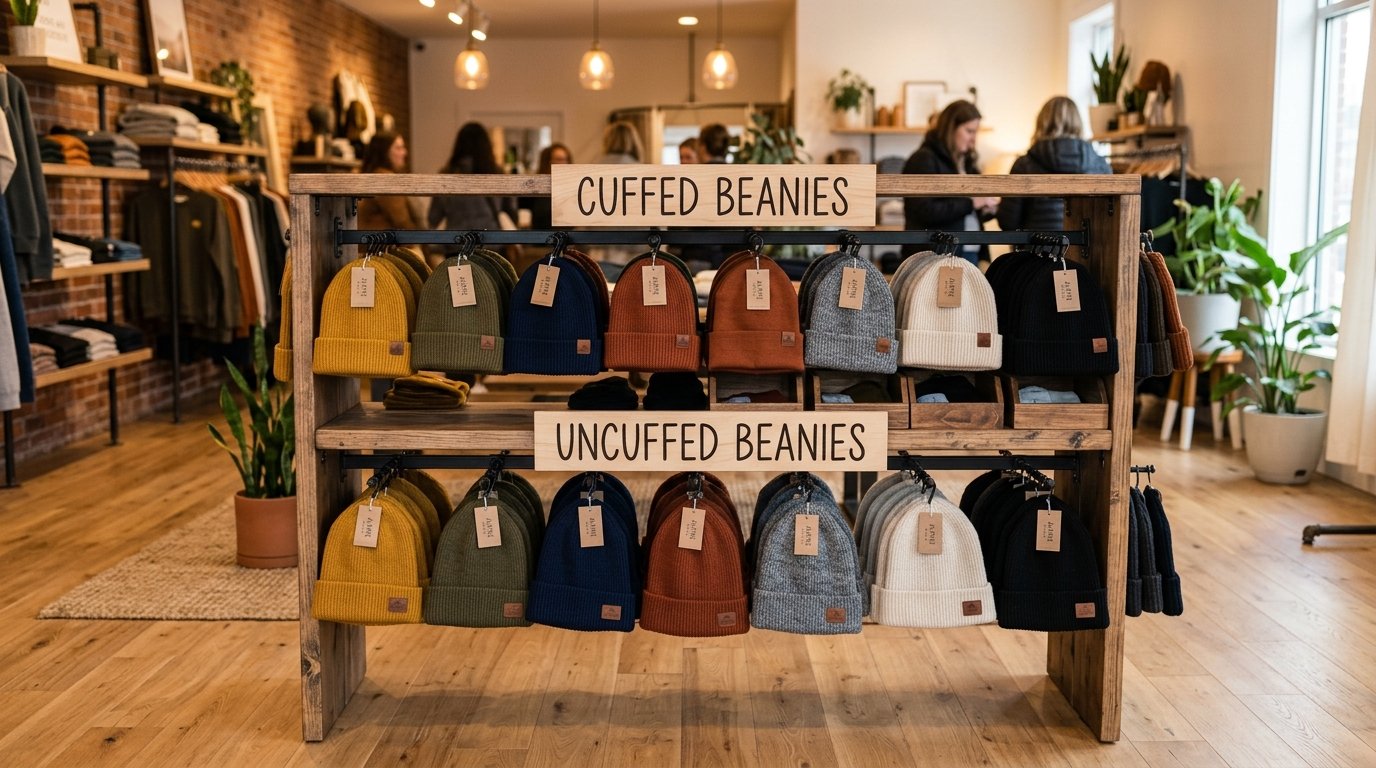
- Primary sales channel: E-commerce favors cuffed beanies because the fold photographs well and communicates visual warmth. Physical retail benefits from offering both styles on the same display fixture — the visual contrast drives comparison shopping and higher basket value.
- Seasonal vs. year-round: If you sell seasonally (winter only), stock 80% cuffed / 20% uncuffed. If you sell year-round accessories, shift to 55% cuffed / 45% uncuffed to capture spring/autumn demand for lightweight uncuffed styles.
- Branding method: Embroidery → choose cuffed. All-over print → choose uncuffed. Leather patch → choose cuffed. Minimalist woven label → either style works equally well.
- Material requirements: For premium natural fibers (merino wool, cashmere blend, alpaca), the cost differential between cuffed and uncuffed is amplified — cuffed versions may cost 35-45% more due to higher raw material consumption. For acrylic and cotton blends, the differential stays around 20-30%.
- Shipping and logistics: Uncuffed beanies pack approximately 15-20% more units per carton, reducing per-unit freight cost. If shipping cost is a major factor, the uncuffed option becomes economically attractive despite the lower per-unit retail price.
- Quality control tolerance: The cuff fold line is a common QC failure point — uneven folds, loose stitching, or inconsistent fold width can lead to batch rejections. Hongyuecap maintains a dedicated cuff inspection station with AQL 2.5 sampling for all cuffed beanie production lines — the same standard required by WRAP-certified facilities. Always confirm your supplier has explicit cuff QC protocols before committing to an order.
Hongyuecap’s product team provides free consultation on cuff-style decisions for orders above MOQ 300. Contact us with your target market, price point, and branding requirements, and we’ll recommend the optimal cuff configuration — backed by production data from over 500,000 beanies manufactured annually.
Frequently Asked Questions: Cuffed vs Uncuffed Beanies Wholesale
What is the MOQ difference between cuffed and uncuffed wholesale beanies?
At Hongyuecap, both cuffed and uncuffed beanies share the same minimum order quantity of 300 units per style and color. However, mixed orders — for example, 200 cuffed plus 100 uncuffed in the same yarn and color — are accepted within a single purchase order. For premium materials like merino wool, the MOQ increases to 500 units.
Can I order both cuffed and uncuffed styles in the same production run?
Yes. Hongyuecap runs both cuff styles on the same knitting machines with a simple program change. There is no minimum separation between styles within an order. This means you can test market response to both cuff types without paying for separate production setups. Many of our long-term wholesale clients start with a 70/30 split and adjust based on sell-through data.
Which beanie style has better durability — cuffed or uncuffed?
Cuffed beanies generally demonstrate longer useful lifespan in consumer use for two reasons: (1) the double-layer cuff area resists stretching and deformation better than single-layer edges, and (2) the fold conceals loose threads and minor pilling that would be visible on an uncuffed hem. Hongyuecap’s internal abrasion testing shows cuffed beanies retain shape through 45-50 wash cycles versus 35-40 cycles for uncuffed, a meaningful difference for premium retail positioning.
Do cuffed beanies shrink differently than uncuffed after washing?
Yes. The double-layer cuff effectively locks in the hem dimensions during washing, reducing hem-level shrinkage to approximately 1-2%. Uncuffed single-layer hems can shrink 3-5%, particularly in acrylic blends. This is important for private-label brands because cuff shrinkage complaints are virtually nonexistent in our customer service data, while fit complaints for uncuffed styles occur at a rate of about 1 in 800 units.
What colors sell best for cuffed vs uncuffed wholesale beanies?
For cuffed beanies, black, charcoal grey, navy, and heather grey account for approximately 65% of wholesale orders globally. For uncuffed beanies, the palette shifts toward brighter options — burgundy, olive green, mustard yellow, and pastel tones collectively represent 55% of orders. This reflects different consumer profiles: cuffed buyers prioritize versatility, while uncuffed buyers make fashion-forward purchases.
How does the cuff affect lead time for bulk orders?
Cuffed beanies add approximately 1-2 additional production days for a standard 5,000-unit order compared to uncuffed. The extra time comes from the cuff pressing and fold-inspection steps. Hongyuecap’s standard lead time is 25-30 days for uncuffed and 27-32 days for cuffed styles, both from order confirmation to EXW shipment. For more on construction variables, see our single vs double layer beanies guide.
Ready to Source Cuffed or Uncuffed Beanies?
Choosing between cuffed and uncuffed beanies doesn’t have to be complicated. The right answer depends on your specific market, branding needs, and price positioning — and Hongyuecap’s production team has the data to guide that decision.
We manufacture over 500,000 knitted beanies annually across both cuff styles, serving wholesale buyers in 15+ countries. Our production capabilities include: 7G, 9G, 12G, and 14G knitting gauges; all major fiber types including acrylic, cotton, wool, bamboo, and recycled polyester; embroidery, screen printing, leather patch, and sublimation decoration; and in-house quality control with AQL 2.5 sampling — compliant with both WRAP and OEKO-TEX standards.
Prefer to talk? Contact our beanie sourcing team →
📋 Related resources for wholesale beanie buyers:
Knitted Beanie Stitch Types Guide — How rib, cable, and jersey stitch affect your product line
Knitted Beanie Wholesale Materials Guide — Six-fiber comparison for bulk buyers
Eco-Friendly Knitted Beanie Materials — GRS certified recycled yarn options
Single vs Double Layer Knitted Beanies — Construction comparison
Knitted Beanie Pilling Resistance Guide — Material quality testing
Beanie Yarn Weight GSM Guide — Yarn weight specifications
Contact Hongyuecap — Request your custom wholesale quote
External references: WRAP Certification Standards | OEKO-TEX Standard 100 | GOTS Organic Textile Standard | Textile Exchange
Written by the Hongyuecap Product Team — 10+ years in B2B custom headwear manufacturing. Last updated: May 03, 2026.