
Bucket Hat Buying Guide Wholesale Buyers Need: How to Source the Right Hat for Your Market, Channel, and Budget
This bucket hat buying guide wholesale sourcing checklist is designed for independent retailers, brand owners, and procurement managers who want to avoid the most common — and expensive — mistakes in bulk hat purchasing. Use it as your pre-order checklist before committing to any supplier.
You ordered 500 bucket hats for your boutique. The sample looked perfect — but when the bulk shipment arrived, the stitching was uneven, the brim shape was inconsistent, and three customers returned their purchases in the first week. Sound familiar? For first-time wholesale buyers, the gap between a promising sample and a disappointing bulk delivery is where most money gets lost. This bucket hat buying guide wholesale buyers rely on will walk you through everything you need to inspect, specify, and negotiate before you place your next order — so you get exactly what you paid for.
If you’re looking for a reliable bucket hat buying guide wholesale buyers can actually use — with concrete specifications, not vague advice — you’re in the right place. Whether you’re stocking a streetwear boutique, outfitting a resort gift shop, or launching a branded merch line, bucket hats are one of the most versatile headwear categories in wholesale today. The global bucket hat market has grown at a compound annual rate of approximately 5.8% since 2022, driven by festival culture, streetwear crossovers, and outdoor lifestyle trends. But with dozens of fabric options, construction methods, and supplier tiers to navigate, buying bucket hats in bulk isn’t as simple as picking a style and placing an order. This guide breaks down the six critical decisions that separate profitable bucket hat sourcing from costly mistakes.
Before diving into materials and construction, take a moment to review our complete bucket hat collection to see how different styles, fabrics, and price points position in the market. Understanding the range of what’s available will help you make sharper sourcing decisions.
1. Why a Buying Guide Matters — and What Most First-Time Buyers Get Wrong
Most first-time wholesale buyers approach bucket hat sourcing the same way: they browse Alibaba or attend a trade show, pick a style that looks good, and negotiate on price. The problem is that price alone tells you almost nothing about what you’re actually buying. A $1.80 bucket hat and a $4.50 bucket hat can look identical in a catalog photo but differ dramatically in fabric weight, stitching density, brim reinforcement, and dye fastness — all of which determine whether your customer keeps the hat or returns it.
According to industry data from the Office of Textiles and Apparel (OTEXA), U.S. headwear imports exceeded $4.2 billion in 2024, with China, Vietnam, and Bangladesh accounting for over 70% of supply. Within that massive pipeline, quality variation is enormous. A 2023 survey by Sourcing Journal found that 41% of independent fashion retailers had experienced at least one bulk order where the delivered product did not match the approved sample — with fabric substitution being the most common issue, followed by sizing inconsistencies and color variation.
The most expensive mistake a buyer can make is conflating “cheap” with “good value.” A bucket hat with a $1.50 unit cost that generates a 12% return rate actually costs more in the long run than a $3.00 hat with a 2% return rate — once you factor in return shipping, customer service time, and lost repeat business. A well-structured buying guide protects you from these hidden costs by giving you a systematic way to evaluate suppliers, materials, and construction before money changes hands.
There are three patterns that consistently trip up first-time buyers: (1) Over-indexing on the sample — one perfect sample does not guarantee 500 consistent units, especially from smaller workshops; (2) Ignoring minimum order quantity (MOQ) dynamics — a supplier’s advertised MOQ of 100 pieces may jump to 300 per color when you actually place the order, which matters enormously for multi-SKU retailers; and (3) Skipping the pre-production sample (PPS) — the PPS is your last checkpoint before bulk production begins, and skipping it is the single strongest predictor of a disappointing bulk delivery. These patterns are especially relevant when you’re buying through platforms like Alibaba, where supplier claims aren’t always independently verified — see our guide on vetting overseas hat suppliers for a deeper dive into supplier due diligence.
2. How to Match Bucket Hat Materials to Your Buyer’s End-Use
Material choice is the single most consequential decision in bucket hat wholesale buying — it determines your cost, your target customer, and how the hat performs in the real world. There are five primary material families used in commercial bucket hat production, and each serves a different buyer persona.
Cotton and Cotton Twill
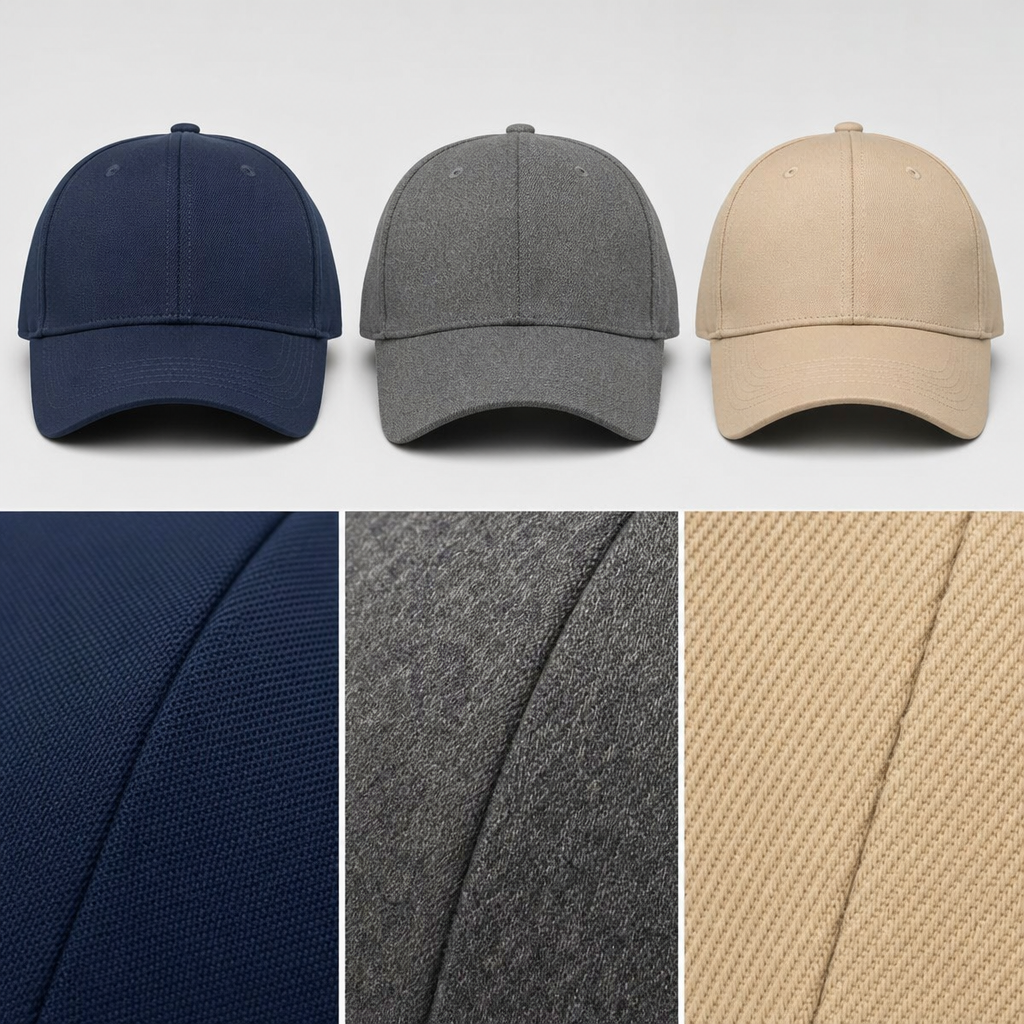
Cotton bucket hats account for roughly 55-60% of the global wholesale market. Within cotton, the two main variants are standard cotton drill (180-220 GSM, or grams per square meter) and heavy cotton twill (260-320 GSM). Standard cotton is lightweight, breathable, and the most affordable option — ideal for promotional giveaways, summer festivals, and budget retail. Heavy twill, by contrast, holds its shape better, drapes more cleanly, and feels substantially more premium to the touch. If your customer is a streetwear boutique or a mid-tier fashion retailer, heavy cotton twill at 280+ GSM is the minimum viable specification.
One critical specification that first-time buyers often miss: pre-shrunk vs. non-pre-shrunk cotton. Non-pre-shrunk cotton can shrink 3-5% after the first wash, which on a 58cm circumference bucket hat translates to roughly 1.7-2.9cm — enough to make the hat uncomfortable. Always ask your supplier whether the fabric is pre-shrunk (also called “sanforized” or “pre-washed”). The incremental cost is typically $0.08-0.15 per unit, and it’s almost always worth it.
Polyester and Nylon (Performance Fabrics)
For outdoor, athletic, and water-resistant applications, polyester and nylon bucket hats dominate. Polyester bucket hats (typically 100-150 GSM) are lightweight, quick-drying, and highly packable — perfect for hiking outfitters, fishing brands, and beachwear retailers. Nylon offers superior tear strength and a slightly more premium hand feel, though at a 15-25% cost premium over polyester. Both materials can be treated with DWR (durable water repellent) coatings for added water resistance, which typically adds $0.20-0.35 per unit.
If your buyer is in the outdoor or travel retail space, specify UPF 50+ rated fabric. Most tightly woven polyester and nylon fabrics naturally achieve UPF 30-50, but getting an official UPF 50+ certification from a lab like Intertek or SGS adds approximately $300-500 per fabric lot for testing — a cost worth absorbing if sun protection is a key selling point for your customer.
Denim, Canvas, and Corduroy
Denim bucket hats (8-12 oz denim) are a growing subcategory within streetwear and vintage-inspired fashion. They’re heavier (300-400 GSM), more structured, and typically command a 30-50% retail price premium over cotton equivalents. Canvas bucket hats follow a similar positioning — think Carhartt and Dickies — built for durability rather than breathability. Corduroy bucket hats have surged in popularity since 2023, particularly in fall/winter collections. The key specification for corduroy is wale count (the number of ribs per inch): 8-10 wale is standard, while 14-16 wale (fine wale) reads as more premium and is better suited for fashion-forward retailers.
Summary: Material Selection by Use Case
| End-Use | Recommended Material | Key Spec | Approx. Wholesale Price (per unit, MOQ 500) |
|---|---|---|---|
| Festival / Promotional | Cotton drill | 180-200 GSM, pre-shrunk | $1.20 – $1.80 |
| Streetwear / Fashion Retail | Heavy cotton twill | 280-320 GSM, pre-shrunk | $2.20 – $3.50 |
| Outdoor / Hiking / Fishing | Polyester or nylon with DWR | 100-150 GSM, UPF 50+ | $2.50 – $4.00 |
| Luxury / Premium | Corduroy (fine wale) or Japanese denim | 14-16 wale / 10-12 oz denim | $4.00 – $7.00 |
| Resort / Beachwear | Cotton-polyester blend | 200-240 GSM, quick-dry | $1.80 – $2.80 |
For more context on how material quality impacts your final product, check out our custom bucket hats wholesale guide which covers specification details in even greater depth.
3. What Construction Details Separate a Premium Bucket Hat from a Promotional Giveaway
Two bucket hats made from the same fabric can feel completely different in the hand — and sell at vastly different price points — based on construction quality alone. There are five construction elements that wholesale buyers need to inspect.
Stitching Density. This is measured in SPI (stitches per inch). Promotional-grade bucket hats typically use 6-8 SPI, which produces visible gaps between stitches and is more prone to unraveling. Mid-tier hats use 8-10 SPI, and premium hats use 10-12 SPI. The difference in production cost between 8 SPI and 10 SPI is roughly $0.10-0.20 per hat, but the visual difference is dramatic — tighter stitching produces cleaner seam lines and extends product life. When reviewing samples, use a stitch counter or a magnifying glass to verify the SPI your supplier claims.
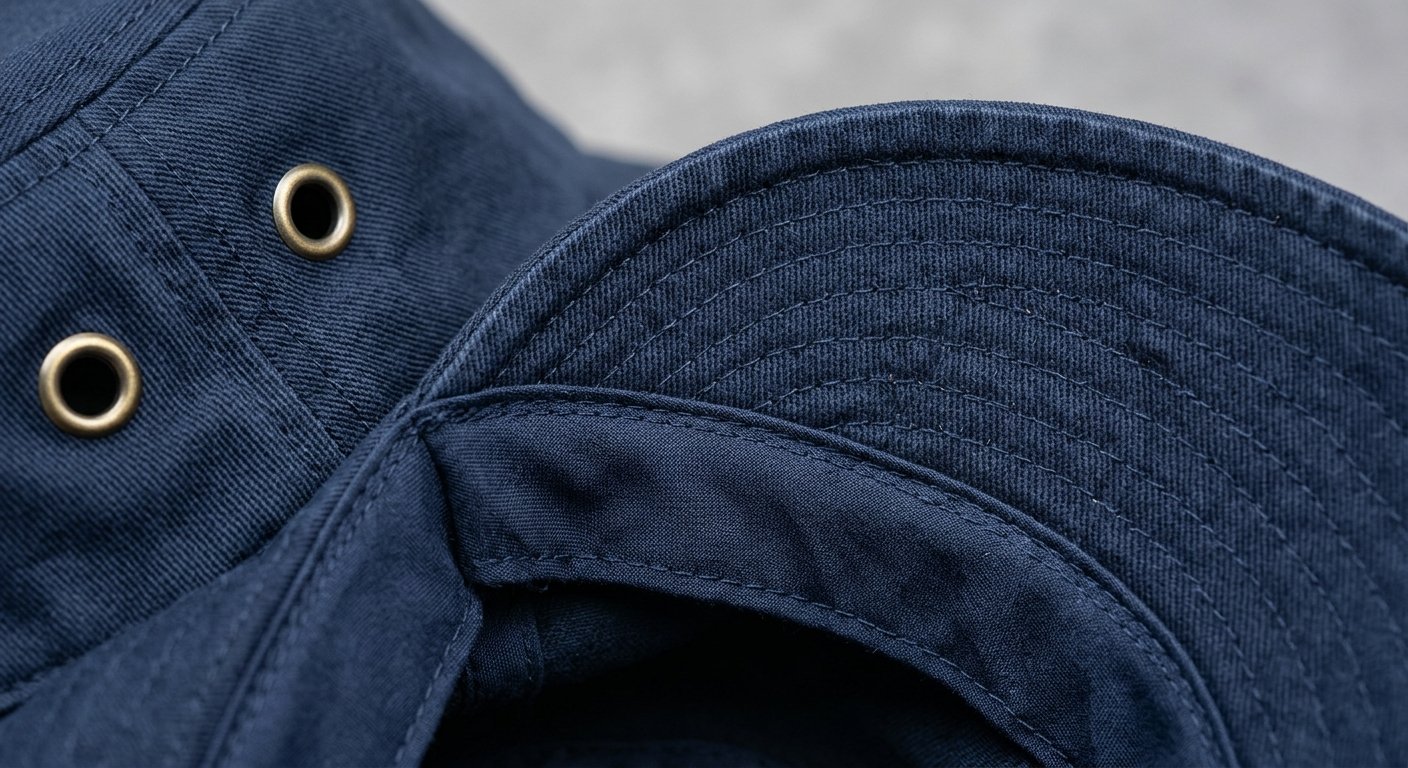
Brim Construction. The brim is the defining feature of a bucket hat, and how it’s constructed determines whether the hat holds its shape or collapses. There are three common brim types: (a) Folded and stitched — the most basic construction, where the brim fabric is simply folded over and top-stitched. This produces a soft, unstructured brim that works for casual styles but droops over time. (b) Interfaced brim — a layer of fusible or sew-in interfacing is inserted between the brim layers before stitching. This adds structure and shape retention without adding significant cost ($0.05-0.10 per unit). (c) Reinforced brim with edge binding — the premium option, where the brim includes interfacing AND a bound edge (bias tape or self-fabric binding wrapped around the raw brim edge). This construction is standard for brands like Kangol and can add $0.20-0.40 per unit in production cost, but it dramatically improves durability and visual finish.
Eyelet Quality. Bucket hats typically have 2-4 metal or embroidered eyelets for ventilation. Metal eyelets should be rust-resistant (brass or stainless steel), evenly spaced, and firmly pressed — a loose eyelet will fall out within weeks of wear. Embroidered eyelets are more common on lightweight cotton hats; the embroidery should be dense (minimum 3,000 stitches per eyelet) to prevent fraying. Eyelet quality is one of the fastest tells of manufacturing care: if the eyelets are crooked, misaligned, or roughly punched, the rest of the hat is probably cut to the same standard.
Sweatband. The internal sweatband is what touches the wearer’s forehead all day. Budget hats use a simple cotton tape sweatband; mid-tier hats use a wider, softer cotton twill tape (2.5-3.5 cm width); premium hats use a terry cloth or moisture-wicking sweatband. For polyester/nylon outdoor hats, specify a mesh or Coolmax® sweatband to prevent sweat buildup. A poorly attached sweatband that twists or separates from the crown is one of the most common failure points — always pull on the sweatband during sample inspection to test the attachment strength.
Seam Finishing. Inside the hat, the seam where the crown panels join should be cleanly finished — ideally with binding tape covering the raw edges. Exposed raw edges inside the crown are acceptable only on the most budget-tier products; for anything sold above a $15 retail price point, bound internal seams are expected. This single detail costs approximately $0.15-0.25 per unit and signals to your customer that the product was made with care. For detailed construction and specification guidance, our bucket hat manufacturing guide covers these technical details comprehensively.
4. How to Specify Sizing, Packability, and Minimum Order Quantities Without Surprises
Sizing, packability, and MOQs are the three operational variables that most frequently cause friction between wholesale buyers and suppliers. Get them right in your specification sheet, and your order flows smoothly; leave them ambiguous, and you’ll be negotiating post-production fixes.
Sizing Standards. Bucket hats are typically sized by head circumference in centimeters. The industry standard for adult one-size-fits-most (OSFM) is 56-58 cm, which fits approximately 85% of adult heads. If your market skews toward larger sizes (common in North America and Northern Europe), specify 58-60 cm. For a more fitted look, 55-57 cm. The difference between 56 cm and 58 cm may sound small, but it translates to roughly 6 mm in radius — enough to be the difference between “snug” and “comfortable.” Always confirm with your supplier whether their stated measurement is the finished hat circumference or the intended head size, as these differ by the thickness of the sweatband and fabric.
For brands selling to diverse demographics, consider offering two sizes (S/M 54-56 cm, L/XL 58-60 cm). The additional SKU complexity is usually offset by a reduction in returns — multi-size offerings have been shown to reduce fit-related return rates by 20-30% according to a 2024 study by the National Retail Federation.
Packability. If your customer is in travel retail, outdoor gear, or e-commerce (where shipping volume equals shipping cost), packability matters. Bucket hats can be designed to fold flat or roll without creasing. The key specifications: (a) Soft brim construction (no interfacing, or a very light fusible) allows the hat to be folded; (b) Crush-resistant fabric like polyester recovers its shape better than cotton after compression; (c) Removable or no structured sweatband avoids the sweatband creating permanent creases. Specify “packable” or “crushable” explicitly in your tech pack — don’t assume your supplier understands this requirement.
Minimum Order Quantities. MOQs in the bucket hat industry typically range from 100 to 1,000 pieces per style, with significant variation by supplier tier. Small workshops (10-30 workers) in Yiwu or Guangdong often accept MOQs of 100-200 pieces per style, but their per-unit pricing is higher (typically $2.50-$4.00 for basic cotton). Mid-size factories (50-200 workers) quote MOQs of 300-500 pieces with better pricing ($1.80-$2.80). Large factories (200+ workers) may require MOQs of 1,000+ but offer the lowest per-unit costs ($1.20-$2.00).
The MOQ trap that catches many buyers: a supplier quotes an MOQ of 200 pieces, but when you submit your order with 4 color variants, the MOQ becomes 200 per color — meaning your actual minimum jumps to 800 pieces. Always clarify in writing: “Is the MOQ per style, per color, or per SKU?” This single question has saved buyers thousands of dollars in unexpected commitment. For more on navigating supplier relationships effectively, read our article on working with our sourcing team who can help negotiate these terms on your behalf.
5. What to Check in a Pre-Production Sample Before Approving Bulk
The pre-production sample (PPS) is your last line of defense before 500, 1,000, or 5,000 hats go into production. Skipping it is the wholesale equivalent of signing a contract without reading it. Here’s a systematic 10-point PPS inspection checklist that takes about 15 minutes per sample — and can save you from a full-batch disaster.
1. Fabric Weight Verification. Bring a small digital scale (or request the supplier send a fabric swatch labeled with its GSM). Feel is subjective; grams per square meter is objective. If you specified 280 GSM cotton twill and the PPS feels thin, weigh it. A variance of ±5% is acceptable; anything beyond that is a red flag.
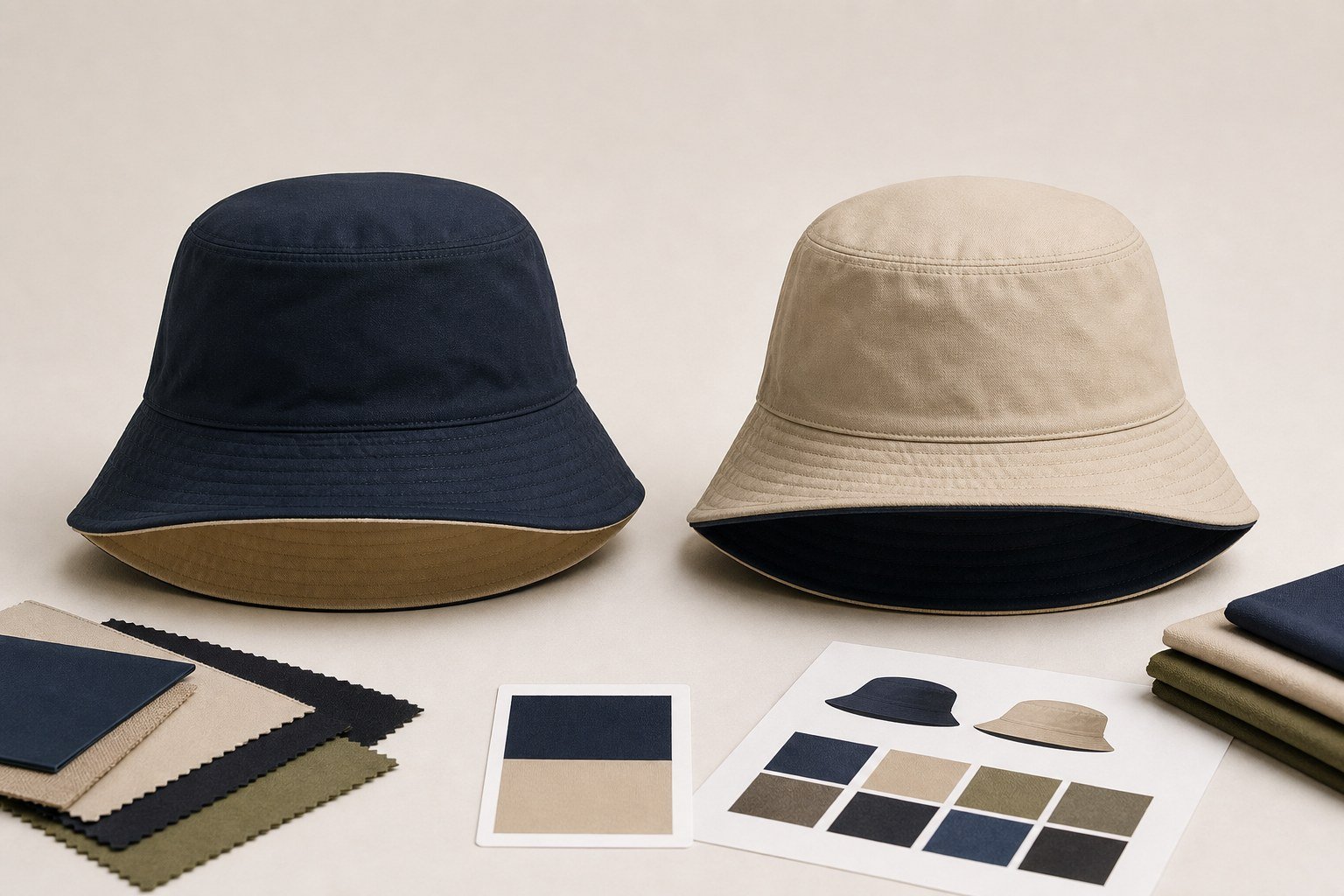
2. Color Matching. Compare the PPS against your approved Pantone or lab-dip reference under at least two lighting conditions: natural daylight and indoor retail lighting (3,000-3,500K). A color that matches perfectly under factory fluorescent lights can look completely different in a boutique window. If your brand has strict color consistency requirements, request a spectrophotometer reading — this provides a Delta E value (color difference), where Delta E < 1.0 is visually imperceptible, 1.0-2.0 is barely noticeable, and > 3.0 is obvious to most viewers.
3. Stitch Count Verification. Use a stitch counter or magnifying loupe to count stitches per inch at three points: the crown seam, the brim edge, and the sweatband attachment. Document the actual SPI and compare it against your spec sheet.
4. Brim Symmetry. Lay the hat flat on a table. Measure the brim width at four points (front, back, left, right). All four should be within 2 mm of each other. An asymmetric brim is the most visible quality defect — it’s the first thing a customer notices when they put the hat on.
5. Sweatband Tension Test. Grip the sweatband with both hands and pull firmly. It should stretch slightly but not tear, separate, or twist. If it fails this test on the PPS, it will fail on the bulk order.
6. Eyelet Integrity. Check that all eyelets are present, evenly spaced, firmly attached (for metal), and free of sharp burrs. Run your finger over each one — any sharp edge is a customer complaint waiting to happen.
7. Label Placement and Legibility. If you’re including a brand label, care label, or size tag, check that it’s sewn straight, at the specified position, and with the correct information. A misspelled care label on 500 pieces is surprisingly common — and surprisingly expensive to fix.
8. Fit Test. Have at least two people with different head sizes try on the PPS. What feels comfortable on a 55 cm head may be tight on a 58 cm head. Document their feedback.
9. Dye Fastness Rub Test. Rub a damp white cloth firmly against the hat’s surface for 10 seconds. If color transfers to the cloth, the dye is not properly fixed — and this hat will bleed color onto your customer’s clothes or skin, especially when wet. According to AATCC (American Association of Textile Chemists and Colorists) Test Method 8, a colorfastness rating of 4.0 or higher (on a 1-5 scale) is the minimum acceptable for apparel.
10. Overall Craftsmanship. Look for loose threads, skipped stitches, uneven seams, and fabric flaws. If you find more than 2-3 minor defects on a single PPS, the supplier’s quality control process is not reliable enough for bulk production. Request a second PPS or find a different supplier. Standards developed by organizations like ASTM International provide detailed testing protocols you can reference in your supplier agreements.

6. When to Customize vs When to Use Stock Bucket Hat Designs
One of the most strategic decisions in bucket hat wholesale buying is whether to customize or buy stock. The right answer depends on your timeline, budget, brand positioning, and sales channel.
Stock (Off-the-Shelf) Bucket Hats. Stock hats are pre-made designs that suppliers keep in inventory. They ship immediately (typically 3-7 days for in-stock items), require no mold or setup fees, and have the lowest per-unit cost because the factory produces them in continuous runs. Stock hats are the right choice when: (a) you’re testing a new product category and don’t want to commit to large MOQs; (b) your timeline is under 4 weeks; (c) your brand doesn’t require a unique silhouette or proprietary material; or (d) you’re doing a promotional run (corporate giveaways, event merch) where speed and cost trump exclusivity.
The compromise with stock hats is limited differentiation. If your competitor can buy the same hat from the same supplier catalog, the only thing separating your products is branding — and a woven label alone doesn’t justify a 3x price premium in the eyes of most retail buyers.
Custom Bucket Hats. Custom production means the hat is made to your specifications: your fabric choice, your brim width, your crown height, your color, your trims. This gives you complete control over the product and creates genuine differentiation. However, custom comes with trade-offs: (a) Longer lead times — 4-8 weeks for sampling plus 4-6 weeks for production, so plan for 8-14 weeks from concept to delivery; (b) Higher MOQs — usually 500-1,000 pieces minimum, because the factory needs to set up dedicated production; (c) Development costs — mold/pattern fees range from $150-$500 for simple modifications to $800-$2,000 for fully custom silhouettes; and (d) Sampling rounds — expect 2-3 rounds of samples before approval, each round taking 2-3 weeks.
The Hybrid Approach. Many successful wholesale buyers use a hybrid strategy: stock hats for their entry-level SKUs and initial market testing, then transition to custom for their best-selling styles once volume justifies the investment. A practical threshold: when a stock hat is selling 200+ units per month consistently, the economics of custom production (lower per-unit cost at scale) usually tip in your favor. This approach minimizes upfront risk while keeping the door open to brand-building down the line.
If you’re considering full customization, one of the most important factors is choosing a factory that can handle both the design iteration and quality consistency. Our bucket hats product page shows examples of how customization can elevate a standard bucket hat into a signature product that builds brand equity.
7. FAQ: Bucket Hat Wholesale Buying Questions Answered
Q: What is a realistic wholesale price for a good-quality cotton bucket hat?
For a 280 GSM pre-shrunk cotton twill bucket hat with interfaced brim and metal eyelets, expect to pay $2.20-$3.50 per unit at MOQ 500 from a mid-tier Chinese factory. At MOQ 1,000+, the price drops to $1.80-$2.80. Prices from Vietnamese or Bangladeshi factories are typically 5-10% lower for comparable quality, but lead times may be 1-2 weeks longer.
Q: How long does wholesale bucket hat production take?
For stock hats: 3-7 days for shipping from inventory, plus freight transit time (7-14 days by air, 25-40 days by sea). For custom production: 4-8 weeks for sampling and approval, plus 4-6 weeks for production, plus transit time. Total timeline for custom: 8-14 weeks by air, 12-18 weeks by sea. Always add 2 weeks of buffer for customs clearance and unexpected delays.
Q: Should I use sea freight or air freight for bucket hats?
Bucket hats are lightweight but bulky — a carton of 200 hats weighs roughly 18-22 kg and occupies about 0.08-0.10 cubic meters. For orders under 1,000 pieces, air freight is often more economical when you factor in the cost of capital tied up during sea transit. For 1,000+ pieces, sea freight (LCL or FCL) becomes more cost-effective. Approximate air freight cost: $2.50-4.00/kg from China to US West Coast; sea freight LCL: $80-150 per cubic meter.
Q: What certifications should I ask my bucket hat supplier for?
At minimum, request: (1) OEKO-TEX Standard 100 certification (verifies the fabric is free from harmful substances — increasingly required by EU and North American retailers); (2) BSCI or SEDEX audit report (social compliance / ethical manufacturing audit); (3) For children’s bucket hats: CPSIA compliance (lead content, phthalates, flammability). For cotton hats marketed as sustainable: GOTS (Global Organic Textile Standard) or OCS (Organic Content Standard) certification. For more on navigating quality standards when sourcing from overseas, see our supplier vetting guide.
Q: How do I handle defective units in a bulk order?
Standard industry practice is to negotiate an AQL (Acceptable Quality Level) in your purchase contract. AQL 2.5 is standard for apparel — this means in a batch of 500 hats, up to 14 defective units (2.8%) are considered acceptable, and the supplier is not obligated to replace them. AQL 1.5 (up to 10 defects per 500) is tighter and often used for premium products. Any defect rate above the agreed AQL should trigger either a discount (typically 5-10% of the order value) or a re-production of the defective quantity. Always specify AQL and remedy terms in writing before production begins — verbal agreements are unenforceable across borders.
Q: Can I order bucket hats with my own brand label?
Yes — this is one of the most common customization requests. Adding a custom woven label (damask weave, 2-3 cm wide) typically costs $0.08-0.15 per hat, plus a one-time mold/machine setup fee of $30-80. Custom printed labels are less expensive ($0.03-0.06 per hat) but look less premium. The label can be placed on the sweatband, the interior crown, or the exterior — exterior placement (e.g., a small woven flag label on the brim edge) is increasingly popular for streetwear brands. Specify the label placement, size, material, and attachment method (sewn vs. heat-transferred) in your tech pack.
Q: What payment terms are standard for wholesale bucket hat orders?
The most common arrangement is 30/70: 30% deposit to start production, 70% balance before shipment (T/T, or telegraphic transfer). For first-time buyers, some suppliers request 50/50. For established relationships with verified suppliers, 30/70 with the balance payable 30 days after shipment (net 30) is achievable. Avoid suppliers who demand 100% upfront payment — this shifts all risk to the buyer and removes the supplier’s incentive to deliver quality. Using a platform like Alibaba Trade Assurance adds a layer of buyer protection for first orders.
The bottom line for any wholesale bucket hat purchase is that the three pillars of a successful order — materials, construction, and supplier relationship — are interconnected. Cutting corners on any one of them compromises the other two. Whether you’re buying 200 hats for a pop-up shop or 5,000 for a nationwide retail rollout, the principles in this guide apply: specify clearly, inspect thoroughly, and build relationships with suppliers who treat quality control as a process, not an afterthought.
Ready to source your next batch of bucket hats? Our team at Hongyuecap specializes in custom and wholesale bucket hat production, from material selection through bulk delivery. Contact us today with your specifications — we’ll provide a detailed quote within 24 hours and can ship samples within 5-7 business days so you can inspect quality before committing to a full order. Whether you need 200 hats for a limited drop or 5,000 for a seasonal collection, we’ll help you get the product, the price, and the timeline right.
Related: Hat Seasonality Planning: When to Order Each Style — complete ordering calendar for wholesale buyers.
Related: Hat Material Comparison Guide: Cotton vs Polyester vs Nylon — complete fabric properties table for wholesale buyers.
Written by the Hongyuecap Product Team — 10+ years in B2B custom headwear manufacturing. Last updated: May 03, 2026.