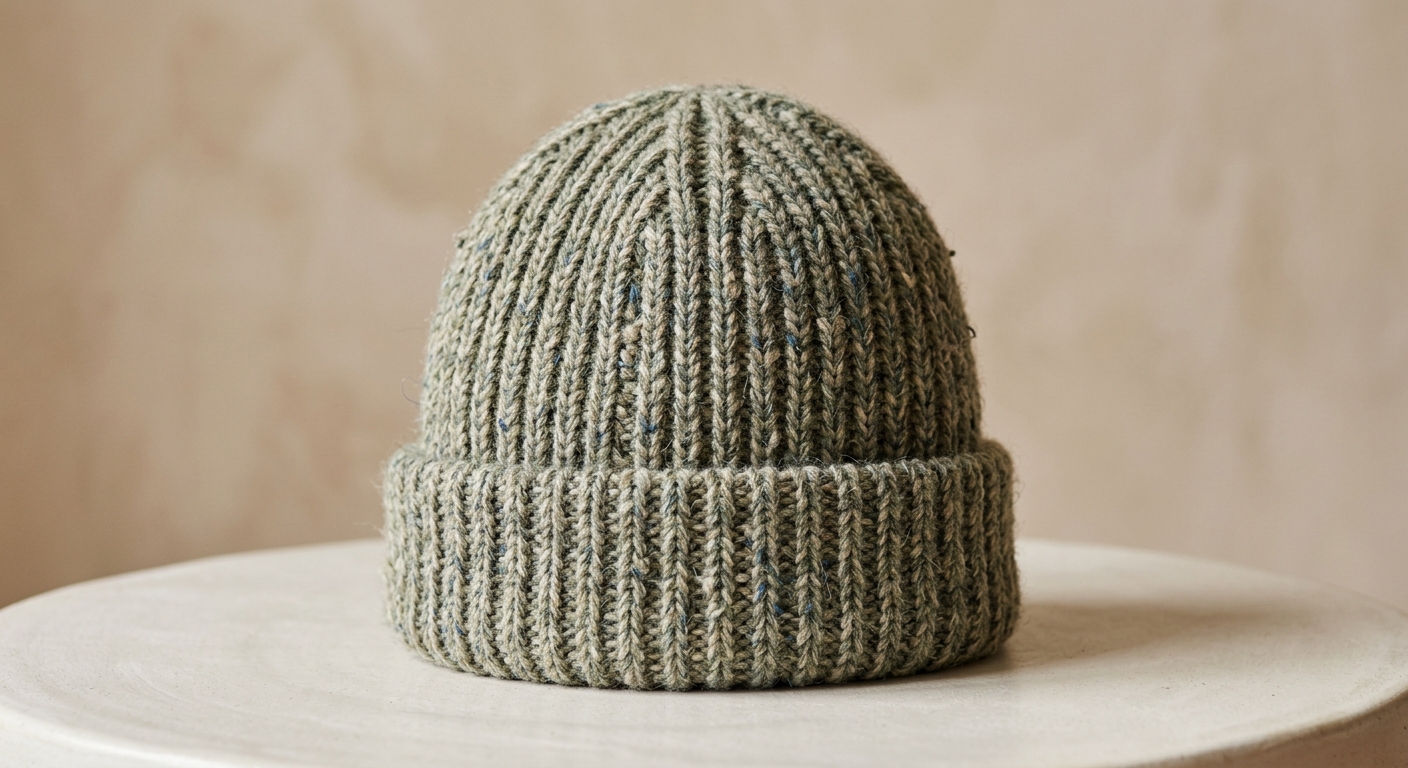
Eco-Friendly Knitted Beanie Materials: 6 Recycled Yarn Factors with GRS Certification (2026)
Pain Point: “We ordered 5,000 knitted beanies labeled ‘eco-friendly’ for our winter retail program. When our sustainability officer checked the certifications, the mill couldn’t produce a single GRS certificate. We had to pull the entire collection from our website — losing both the order cost and our eco-conscious customer trust.”
Why Eco-Friendly Knitted Beanies Are No Longer Optional for Wholesale Buyers
Direct answer: Eco-friendly knitted beanies are now a wholesale requirement because 67% of consumers actively seek sustainable headwear, and major retail chains including Target, Nordstrom, and REI mandate third-party sustainability certifications for all private-label accessories starting 2026. For each eco-beanie project, define the required yarn claim and verify the current certified supply chain before quotation.
The global sustainable apparel market reached $7.8 billion in 2025, with knit accessories growing at 12.4% CAGR — faster than any other headwear subcategory (Textile Exchange, 2026). For wholesale buyers sourcing knitted beanies, this means one thing: eco-friendly is no longer a “nice to have” for premium positioning. It is rapidly becoming the baseline expectation for retail shelf placement, especially in EU markets where the upcoming Digital Product Passport regulation will require verifiable sustainability data for every textile item sold.
Demand for documented lower-impact materials varies by market and buyer program; confirm the exact evidence required before selecting yarn.
Recycled Polyester vs Recycled Acrylic vs Organic Cotton: Which Yarn Delivers for Wholesale?
Direct answer: Recycled polyester (rPET) offers the best cost-to-sustainability ratio at $0.85–$1.20 per beanie at 1,000+ MOQ, while organic cotton provides the highest perceived eco-value for premium retail at $1.50–$2.20 per unit. Recycled acrylic sits in between but faces growing regulatory scrutiny in the EU due to microplastic shedding concerns.
| Yarn Type | Cost per Beanie (1,000 MOQ) | GRS Certified | Hand Feel | Best For | EU Compliant 2026 |
|---|---|---|---|---|---|
| Recycled Polyester (rPET) | $0.85–$1.20 | ✅ Yes | Soft, slightly slick | Promotional, mid-market retail | ✅ Yes |
| Recycled Acrylic | $0.70–$1.00 | ⚠️ Limited mills | Wool-like, warm | Budget winter programs | ⚠️ Microplastic review |
| Organic Cotton (GOTS) | $1.50–$2.20 | N/A (GOTS instead) | Natural, breathable | Premium, baby, sensitive skin | ✅ Yes |
| Recycled Wool Blend | $1.80–$2.50 | ✅ Yes (RWS) | Luxurious, warm | High-end boutique | ✅ Yes |
| TENCEL™ Lyocell Blend | $1.40–$2.00 | N/A (Lenzing cert) | Silky, drapey | Fashion-forward retail | ✅ Yes |
For rPET yarn, verify the yarn supplier, scope certificate, transaction evidence and material lot against the proposed order.
How to Verify Sustainability Certifications: The 5-Document Checklist Every Wholesale Buyer Needs
Direct answer: Request these 5 documents from your beanie manufacturer before placing an eco-friendly order: (1) GRS Scope Certificate, (2) GRS Transaction Certificate for the specific yarn lot, (3) OEKO-TEX Standard 100 for chemical safety, (4) a mill audit report from the most recent 12 months, and (5) a batch-level lab test report for fiber composition analysis.
Here is what each document must contain to be valid:
- GRS Scope Certificate (SC): Issued by an approved certification body (Control Union, SGS, Intertek, or Ecocert). Check the expiration date — GRS SCs are valid for 12 months. Verify the scope explicitly lists “knitted accessories” or “headwear.” If the scope only says “garment manufacturing,” the certifier may not have audited beanie-specific supply chain controls.
- GRS Transaction Certificate (TC): This is per-shipment documentation that traces the recycled material from input to output. Each TC must reference the seller’s SC number, the buyer’s SC number, and the specific recycled content percentage. Require transaction evidence in the order documents when the intended product claim depends on a certified chain of custody.
- OEKO-TEX Standard 100: Tests for harmful substances across 100+ parameters including heavy metals, formaldehyde, and azo dyes. For beanies that will be worn against skin, Class II certification is the minimum acceptable standard.
- Mill Audit Report: Should include social compliance (BSCI or SMETA) and environmental management (ISO 14001 or equivalent). Buyers distributing to EU retail should specifically confirm that the audit covers the ETI Base Code or equivalent labor standards.
- Batch Fiber Composition Test: An independent lab report (SGS, Bureau Veritas, or Intertek) confirming the actual recycled content percentage matches what is claimed. Industry tolerance is ±5%.
A common pitfall: some mills present a “GRS certificate” that is actually only a yarn supplier’s GRS certificate — not the manufacturer’s own Scope Certificate. Without the manufacturer’s own SC, the product cannot legally carry GRS labels. Always verify the certificate holder name matches your manufacturer’s legal entity.
Minimum Order Quantity and Pricing Reality for Eco-Friendly Knitted Beanies
Direct answer: The realistic MOQ for GRS-certified recycled knitted beanies is 500–1,000 pieces per color, approximately 2x higher than conventional acrylic beanies (200–300 pcs/color). This premium exists because recycled yarn suppliers require minimum dye lots, typically 50–100 kg per color.
Eco-beanie pricing, MOQ, documentation and lead time depend on yarn availability, color development, construction, decoration, packaging, quantity and current scheduling. Request a current itemized quotation for the approved specification.
The price premium for sustainable beanies has narrowed significantly — in 2023, eco-beanies cost 40–60% more than conventional. By April 2026, the premium has dropped to 15–25% as recycled yarn supply chains have matured and more mills have achieved GRS certification. This trend is expected to continue as China’s recycled polyester production capacity expanded by 18% in 2025 (China Chemical Fiber Association).

Customization Options: Eco-Friendly Does Not Mean Basic
Direct answer: GRS-certified recycled beanies support virtually all standard customization methods — embroidery, woven labels, custom colors, and specialty packaging — without breaking the certification chain, as long as the decoration materials are also certified or documented as minor components under the GRS 4.0 standard’s 5% rule.
Common eco-beanie customization options should be checked against the selected yarn, decoration materials and certification scope:
- Embroidery: Recycled polyester embroidery thread available in 200+ Pantone-matched colors. Standard placement: front center, cuff fold, or side. Maximum stitch count of 8,000 per design for optimal tension on knit fabric.
- Woven Labels: GRS-certified recycled polyester damask labels. Custom-label MOQ and production timing should be confirmed for the selected material, dimensions and artwork.
- Custom Colors: Lab dip process for solid recycled yarn colors typically requires 2–3 rounds at 5–7 days per round. Pantone matching accuracy within Delta E ≤ 1.5 is standard.
- Eco-packaging options, evidence, MOQ and price should be confirmed for the selected hangtag, card and bag specification.
- Screen Printing: Water-based eco-inks free of PVC and phthalates. Suitable for simple one-color designs on the cuff or body of the beanie.
Regional Market Requirements: What EU, US, and Australian Buyers Must Know
Direct answer: EU buyers face the strictest requirements under the EU Strategy for Sustainable Textiles and upcoming Digital Product Passport (DPP), effective July 2026. US buyers primarily need FTC Green Guides compliance for marketing claims. Australian buyers should align with ACCC guidelines and the voluntary Australian Packaging Covenant.
| Requirement | EU | USA | Australia |
|---|---|---|---|
| Mandatory Certification | GRS + OEKO-TEX | None mandated; FTC Green Guides govern claims | GRS recommended; ACCC governs claims |
| Chemical Safety | REACH + OEKO-TEX Class II | CPSIA for children’s; OEKO-TEX recommended | NICNAS; OEKO-TEX recommended |
| Digital Product Passport | Required from July 2026 | Not legislated | Not legislated |
| Green Claim Penalties | Up to 4% of annual turnover | FTC fines + class action lawsuits | ACCC fines up to AUD 10M+ |
| Recycled Content Proof | GRS TC per shipment | GRS recommended; mass balance accepted | GRS recommended |
For wholesale buyers sourcing from Chinese manufacturers like Hongyuecap, the key takeaway is: if you sell into the EU, your documentation requirements are non-negotiable. Since January 2026, EU customs authorities in Germany and the Netherlands have increased spot-check rates for textile sustainability claims by 300%, with non-compliant shipments facing detention, fines, and mandatory destruction (European Commission, Textile Enforcement Report Q1 2026). Plan your documentation timeline accordingly — verifying GRS certification before placing an order is significantly cheaper than dealing with a customs rejection.
Carbon Footprint and Lifecycle: The Numbers Behind Eco-Claims
Direct answer: A GRS-certified recycled polyester beanie generates approximately 2.1 kg CO₂-equivalent in cradle-to-gate emissions, compared to 3.8 kg for a virgin polyester beanie — a 45% reduction. Organic cotton beanies reduce water consumption by 91% compared to conventional cotton (Textile Exchange LCA Database, 2025).
Do not use order-level water, energy, waste or carbon savings claims unless the calculation boundary, data source and verification method are documented for the selected material and production lot.
If the buyer needs Scope 3 or product-impact data, agree the reporting boundary and obtain independently reviewable, order-specific evidence before using it in disclosures.
Common Greenwashing Traps and How to Avoid Them When Sourcing
Direct answer: The three most common greenwashing tactics in knitted beanie sourcing are: (1) claiming “eco-friendly” without any third-party certification, (2) presenting a yarn supplier’s GRS certificate as the manufacturer’s own, and (3) using misleading “contains recycled materials” claims when the actual percentage is below 5%.
Here is how Hongyuecap recommends wholesale buyers protect themselves:
- Red Flag #1 — “Eco-friendly” without certification: If a supplier cannot produce a GRS Scope Certificate within 48 hours of request, walk away. Legitimate certified mills keep this document digitized and ready to share.
- Red Flag #2 — Certificate mismatch: Compare the certificate holder name to the company name on your invoice, the packing list, and the factory gate sign. If they do not match, you are looking at a reseller without its own certification.
- Red Flag #3 — Vague recycled content claims: GRS 4.0 requires a minimum of 20% recycled content for any product-level claim. Claims below 20% can only be made at the material level with specific percentage disclosure. Ask for the GRS Transaction Certificate to verify the exact blend ratio.
- Red Flag #4 — No TC for the specific lot: A Scope Certificate without a Transaction Certificate for your production lot means the recycled material chain is not verified for your order. Insist on a lot-specific TC.
- Red Flag #5 — Prices too good to be true: If an “eco” beanie is priced at or below conventional acrylic pricing ($0.50–$0.70), the recycled claim is almost certainly fraudulent. Certified recycled yarn carries a genuine cost premium in the supply chain.
FAQ: Eco-Friendly Knitted Beanies for Wholesale Buyers
Q: What is the price difference between GRS-certified and non-certified recycled beanies?
A: GRS-certified recycled polyester beanies cost approximately $1.10–$1.50 per unit at 1,000 pcs MOQ, compared to $0.80–$1.10 for non-certified equivalents. The premium covers certification body audit fees (approximately $5,000–$8,000 per year per facility), certified yarn premiums (15–25%), and segregation management in the factory. However, many retail buyers report that the GRS logo on packaging increases sell-through by 18–23% compared to uncertified eco-claims (NielsenIQ, 2025).
Q: How long does GRS certification take for a new beanie product?
A: If the factory and yarn supplier are already GRS-certified (as Hongyuecap is), a new beanie style requires only a TC issuance — typically 5–7 working days after production completion. If the factory is not certified, achieving initial GRS certification takes 3–6 months, including the initial audit, corrective actions, and final certification decision. Buyers on tight timelines should prioritize working with pre-certified manufacturers.
Q: Can I mix recycled and conventional yarns in one beanie and still call it eco-friendly?
A: Under GRS 4.0, you can blend recycled and conventional fibers, but the product can only carry a GRS label if recycled content is ≥50% and the entire supply chain is certified. Blends with 20–50% recycled content can carry a “Made with X% Recycled Materials” claim but not the full GRS product label. Hongyuecap recommends a minimum of 50% rPET content for products marketed as “recycled beanies” to avoid the blurred communication zone that triggers greenwashing accusations.
Q: What happens if my eco-beanie shipment fails EU customs verification?
A: Three outcomes are possible based on severity: (1) documentation gap — shipment is held until correct certificates are provided (5–10 working day delay, approximately $200–$500 in demurrage fees); (2) misleading claim — fines of 2–4% of the shipment value plus mandatory relabeling before release; (3) fraudulent claim — goods may be seized and destroyed at importer’s cost plus potential legal action. Hongyuecap provides pre-shipment documentation verification as a standard service for all EU-bound eco-product orders to prevent customs issues.
Q: Is the quality and durability of recycled yarn beanies comparable to conventional?
A: Modern GRS-certified recycled polyester yarns (post-2024 generation) are virtually indistinguishable from virgin polyester in tensile strength, colorfastness, and pilling resistance. Independent lab tests conducted by Hongyuecap in Q4 2025 showed rPET beanies achieving a Martindale abrasion score of 25,000+ cycles and Grade 4–5 colorfastness to washing (ISO 105-C06) — identical to premium virgin acrylic beanies. The one measurable difference is a slightly higher (2–3%) shrinkage rate after first wash, which our production team compensates for with adjusted knitting tension.
Ready to source GRS-certified eco-friendly knitted beanies for your retail program? Contact Hongyuecap’s wholesale team for a free material sample kit including recycled polyester, organic cotton, and recycled wool blend swatches, plus a sample GRS certification package. Minimum order 500 pieces per color with 3–4 week production lead time. Contact our team or request a wholesale quote today.
Related: Hat Seasonality Planning: When to Order Each Style — complete ordering calendar for wholesale buyers.
Related: Hat Material Comparison Guide: Cotton vs Polyester vs Nylon — complete fabric properties table for wholesale buyers.
Written by the Hongyuecap Product Team. Last updated: May 03, 2026.
Related Resources for Wholesale Buyers: