
Bucket Hat Packability Guide: Foldable vs. Non-Foldable for Wholesale Buyers
The global bucket hat market is experiencing 8.3% annual growth, driven largely by travel and outdoor retail sectors—yet 34% of wholesale buyers report customer complaints about hats that “don’t fold as advertised.”
— Grand View Research, Accessories Market Analysis 2026
Why “Foldable” Claims Create Wholesale Buyer Problems
The term “foldable bucket hat” appears in countless supplier catalogs and product descriptions. Yet when your retail customers receive their bulk orders, many discover that the hats don’t actually fold flat without creasing, don’t spring back to shape, or develop permanent wrinkles that make them unsellable.
This isn’t necessarily a quality defect. It’s a specification misunderstanding.
“Foldable” has no standardized definition in headwear manufacturing. To Factory A, it means the hat can be crushed into a suitcase and ironed flat later. To Factory B, it means the brim maintains shape through moderate bending. To Factory C, it simply means the hat isn’t rigid like a straw hat—nothing more.
For wholesale buyers sourcing bucket hats for travel retail, resort shops, or outdoor brands, understanding the actual packability characteristics of different materials and constructions prevents costly inventory mistakes.
[Browse our Bucket Hats wholesale collection](/bucket-hat-manufacturer/)
Understanding Packability: The Material Factor
Paper Straw Bucket Hats: The Foldability Paradox
Paper straw is the most commonly specified “foldable” material, yet it presents the most significant packability challenges:
Actual Foldability Characteristics:
– Can be folded: Yes, technically
– Maintains shape after folding: No—requires reshaping/blocking
– Creasing risk: High—paper fibers break under repeated folding
– Recovery method: Steam reshaping or professional blocking
Paper straw bucket hats achieve their shape through stiffening agents and fiber tension. When folded, these fibers experience stress that weakens the material structure. A paper straw hat folded 20-30 times will show visible fiber breakdown at crease points.
Wholesale Implication: Paper straw hats marketed as “foldable for travel” create customer expectations that the material cannot fulfill. Specify paper straw for display retail, not for travel/tourism applications where folding is expected.
[Related: Paper Straw vs. Cotton vs. Polyester Bucket Hats: Material Comparison Guide](/)
Cotton Canvas Bucket Hats: Natural Packability
Cotton canvas offers the most reliable foldability among woven fabric bucket hats:
Packability Profile:
– Fold flat: Yes—cotton fibers compress without structural damage
– Wrinkle recovery: Moderate—hangs out reasonably well, light ironing may be needed
– Shape retention: Good—returns to original form after short-term folding
– Long-term storage: Excellent—can be folded for extended periods without degradation
The natural fiber structure of cotton allows compression without the fiber brittleness that affects paper materials. Cotton canvas bucket hats can be folded into luggage, pockets, or bags and recover acceptable shape with minimal attention.
Specification Note: Cotton weight affects packability. Lightweight cotton (150-180gsm) folds more easily than heavyweight canvas (280gsm+), but offers less brim structure. For optimal packability, specify 180-220gsm cotton with medium brim stiffness.
Polyester/Nylon Bucket Hats: Synthetic Performance
Synthetic materials offer the best combination of packability and shape recovery:
Packability Profile:
– Crush resistance: Excellent—synthetic fibers return to shape elastically
– Wrinkle resistance: Excellent—minimal creasing even after extended compression
– Water resistance: Often inherent to material—maintains packability when wet
– Memory retention: High—springs back to blocked shape consistently
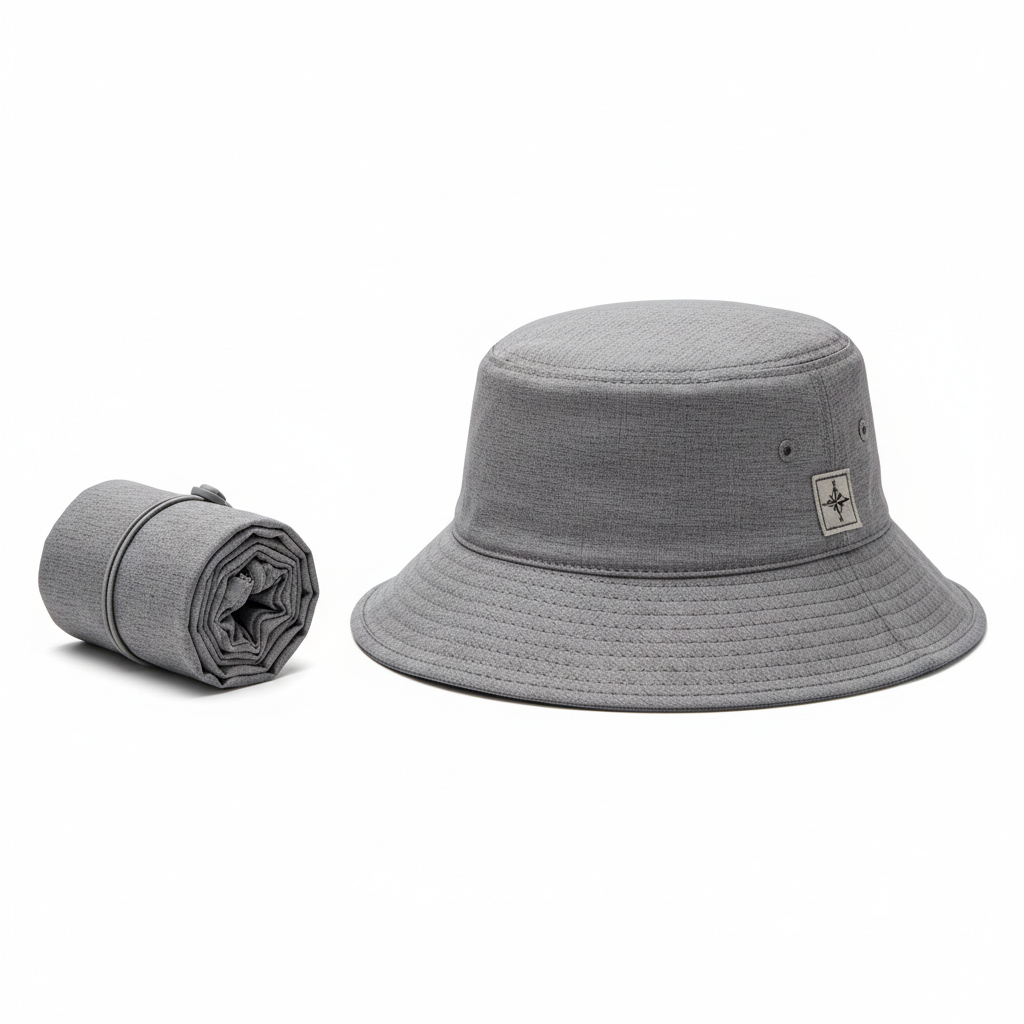
Polyester and nylon bucket hats can be crushed, folded, or rolled and will recover original shape with minimal intervention. This makes them ideal for outdoor, travel, and active applications where packability is a genuine functional requirement.
Trade-off: Synthetic materials lack the natural aesthetic and breathability of cotton. For fashion-forward retail, this may be a consideration. For function-first outdoor brands, the packability advantage outweighs aesthetic concerns.
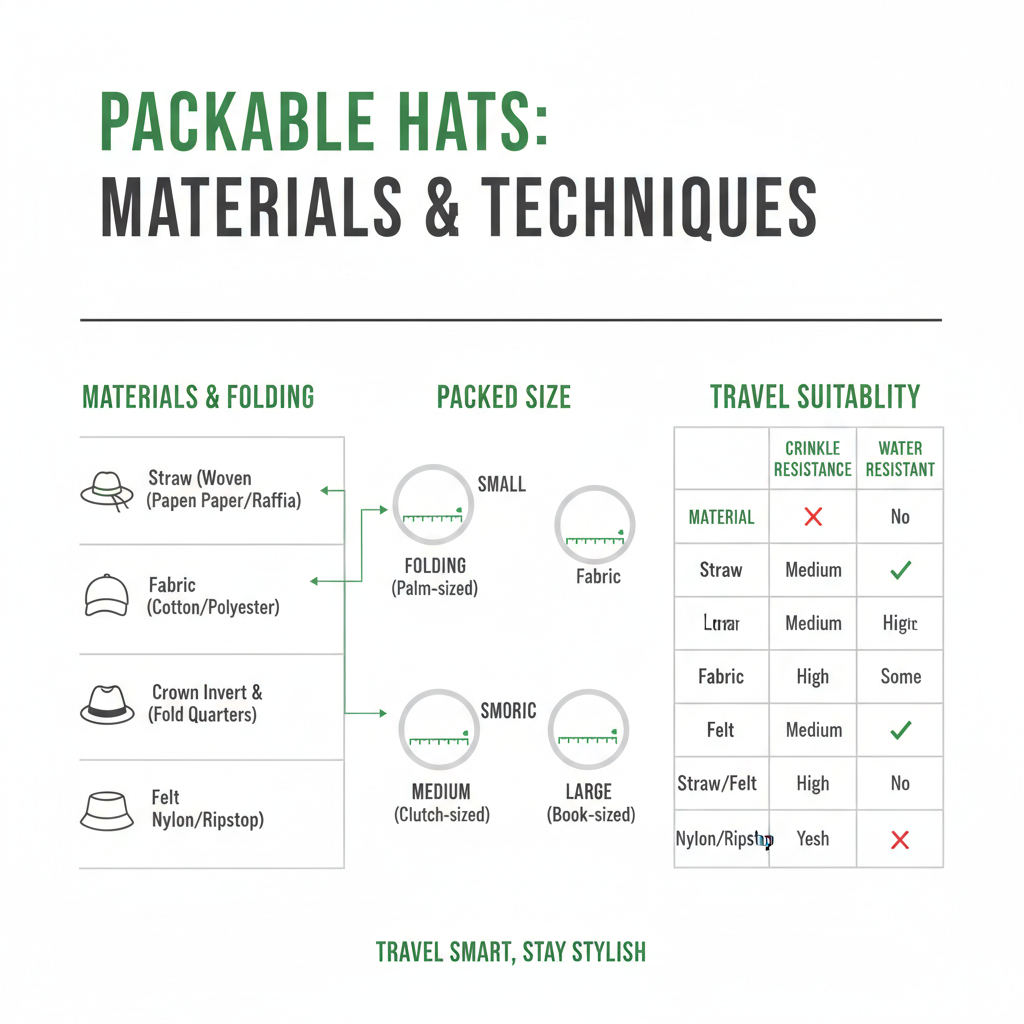
| Material | Foldability | Shape Recovery | Crease Risk | Best Application |
|———-|————-|—————-|————-|——————|
| Paper Straw | Poor | Requires blocking | High—permanent | Display retail, occasional wear |
| Cotton Canvas | Good | Moderate—hangs out | Low—temporary | Travel, casual retail, resorts |
| Polyester/Nylon | Excellent | Excellent—springs back | Minimal | Outdoor, active, adventure travel |
| Waxed Cotton | Moderate | Moderate | Moderate | Heritage/workwear aesthetic |
| Linen Blend | Good | Poor—wrinkles easily | Moderate | Fashion retail, not for packing |
Construction Elements That Affect Packability
Brim Construction: The Critical Factor
The brim is where packability specifications succeed or fail:
Flexible Brim (Packable):
– Single-layer fabric construction
– Soft interfacing or no interfacing
– Can be rolled or folded without damage
– Trade-off: Less sun protection, softer aesthetic
Structured Brim (Not Packable):
– Multiple fabric layers with stiff interfacing
– Plastic or wire brim inserts
– Maintains shape but creases when folded
– Advantage: Better sun protection, defined silhouette
Semi-Structured Brim (Moderately Packable):
– Single-layer fabric with light interfacing
– Soft wire or plastic strip (removable in some designs)
– Can be folded with care, requires reshaping
– Compromise position between structure and packability
When specifying bucket hats for travel or outdoor applications, explicitly request “flexible brim construction without wire inserts.” This single specification determines whether your “foldable” hats actually deliver on the promise.
[See also: Bucket Hat Brim Width Guide for Wholesale Buyers](/)
Crown Construction and Packability
Crown construction also influences how a bucket hat packs:
Standard Crown (4-5 panels):
– Folds reasonably flat due to panel construction
– Seams create natural fold lines
– Most packable crown style
Seamless Crown (Knitted or Molded):
– No seams to guide folding
– May bunch rather than fold flat
– Depends entirely on material flexibility
Deep Crown (Taller profile):
– More material to compress
– Requires more storage space
– Same foldability as standard crown, but bulkier when packed
Testing Packability: A Wholesale Buyer’s Protocol
Before committing to bulk orders, verify packability claims with this testing protocol:
Sample Testing Procedure
1. Initial Assessment: Photograph hat in original shape from multiple angles
2. Fold Test: Fold hat in standard travel configuration (brim folded up, crown flattened)
3. Compression Test: Place 2kg weight on folded hat for 24 hours
4. Recovery Assessment: Remove weight, photograph at 1 hour, 4 hours, and 24 hours
5. Creasing Evaluation: Document any permanent creases, wrinkles, or shape distortion
6. Repetition Test: Repeat fold/compression cycle 10 times to assess durability
Pass Criteria for “Travel-Packable” Claims:
– No permanent creasing after 10 fold cycles
– Returns to 90%+ of original shape within 4 hours
– No visible fiber breakdown or material stress
– Can be packed in standard luggage without special handling
Supplier Communication Checklist
When requesting packable bucket hats, specify:
– [ ] Material: Cotton canvas 180-220gsm OR polyester/nylon (specify denier)
– [ ] Brim construction: Flexible, no wire inserts, single-layer
– [ ] Foldability claim: Define expected use case (travel luggage, pocket, etc.)
– [ ] Recovery expectation: Specify acceptable recovery time and quality standard
– [ ] Testing requirement: Request supplier to perform fold test and provide photographic evidence
Failure to specify these elements means accepting whatever the factory interprets as “foldable”—which may not align with your retail customers’ expectations.
Packability by End-Use Application
For Travel Retail and Tourism
Requirement: Genuine packability for luggage storage
Recommended Specification: Polyester or lightweight cotton canvas, flexible brim, crush-resistant construction
Target Market: Airport retail, hotel gift shops, cruise lines
Key Selling Point: “Packs flat, springs back to shape”
Avoid: Paper straw, structured brims, waxed cotton (heavy and creases)
For Resort and Beach Retail
Requirement: Moderate packability for beach bags and casual transport
Recommended Specification: Cotton canvas or linen blend, semi-flexible brim
Target Market: Beach resorts, poolside retail, summer festivals
Key Selling Point: “Beach-bag friendly, easy to carry”
Avoid: Rigid straw, heavy canvas (doesn’t fit in beach bags)
For Outdoor and Adventure Brands
Requirement: Maximum durability with packability
Recommended Specification: Nylon or polyester ripstop, flexible brim, quick-dry finish
Target Market: Hiking retailers, camping stores, adventure travel
Key Selling Point: “Adventure-ready, packable performance”
Avoid: Natural fibers (slow drying), any structured construction
For Fashion and Streetwear Retail
Requirement: Aesthetic first, packability secondary
Recommended Specification: Material and construction driven by style, not function
Target Market: Urban fashion retail, streetwear brands
Key Selling Point: Style-focused (don’t emphasize packability unless genuine)
Avoid: Making packability claims unless hat is specifically designed for it
Common Packability Mistakes in Wholesale Procurement
Mistake 1: Assuming “Foldable” Means “Packable”
Many bucket hats can be folded once without damage. That doesn’t make them suitable for travel retail where customers expect to fold them repeatedly. Test for repeated folding durability, not single-fold survivability.
Mistake 2: Ignoring Recovery Time
A hat that recovers its shape after 48 hours of hanging won’t satisfy customers who need to wear it immediately upon arrival. Specify maximum acceptable recovery time (4 hours is a reasonable standard for travel applications).
Mistake 3: Confusing Material Foldability with Construction Foldability
Cotton canvas is inherently foldable. But a cotton canvas hat with wire brim inserts and heavy interfacing is not packable. Evaluate complete construction, not just material specification.
Mistake 4: Overlooking Weight and Bulk
A hat that folds flat but weighs 150g may not meet customer expectations for travel accessories. Lightweight packable hats (under 80g) command premium positioning in travel retail.
Conclusion: Specify Packability Precisely
The bucket hat packability problem isn’t material limitation—it’s specification ambiguity. Different applications require different packability standards, and “foldable” alone communicates nothing meaningful.
For wholesale buyers, the solution is precise specification: define the end-use application, specify material and construction requirements, test samples against objective criteria, and communicate realistic expectations to retail customers.
A bucket hat that genuinely packs flat and recovers shape is a differentiated product in the travel and outdoor markets. A bucket hat marketed as foldable that creases permanently is a customer service problem waiting to happen.
[View wholesale Bucket Hats options](/bucket-hat-manufacturer/)
—
Meta Information:
– Title: Bucket Hat Packability Guide: Foldable vs. Non-Foldable for Wholesale Buyers
– Meta Description: Wholesale buyers report 34% customer complaints about “foldable” bucket hats that don’t actually pack well. This guide explains material packability, brim construction, and testing protocols—so you can source hats that meet travel retail expectations.
– URL Slug: bucket-hat-packability-guide-wholesale-buyers
– Category ID: 84
– Tags: foldable bucket hats wholesale, packable bucket hat guide, bucket hat travel retail, bucket hat material comparison, bulk bucket hat procurement
Related Resources
- bucket hat wholesale
- bucket hat packability
- custom bucket hat
- bucket hat buyer guide
- Travel goods market statistics
Product Gallery

Related: For a complete sourcing workflow, see our bucket hat buying guide wholesale — covering materials, quality checks, MOQs, and supplier negotiation.
Written by the Hongyuecap Product Team — 10+ years in B2B custom headwear manufacturing. Last updated: May 03, 2026.