
Beanie Yarn Weight GSM Guide for Wholesale Buyers Worldwide
Approximately 63% of the U.S. apparel market now specifies yarn weight by GSM rather than by ply count. In headwear, this shift is slower but accelerating. Wholesale buyers who still rely on ply count alone are paying for weight they do not need.
— Textile World, 2025 Fiber Sourcing Report
Why GSM Is the First Specification Every Wholesale Beanie Buyer Must Get Right
Yarn weight is not a vague quality indicator. It is a measurable, contractually enforceable specification that directly determines cost per unit, perceived quality, and performance across temperature ranges. A buyer who specifies “medium weight” without a GSM target is buying ambiguity — and ambiguity costs money.
In the wholesale headwear market, yarn weight affects the final retail price point more than any other single material specification. Move from 200 GSM to 280 GSM and you have added approximately 40% more yarn weight. At an acrylic price of USD 4.50 per kilogram, that 80 GSM increase translates to a unit cost difference of USD 0.36 at standard beanie dimensions — before labour, finishing, or packaging.
The buyer who understands yarn weight can negotiate with precision. The buyer who does not will accept whatever the supplier offers at whatever the supplier decides to charge.
For more on cost specification, read How to Read Cost Implications in Wholesale Headwear in the specification section below.
GSM and Stitch Count: The Two Numbers That Define Every Beanie Specification
What GSM Actually Measures
GSM — grams per square metre — is the weight of one square metre of knitted fabric, measured under standardised conditions (ISO 3801) after the fabric has been washed and conditioned. In a wholesale beanie context, GSM describes the fabric weight before the panels are cut and sewn.
For knitted beanies, GSM ranges from approximately 180 GSM (lightweight, liner-style) to 340 GSM (heavyweight, outdoor workwear). Most retail beanies fall between 220 and 280 GSM.
According to Grand View Research, the global knit apparel market exceeded USD 380 billion in 2024, with GSM standardisation being cited as a primary driver of quality consistency in manufacturing contracts.
| Beanie Type | Typical GSM | Primary Fibre | End Customer |
|---|---|---|---|
| Lightweight liner | 180–200 GSM | Polyester/Acrylic blend | Outdoor sports, layering |
| Standard retail | 220–260 GSM | Acrylic or wool-acrylic blend | General consumer, casual |
| Heavyweight outdoor | 280–340 GSM | Wool or wool-acrylic blend | Workwear, cold climate |
| Premium fashion | 240–300 GSM | Merino wool or cashmere blend | Premium retail, gifting |
Stitch Count: The Structural Complement to GSM
Stitch count describes how many stitches exist per centimetre in both the knit and purl directions of the fabric. Combined with yarn diameter, stitch count determines fabric density.
A standard 12-gauge beanie produces approximately 8–10 stitches per centimetre horizontally and 14–18 rows per centimetre vertically. A 7-gauge beanie produces approximately 5–7 stitches per centimetre — a visibly chunkier, more textured fabric.
For wholesale buyers specifying production:
- Request the knitted swatch before bulk production
- Measure stitch count under standardised lighting with a stitch counter
- Confirm stitch count in the purchase contract with a tolerance of ±1 stitch per centimetre
Yarn Weight and Cost: The Financial Impact
Yarn accounts for 55–70% of the total manufacturing cost of a knitted beanie. At a standard 250 GSM, 90% acrylic/10% elastane, in solid colour with no decoration:
- Yarn cost: approximately USD 1.80–2.20 per unit
- Knitting and linking labour: USD 0.40–0.60 per unit
- Finishing (washing, blocking, inspection): USD 0.15–0.25 per unit
- Packaging: USD 0.10–0.20 per unit
- Total direct cost: approximately USD 2.45–3.25 per unit
Increase GSM to 300 GSM (+20%): yarn cost increases by approximately USD 0.36–0.44 per unit, labour by approximately USD 0.08–0.12 per unit. At a USD 8–10 wholesale price point, that GSM difference represents the entire gross margin on the heavier beanie.
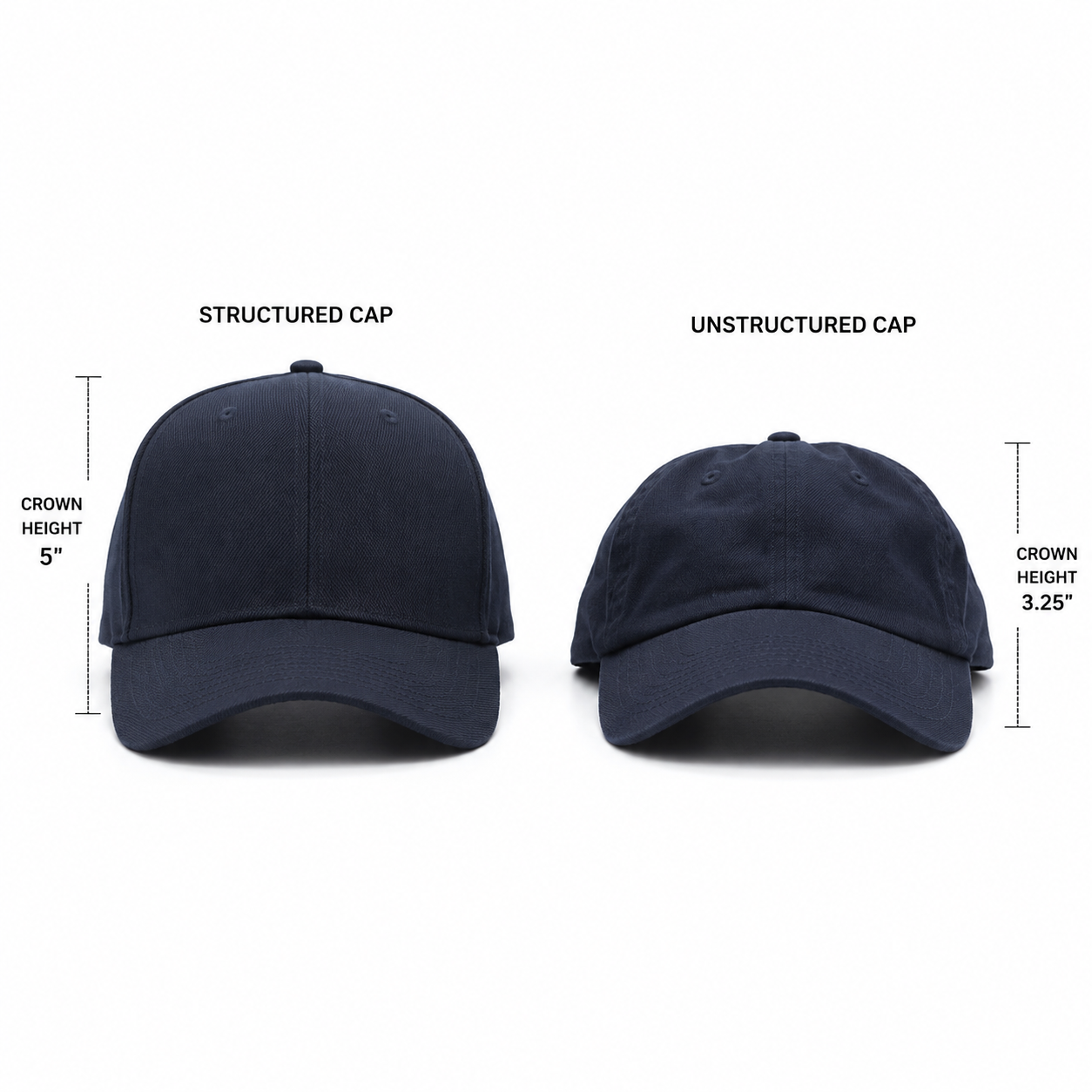
For a comparison with baseball cap specifications, see Baseball Cap Crown Shape Guide.
Acrylic vs. Wool vs. Blends: Reading the Fibre Label Correctly
Acrylic: The Dominant Wholesale Fibre
Acrylic accounts for approximately 68% of all manufactured beanie yarn globally, according to Grand View Research. In wholesale headwear, its dominance is even more pronounced: it offers consistent colour dyeing, machine washability, and a cost structure that wool cannot match.
When specifying acrylic for wholesale:
- Request the ASG (acrylic/specialty gauge) classification
- Standard acrylic has a denier per filament (DPF) of 2.5–3.0 dpf for standard yarn
- Micro-acrylic (DPF below 1.5) produces softer hand feel but at approximately 15–20% higher cost
- Confirm whether the acrylic is standard or modacrylic if flame resistance is required
Wool and Wool Blends: Where Quality Premiums Actually Live
Wool beanies wholesale at a minimum of 2.5–3× the unit cost of equivalent acrylic beanies. The premium is real and justified for outdoor workwear in sub-zero conditions, premium retail positioning, and corporate gifting.
The key specification for wool in beanie production is micron count. Lower micron count means softer hand feel.
| Wool Grade | Micron Count | Typical End Use | Cost Indicator |
|---|---|---|---|
| coarse wool | >30 microns | Workwear, industrial | Lowest wool cost |
| medium wool | 25–30 microns | Standard outdoor | Moderate |
| fine wool | 20–25 microns | Premium retail | High |
| merino | 17–20 microns | Luxury, performance | Highest |
A “100% wool” beanie using 30-micron wool will feel scratchy to most consumers. A “50% wool 50% acrylic” blend using 21-micron merino will feel significantly softer and command a higher retail price.
For further reading on fibre comparison, see Acrylic vs Wool Beanie: A Wholesale Buyer’s Guide.
Choosing by End Customer Archetype
By Retail Channel
For retail consumers: specify 240–280 GSM acrylic or wool-acrylic blend. Crown shape and colour consistency matter most. Embroidery decoration is the preferred decoration method.
For corporate and promotional buyers: specify 220–260 GSM acrylic with a minimum 2×2 rib cuff. Cost per unit and decoration capability are the priority. Screen print or embroidery both viable.
For active outdoor and workwear buyers: specify 280–340 GSM wool or wool-acrylic blend with a deep cuff. Performance fabric with moisture-wicking properties is preferred. Durability is the primary selection criterion.
By Climate and Season
- Warm climate retail: 200–220 GSM lightweight acrylic or bamboo-acrylic blend. Breathability and colour range are the priorities.
- Temperate climate year-round: 240–260 GSM standard acrylic or cotton-acrylic blend. Versatility and washability.
- Cold climate and outdoor workwear: 300–340 GSM wool or wool-acrylic blend with wind-resistant lining option.
Browse our Knitted Beanies wholesale collection
Choosing the Right GSM by End Use and Climate
Understanding the actual performance requirements of your end customer is the most reliable method for selecting the correct GSM. A wholesale buyer who specifies by end use — rather than by generic quality perception — consistently achieves better margin outcomes.
By Climate Zone
For tropical and equatorial markets (Southeast Asia, Sub-Saharan Africa, Central America): specify 180–220 GSM lightweight acrylic or bamboo-acrylic blend. The priority is breathability and moisture management in high-humidity conditions. Brim width and UPF rating are more important than fabric weight. Colour range and washability drive repeat orders.
For temperate markets (Northern Europe, East Asia, Pacific Northwest): specify 220–260 GSM standard acrylic or cotton-acrylic blend. Seasonal variation means spring/autumn weight and winter weight are distinct specifications. A mid-weight beanie (240–260 GSM) covers spring and autumn; a heavier weight (280–300 GSM) is needed for winter.
For cold climate and alpine markets (Scandinavia, Canada, Russia, northern China): specify 300–340 GSM wool or wool-acrylic blend. Wind resistance becomes as important as warmth. A wind-resistant inner lining or tight-weave outer fabric extends the effective temperature range by 3–5 degrees Celsius compared to an unlined equivalent.
By Retail Price Point
| Retail Price | GSM Target | Fibre | Decoration |
|---|---|---|---|
| USD 8–15 | 180–220 GSM | Standard acrylic | No decoration or simple screen print |
| USD 15–30 | 220–260 GSM | Acrylic or cotton-acrylic | Screen print or simple embroidery |
| USD 30–60 | 260–300 GSM | Premium acrylic or wool blend | Full embroidery, woven label |
| USD 60+ | 300–340 GSM | Merino wool or cashmere blend | Full embroidery, custom label, premium packaging |
A buyer who specifies the wrong GSM for their target retail price either destroys margin by overspecifying (paying for a 300 GSM beanie to sell at USD 15 retail) or creates customer complaints by underspecifying (a 200 GSM beanie that pills after three wears at USD 40 retail).
Specifying Yarn Weight in Your Supplier Agreement: The Non-Negotiable Language
Before you pay for bulk production, your purchase agreement must specify the following in writing:
Fabric specifications:
- GSM target (e.g., 260 GSM ±5%) — standard industry tolerance is ±5% on GSM per ISO 3801
- Gauge of knitting machine (e.g., 12-gauge, 7-gauge)
- Stitch count target with tolerance (±1 stitch per centimetre)
- Fabric width after knitting (before cutting)
Fibre composition:
- Exact fibre content percentages (e.g., 90% acrylic, 10% elastane — not “predominantly acrylic”)
- Micron count if wool is specified
- DPF if acrylic softness is a priority
Pre-production requirements:
- Swatch submission for approval before bulk production
- Laboratory test report for GSM measurement (ISO 3801)
- Production sample approval (minimum 3 units in each colour)
See our guide on cuffed vs uncuffed knitted beanies for more details.
Failure to specify these in writing means you have no enforceable quality standard. Suppliers will produce to the lowest cost specification within your vague brief, and you will have no grounds for rejection.
For supplier communication templates, see the Wholesale Headwear Sourcing Guide.
Conclusion
Yarn weight is not a detail. GSM gives you a measurable target. Stitch count gives you a quality indicator. Fibre composition gives you a cost and performance profile. Together, they give you a specification you can hold a supplier to.
The wholesale buyers who consistently achieve the best cost-quality ratio are the ones who specify in numbers, not adjectives. “260 GSM, 12-gauge, 90% acrylic 10% elastane, minimum 21-micron merino if wool is present” — that is a specification. “Good quality acrylic beanie” is a hope.
Specify in numbers. Require swatches. Test the sample. Then negotiate.
Browse our Knitted Beanies wholesale collection
View wholesale Knitted Beanies options
Written by the Hongyuecap Product Team — 10+ years in B2B custom headwear manufacturing. Last updated: May 03, 2026.
Related Sourcing Resources:
- 5 Panel vs 6 Panel Hat: Manufacturing & MOQs
- Custom Baseball Caps Manufacturing Guide
- Wholesale Bucket Hats Sourcing
- Request a Factory Quote & Samples