
Pain Point: Your logo looked great on the digital proof, but the embroidered caps arrived with thin, gappy stitching that makes your brand look cheap. The key metric you need to specify is baseball cap embroidery thread density — measured in stitches per inch — which controls the fill quality and professional appearance of every embroidered cap. Without it in your spec, the embroidery shop cuts costs and your brand suffers.
1. Thread Density: The Hidden Specification That Controls Embroidery Quality
Direct answer: Baseball cap embroidery thread density — measured in stitches per inch (SPI) or total stitch count per design — is the single most important specification for embroidered baseball caps. A density of 5,500-6,500 stitches per square inch of filled area produces professional-grade results. Anything below 4,500 SPI looks thin and amateurish; anything above 8,000 SPI risks puckering and thread breakage on cap fabric.
Thread density is the metric that separates premium embroidered caps from budget imports. It’s also the specification that most wholesale buyers never think to include in their purchase orders — and the one that embroidery shops exploit to cut costs. Reducing stitch density from 6,000 to 4,500 SPI saves approximately 25% on thread cost and 20% on machine time, but the visual result is noticeably inferior.
The relationship between stitch density and appearance is not linear. The critical threshold is approximately 5,000 SPI: below this, individual stitches become visible to the naked eye at arm’s length, creating a “gappy” or “dotted” appearance. Above 5,000 SPI, the stitches blend into a smooth, solid fill that looks professional and premium. Wholesale buyers should specify 5,500-6,500 SPI as their minimum acceptable density.
For complex designs with fine details — small text (under 0.25″ letter height), thin lines, or intricate logos — the minimum density should increase to 6,500-7,500 SPI to maintain legibility. Conversely, large solid fill areas (over 2 square inches) can use 5,000-5,500 SPI without visible quality loss, saving thread cost and reducing production time.
Browse custom baseball cap options at Hongyuecap
2. Backing Materials: The Foundation of Durable Embroidery
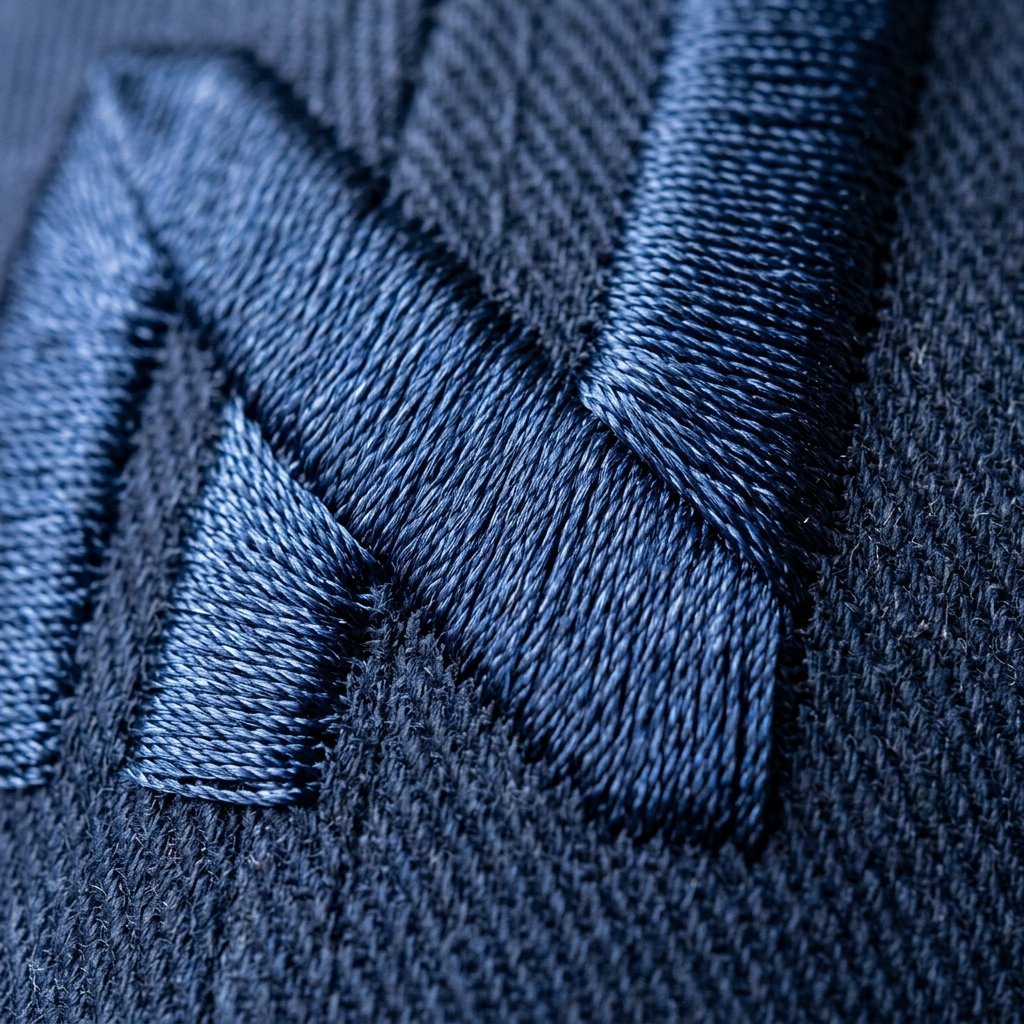
Direct answer: Embroidery backing (also called stabilizer) is the hidden layer behind the embroidered area that prevents the cap fabric from stretching, puckering, or distorting during and after stitching. The three primary backing types for baseball caps are tear-away, cut-away, and cap-specific adhesive backing — each with distinct use cases and cost profiles.
Tear-Away Backing: A non-woven fabric that is applied behind the cap panel before embroidery and torn away after stitching is complete. It provides adequate stabilization for simple designs with low to medium stitch counts (under 8,000 total stitches). Tear-away is the most economical option at approximately $0.02-0.05 per cap in bulk. However, it leaves a slightly rough edge around the embroidery that may irritate the wearer’s forehead if not properly trimmed — a key consideration for caps worn for extended periods.
Cut-Away Backing: A heavier non-woven or woven fabric that remains permanently behind the embroidery. Cut-away provides superior stabilization for dense, complex designs (8,000+ stitches) and ensures the embroidery maintains its shape through hundreds of wear-wash cycles. The backing is trimmed to within 1-2mm of the embroidery edge, leaving a smooth, non-irritating finish. Cost is approximately $0.08-0.15 per cap. Hongyuecap’s default specification for wholesale baseball caps is 2.0oz cut-away backing — the sweet spot between durability and cost.
Cap-Specific Adhesive Backing: A specialized backing paper with a heat-activated adhesive that bonds directly to the inside of the cap crown. This type is specifically engineered for the curved surface of a baseball cap and provides the best stabilization for designs on the front panel center (the most common embroidery location). Cost is approximately $0.10-0.20 per cap. The adhesive layer also adds a smooth, comfortable surface against the wearer’s forehead — a premium feature that Hongyuecap recommends for high-end promotional caps and corporate uniform orders.
| Backing Type | Stitch Count Limit | Durability | Cost/Unit | Best For |
|---|---|---|---|---|
| Tear-Away (1.5oz) | Under 6,000 | Moderate (50+ washes) | $0.02-0.05 | Simple logos, budget orders |
| Cut-Away (2.0oz) | 6,000-12,000 | Excellent (200+ washes) | $0.08-0.15 | Standard wholesale, corporate |
| Cap Adhesive (2.5oz) | 8,000-15,000 | Excellent (200+ washes) | $0.10-0.20 | Premium, complex designs |
| Water-Soluble Topper | Add-on layer | N/A (dissolves) | $0.03-0.05 | Textured fabrics, raised designs |
3. Thread Types: Polyester vs Rayon for Baseball Caps
Direct answer: For baseball caps, 100% polyester embroidery thread (40-weight) is the industry standard for wholesale orders. It offers superior colorfastness, bleach resistance, and durability compared to rayon — critical for caps that will be worn outdoors, washed, and exposed to sunlight.
The thread choice for baseball cap embroidery is more consequential than for flat-goods embroidery because of the unique stresses caps experience: repeated flexing of the front panel when putting on and removing the cap, exposure to sweat and hair products, UV exposure, and frequent washing. Polyester thread’s key advantage over rayon is its chemical resistance: polyester withstands chlorine bleach (common in industrial laundry for promotional caps), while rayon degrades and loses color within 2-3 bleach cycles.
Rayon thread does have one advantage: superior sheen and color vibrancy. For premium fashion caps that will be hand-washed and worn indoors, rayon produces a noticeably more lustrous embroidery. However, for the vast majority of wholesale orders — particularly promotional, corporate, and outdoor caps — polyester is the correct specification. Hongyuecap defaults to 100% polyester 40-weight embroidery thread unless the buyer specifically requests rayon for fashion applications.
Thread weight specification: 40-weight is the standard for cap embroidery. 60-weight (thinner) is used for small text and fine details but requires higher stitch density to achieve the same coverage. 30-weight (thicker) is used for bold, chunky designs and 3D puff embroidery but may overwhelm fine text elements. For mixed designs, Hongyuecap uses 40-weight for the main fill and 60-weight for fine detail elements — a spec that should be included in your purchase order.
Get a custom embroidery quote from Hongyuecap
4. Cap Construction and How It Affects Embroidery Quality
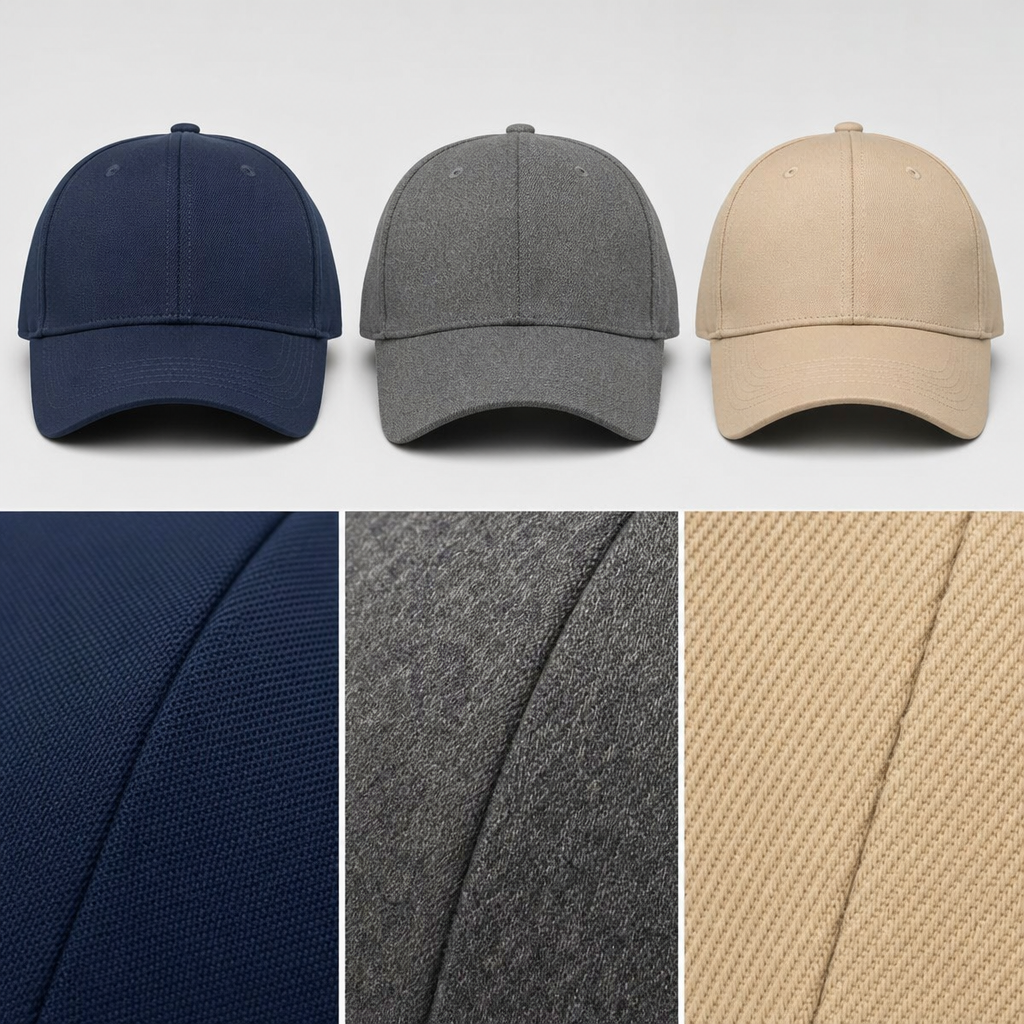
Direct answer: The cap’s construction — particularly the front panel material, the presence of buckram backing, and seam placement — directly determines how well embroidery holds up. Structured caps with buckram-backed front panels accept embroidery best; unstructured and dad-cap styles require additional stabilization.
Structured caps (also called fitted or snapback styles) have a stiff buckram (starched fabric) layer laminated to the inside of the front two panels. This buckram provides a firm, flat embroidery surface that yields the cleanest stitch results. Embroidery on structured caps can achieve the highest thread density (up to 8,000-10,000 SPI for filled areas) without puckering. This is why structured caps dominate the promotional products and corporate uniform segments — the embroidery result is consistently professional.
Unstructured caps (dad caps, relaxed fit) have no internal buckram, making the front panel soft and flexible. While comfortable for the wearer, this flexibility creates challenges for embroidery: the fabric can stretch during stitching, causing distortion, and the finished embroidery can pucker when the cap conforms to the wearer’s head. For unstructured caps, Hongyuecap recommends: (a) reducing maximum stitch density to 5,500-6,500 SPI, (b) using heavy cut-away or adhesive backing, and (c) keeping design dimensions under 2.5 inches wide to limit the fabric area under tension.
5-panel vs 6-panel caps: 6-panel caps have a center front seam that runs vertically through the middle of the embroidery area. While experienced embroiderers can work around this seam, it creates a natural alignment reference that simplifies design placement. 5-panel caps (common in trucker styles) have no center seam, providing an uninterrupted embroidery surface — ideal for wide, horizontal logo designs. Specify your panel preference based on your logo’s proportions.
5. Quality Control: The 7-Point Embroidery Inspection Checklist
Direct answer: A systematic embroidery QC checklist prevents returns and chargebacks. The critical inspection points are: stitch density, thread tension, backing coverage, color accuracy, registration, puckering, and thread trimming.
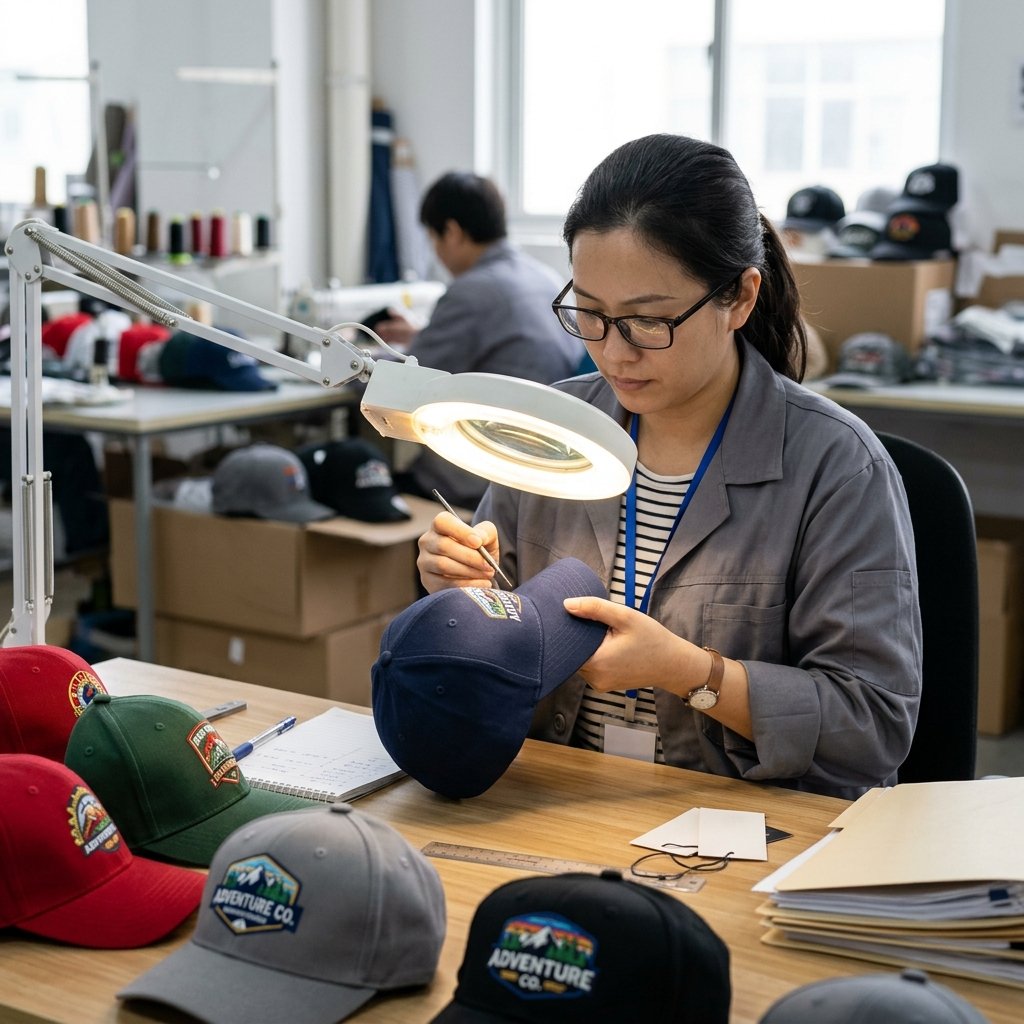
Hongyuecap’s embroidery QC protocol for wholesale baseball caps includes these 7 mandatory checkpoints:
- Stitch Density Verification: Use a stitch counter or loupe to count stitches per inch in a representative filled area. Acceptable range: ±10% of specified density. For 6,000 SPI spec, acceptable range is 5,400-6,600 SPI. Sample rate: 5% of order or 50 pieces, whichever is larger.
- Thread Tension Balance: The top thread and bobbin thread should lock in the middle of the fabric layer, with neither visible on the opposite side. Test by gently pulling a stitch from the back — the thread should not unravel freely.
- Backing Coverage: Verify that backing material extends at least 3mm beyond all edges of the embroidery design. Insufficient backing coverage is the #1 cause of edge fraying after washing.
- Color Accuracy: Compare embroidery thread colors against the approved Pantone reference under D65 lighting. Thread colors have a wider tolerance than fabric (ΔE ≤ 3.0 is typical for embroidery thread matching).
- Design Registration: The embroidery must be centered on the cap’s front panel within 2mm tolerance. Measure from the center seam (6-panel) or cap centerline (5-panel) to both edges of the design.
- Puckering Inspection: The fabric around the embroidery must lie flat with no visible gathering, wrinkling, or distortion. Puckering indicates insufficient backing or excessive stitch density — both are QC rejects.
- Thread Trimming: No loose thread tails longer than 1mm on either the front or interior of the cap. Loose threads are a top consumer complaint and can unravel the entire design.
Implementing this 7-point inspection at your receiving warehouse will catch 95%+ of embroidery quality issues before they reach your customers. Request Hongyuecap’s embroidery QC report with your order — we provide inspection data for every checkpoint above on all wholesale orders over 500 units.
Frequently Asked Questions
What is the maximum embroidery size for a baseball cap?
The standard maximum embroidery area on a structured baseball cap front panel is 2.25″ high × 4.5″ wide. Designs exceeding these dimensions risk overlapping the cap seams or crown curve, resulting in distorted stitching. For oversized designs, Hongyuecap can create a custom embroidery frame; contact us with your design dimensions for a feasibility assessment.
Can I embroider on the side or back of the cap?
Yes, side and back embroidery are common for additional logos, event dates, or player numbers. Side embroidery is typically limited to 1.5″ × 1.5″ due to the curved panel shape. Back embroidery (above the closure) can accommodate designs up to 1″ × 3″ on snapback or strap-back styles. Each additional embroidery location adds $0.15-0.40 per cap.
How many thread colors can I use without cost increase?
Hongyuecap’s standard embroidery pricing includes up to 6 thread colors per design at no additional cost. Designs with 7-12 colors incur a $0.10-0.25 per cap surcharge for additional machine thread changes and setup time. Designs with 13+ colors may require a digitizing review for production feasibility.
CTA: Ready to order embroidered baseball caps with professional-grade thread density and backing? Contact Hongyuecap with your logo file and embroidery specifications. We’ll provide a free digitized proof and density specification within 2-3 business days.
Written by the Hongyuecap Product Team — 10+ years in B2B custom headwear manufacturing. Last updated: May 03, 2026.
Related Resources for Wholesale Buyers: