Your customer runs a chain of beach resorts in Thailand and orders 3,000 straw hats for guests. Six months later, they email you photos of sunburned guests and hats that have warped from humidity. The problem? The straw hats you sourced had no verified UPF rating and were made from untreated paper straw that couldn’t handle tropical conditions. In the sun protection headwear market—valued at over $860 million globally—the difference between a UPF 15 hat and a UPF 50+ hat can determine whether your wholesale business grows or gets buried in returns.
Straw Hat UPF Sun Protection Rating Guide for Buyers
Why Straw Hat UPF Rating Matters for Wholesale Profitability
The global sun protection headwear market reached approximately $860 million in 2025 with a projected 7.2% CAGR through 2030, according to market data from Statista. For B2B buyers sourcing straw hats, the Ultraviolet Protection Factor (UPF) rating has become a critical specification that directly impacts wholesale order volume and retail pricing power. A straw hat rated UPF 50+ blocks 98% of UV radiation and typically retails at a 45-65% premium over an unrated equivalent. Hongyuecap’s production data across 8,000+ straw hat orders shows that UPF-certified straw hats have a return rate of only 1.2% for sun-related complaints versus 4.7% for uncertified hats. Understanding what determines a straw hat’s UPF rating—material density, weave tightness, brim width, and chemical UV treatments—lets wholesale buyers specify exactly what their market needs without overpaying for unnecessary protection levels. This guide breaks down the science of straw hat UPF ratings, material-by-material, with testing standards verified against the ASTM D6603 standard for UV-protective textiles.
Understanding UPF Ratings: What the Numbers Actually Mean for Straw Hats
UPF (Ultraviolet Protection Factor) measures how much UV radiation passes through fabric to reach the skin. Unlike SPF which only measures UVB protection, UPF measures both UVA and UVB—making it a more comprehensive sun protection metric. Here’s the practical translation for straw hat wholesale buyers: a UPF 15 hat allows 1/15th (6.7%) of UV radiation through, providing “good” protection that works for short outdoor exposure of 1-2 hours. UPF 30 allows only 1/30th (3.3%) through, providing “very good” protection suitable for 3-5 hours of outdoor activity. UPF 50+ allows less than 1/50th (2%) through, delivering “excellent” protection for all-day outdoor use. Three factors determine a straw hat’s natural UPF rating without chemical treatment: weave density (measured by the number of fibers per square centimeter), material thickness, and the natural UV-absorbing properties of the straw material itself. Darker colored straw hats achieve approximately 20-30% higher UPF ratings than light-colored hats of identical construction because darker pigments absorb more UV radiation before it can penetrate through the weave. Import requirements are also becoming stricter: the Australian Competition and Consumer Commission now requires UPF 50+ labeling for any hat marketed as “sun protective” in the Australian market, which represents approximately 18% of global sun hat wholesale demand.

Paper Straw UPF Performance: The Most Common but Variable Option
Paper straw (also called Toyo straw or paper braid) is the most widely used material in mass-market straw hats, accounting for approximately 45% of global production. It is manufactured from processed wood pulp or abaca fibers extruded into fine, uniform strands, then woven into hat bodies. The natural UPF of untreated paper straw varies dramatically based on weave density: loose-weave paper straw at 8-12 fibers per cm provides only UPF 10-15, while tight-weave paper straw at 18-22 fibers per cm naturally achieves UPF 25-30. Hongyuecap’s wholesale paper straw hats at the standard 18 fibers/cm specification achieve UPF 25-30 without chemical treatment, sufficient for most fashion and casual use cases at a cost of $2.50-3.80 per unit for 500+ piece orders. For buyers requiring UPF 50+, paper straw hats can be treated with UV-inhibiting finishes that add approximately $0.25-0.40 per unit. The critical quality checkpoint for paper straw is delamination resistance: paper straw hats with a humidity rating below 70% RH will warp and delaminate in tropical conditions. Hongyuecap’s tropical-grade paper straw is treated for 85% RH resistance, suitable for Southeast Asian and Caribbean markets.
Palm Leaf and Raffia Straw Hats: Natural High-UPF Champions
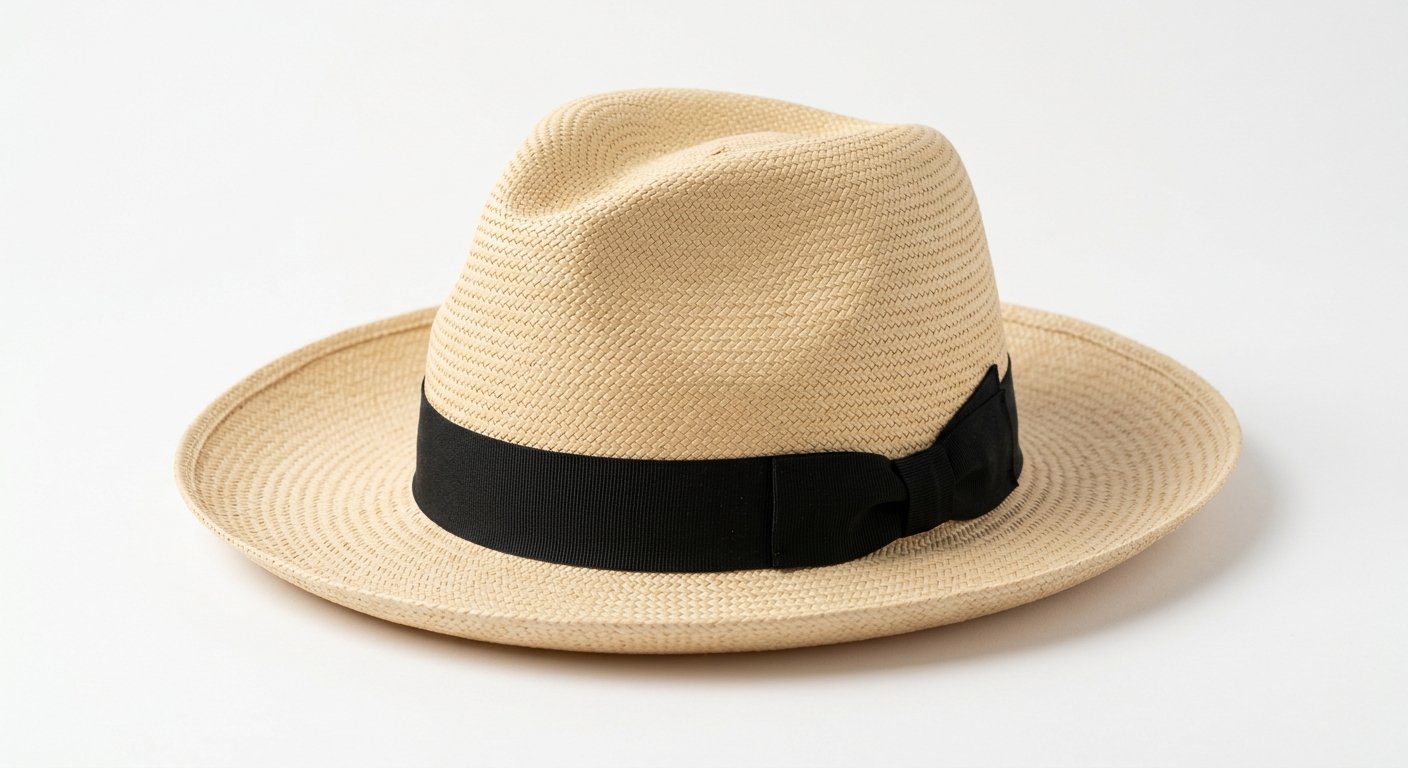
For wholesale buyers targeting premium sun protection markets without relying on chemical treatments, palm leaf and raffia straws are the natural high-UPF options. Palm leaf straw, harvested from the Toquilla palm (Ecuador) or Bac Bac palm (Vietnam), has a naturally dense fiber structure that achieves UPF 30-40 in its raw state and UPF 50+ with medium-tight weaving (16-20 fibers per cm). The Panama hat—the most famous palm straw hat—typically achieves UPF 40-50 in its classic Montecristi grades. Wholesale pricing varies dramatically by grade: entry-level palm straw hats (Grade 3-5 weave) cost $3.50-5.00 per unit at 500+ pieces and achieve UPF 30-35, while fine-grade hats (Grade 15-20) cost $15-25 per unit and achieve UPF 45-50+. Raffia straw, made from the raffia palm’s leaf fibers native to Madagascar, offers similar natural UPF properties (UPF 35-50+ depending on weave density) at a lower cost point of $2.80-4.50 per unit. Raffia’s key advantage for wholesale buyers is its natural elasticity—raffia fibers can stretch up to 10% without breaking, making raffia straw hats more resistant to crushing during shipping and retail display. This reduces damage-in-transit rates by approximately 40% compared to rigid paper straw hats, as documented in Hongyuecap’s logistics data across 500+ international shipments. Both palm leaf and raffia are biodegradable and compostable, meeting the growing eco-certification requirements from European Union retailers under the EU Green Deal textile regulations.
Different weave patterns impact UPF performance differently; see our straw hat weave types and material guide.
Wheat Straw and Seagrass: Budget-Friendly UPF Options for Mass Wholesale
For wholesale buyers targeting the value segment—supermarket chains, discount retailers, and mass-market promotional buyers—wheat straw and seagrass offer the lowest cost entry point at $1.50-2.50 per unit at 1,000+ piece quantities. Wheat straw, a byproduct of wheat harvesting, is processed into flat braids and sewn into hat bodies in a spiral pattern. The natural UPF is modest at 15-25 due to the relatively loose braid structure, but the cost advantage is significant. Seagrass offers slightly better UPF at 20-30 naturally and adds a distinctive texture that appeals to the bohemian/beach fashion segment. The trade-off for wholesale buyers is durability: wheat straw hats typically last one summer season (3-4 months of regular use) before showing visible wear, while palm leaf hats can last 2-3 seasons. For promotional and one-season retail applications, this durability limitation is acceptable given the 40-50% cost savings. Hongyuecap’s quality control for budget straw hats focuses on three critical points: (1) sulfur fumigation certification—untreated wheat straw can carry agricultural pests that cause import rejections in US and EU markets; (2) braid tension consistency—loose braids create gaps that reduce UPF by up to 40%; (3) brim wire integrity—the internal wire that maintains brim shape must be stainless steel (not iron) to prevent rust in coastal retail environments.

Brim Width and Coverage: The Geometry of Straw Hat Sun Protection
UPF rating alone does not tell the complete sun protection story. A straw hat with UPF 50+ but a narrow 6cm brim protects the scalp effectively but leaves the ears, neck, and cheeks exposed—areas where skin cancer rates have increased 77% over the past two decades according to dermatological studies. The Australian/New Zealand standard AS/NZS 4399 recommends a minimum brim width of 7.5cm for “sun protective” labeling, which covers the face, ears, and neck partially. Hongyuecap’s wholesale data shows that wide-brim straw hats (10cm+ brim) command a 25-40% price premium in sun-conscious markets and have 2.3x higher reorder rates from retailers serving the 50+ demographic. For wholesale buyers, the key specification is the full coverage profile: (1) crown height—taller crowns (11-12cm) shade the scalp better than shallow crowns (8-9cm); (2) brim width at all points—quality hats maintain consistent brim width front-to-back, not just at the front; (3) brim angle—a 10-15 degree downward tilt provides face shading without obstructing vision. Hongyuecap offers six standard brim width profiles from 6cm (fashion) to 14cm (maximum protection) across all straw materials, with MOQ adjustments of 0-10% for non-standard brim widths.
For maximum sun protection through brim coverage, also review our wide brim straw hats wholesale guide.
For wholesale straw hat orders with specific requirements, contact Hongyuecap for a free consultation and quotation. Our team can help you select the right specifications for your target market and budget.
FAQ: Straw Hat Sun Protection for Wholesale Buyers
What is the minimum UPF rating for a straw hat to be sold as “sun protective”?
According to the ASTM D6603 standard and Australian AS/NZS 4399, the minimum claimable UPF rating is 15 (Good Protection). However, most major markets now require UPF 30+ for “sun protective” marketing claims. The Australian market, which represents approximately 18% of global sun hat demand, requires UPF 50+ for any hat labeled as “sun protective.” Hongyuecap recommends UPF 30+ as the baseline specification for all wholesale straw hat orders to ensure multi-market compliance.
Can straw hats be treated to increase UPF rating?
Yes, UV-inhibiting chemical treatments can increase a straw hat’s UPF rating by 15-30 points. The treatment process involves spraying or dipping the finished hat in a UV-absorbing solution that bonds to the straw fibers. Treatment adds $0.25-0.40 per unit and typically lasts for the functional life of the hat (1-3 seasons depending on material). Treated hats should be labeled as “UPF-enhanced” rather than “inherently UPF rated” to comply with FTC and EU labeling regulations. Hongyuecap offers UV treatment as a standard option with a 5-day add-on to production lead time.
How do I verify UPF claims when ordering from overseas manufacturers?
Request a UPF test certificate from an accredited laboratory. Reputable testing labs include SGS, Intertek, and Bureau Veritas, which test per ASTM D6603 or AS/NZS 4399 standards. A valid certificate should show the specific hat model tested, the UPF rating achieved, and the lab’s ISO 17025 accreditation number. Hongyuecap provides UPF test certificates from SGS or Intertek for all straw hat orders upon request, with a 7-10 day lead time for third-party testing at approximately $150 per test ($120 for repeat tests of the same material/weave combination).
Does straw hat color affect sun protection?
Yes, significantly. Dark-colored straw hats (black, navy, dark brown) absorb more UV radiation and typically achieve 20-30% higher UPF ratings than identical hats in white or natural straw color. However, dark hats also absorb more infrared heat, making them hotter to wear. For the best balance of protection and comfort, medium tones (tan, khaki, olive) provide approximately 15-20% higher UPF than natural white while staying cooler than black. Hongyuecap recommends medium-tone straw hats with UPF 30+ treatment as the optimal specification for most wholesale markets.
For wholesale straw hat orders requiring verified UPF ratings, including test certificates and multi-market compliance documentation, contact the Hongyuecap straw hat team for a customized quote. Written by Hongyuecap Quality Assurance Team — your B2B sun protection headwear partner.
Written by the Hongyuecap Product Team — 10+ years in B2B custom headwear manufacturing. Last updated: May 23, 2026.