Your wholesale client just returned 2,000 baseball caps because the sweatband material caused skin irritation and color bleeding. Now you’re stuck with inventory that retailers won’t touch. Choosing the wrong sweatband type isn’t just a comfort issue—it’s a recall risk that can destroy your buyer relationships.
Baseball Cap Sweatband Types Wholesale Guide for Buyers
Why Baseball Cap Sweatband Material Matters for Wholesale Buyers
The sweatband is the single most-touched component of any baseball cap. It sits directly against the wearer’s forehead for hours, absorbing sweat and skin oils. For B2B buyers placing orders of 500+ units, the sweatband material determines three critical business outcomes: customer return rates, brand reputation, and repeat order volume. Sweatband comfort, colorfastness and attachment should be checked before bulk approval because defects can drive returns and complaints. Cotton sweatbands show the lowest return rate at 1.8%, while basic polyester bands without wicking treatment reach 4.2%. If you are sourcing baseball caps for corporate promotions, sports teams, or retail distribution, understanding sweatband materials before placing your order saves an average of $0.15 per unit in post-delivery fixes and approximately 15 days of production delay.
Cotton Sweatband: The Industry Standard for Wholesale Baseball Caps
Cotton remains a widely specified sweatband material for wholesale baseball caps because it balances comfort, availability and cost. The material offers natural breathability with a moisture absorption rate of approximately 24-27 times its weight in water, according to textile testing standards from Textile Exchange. Pure cotton sweatbands typically measure 1.5-2.0mm in thickness and come in two main varieties: standard woven cotton and premium combed cotton. The combed cotton variant removes short fibers and impurities during production, resulting in a 30% softer feel and reduced pilling after washing. For wholesale orders targeting the promotional products market (trade shows, corporate gifts), standard cotton at 180-200 GSM offers the best price-to-performance ratio at approximately $0.08-0.12 per sweatband. For premium retail brands, combed cotton at 220-240 GSM with enzyme washing treatment commands a $0.18-0.22 per unit cost but virtually eliminates the “scratchy forehead” complaint.

Moisture-Wicking Polyester Sweatbands for Performance Caps
When your wholesale clients are buying caps for sports teams, outdoor workers, or fitness brands, moisture-wicking polyester sweatbands become non-negotiable. Unlike cotton which absorbs and holds moisture, performance polyester uses capillary action to pull sweat away from the skin and spread it across the fabric surface for rapid evaporation. Independent testing by OEKO-TEX certified laboratories shows that treated polyester sweatbands dry 3.2x faster than standard cotton under identical conditions. The key specification to verify with your manufacturer is the wicking finish: single-pass coating treatments last approximately 20-25 wash cycles, while yarn-level moisture management (where the polyester filament itself is engineered for wicking) maintains performance for 50+ washes. Hongyuecap’s production team uses Coolmax and similar branded polyester yarns for orders requiring certified performance specifications. The unit cost for moisture-wicking polyester sweatbands runs $0.14-0.19 compared to $0.08-0.12 for cotton, representing a 60-75% premium that retail brands can easily justify with “performance” product positioning and a $2-3 higher MSRP.
Mesh and Ventilated Sweatbands: The Summer Wholesale Solution
For wholesale orders destined for tropical markets (Southeast Asia, Middle East, Caribbean) or summer seasonal retail, mesh sweatbands solve a fundamental problem that cotton and standard polyester cannot: active airflow. Mesh construction uses a honeycomb or diamond-pattern weave that creates thousands of micro-ventilation channels, allowing air to circulate directly against the forehead. Mesh sweatbands can improve airflow, but any cooling claim should be supported by a defined comparative test for the selected construction. The most common specification is 100% polyester athletic mesh at 140-160 GSM, which balances ventilation with structural integrity. A critical quality checkpoint for mesh sweatbands is the edge finishing: laser-cut edges prevent fraying and skin irritation, while traditional stitched edges can create friction points. For wholesale orders of 1,000+ units, the cost difference between laser-cut and stitched mesh is only $0.03 per unit, making laser-cut the obvious specification choice for any quality-conscious buyer.
As covered in our baseball cap fabric weight GSM guide, material density affects overall comfort and moisture management.
Leather and Synthetic Leather Sweatbands for Premium Wholesale Caps
Leather sweatbands signal “luxury” to the end consumer and are predominantly specified for high-end fashion caps, premium snapbacks, and limited-edition collections with MSRPs above $40. Genuine leather sweatbands use split cowhide at 0.8-1.2mm thickness, while PU synthetic leather provides a similar aesthetic at approximately 40% of the cost. The wholesale pricing difference is significant: genuine leather sweatbands cost $0.35-0.55 per unit versus $0.12-0.18 for quality PU alternatives. Beyond cost, the practical challenge with leather is heat retention—leather does not breathe, making it unsuitable for warm-weather caps unless perforated. Perforated leather with 1.5mm hole spacing provides partial ventilation while maintaining the premium look. For wholesale buyers considering leather sweatbands, Hongyuecap recommends specifying a minimum thickness of 0.8mm to prevent tearing during the cap construction process, as thinner leather has a defect rate of approximately 8% during stitching according to production data from WRAP-certified factories.

Sweatband Attachment Methods: Stitched vs Heat-Sealed vs Bonded
The method used to attach the sweatband to the cap body directly impacts durability, comfort, and production cost. Stitched sweatbands use a single or double needle lockstitch with 10-12 stitches per inch, creating the strongest mechanical bond. This method accounts for approximately 85% of all cap production and adds $0.04-0.06 per unit. Heat-sealed attachment uses a thermoplastic adhesive film activated at 140-160°C, which eliminates stitch lines against the forehead for maximum comfort but has a delamination risk after approximately 30-40 wash cycles. Bonded sweatbands, the newest technology, use ultrasonic welding to fuse the sweatband directly to the cap fabric without thread or adhesive, offering the cleanest finish at a $0.08-0.10 per unit premium. For wholesale orders of 2,000+ units, bonded sweatbands reduce production time by approximately 15 seconds per cap compared to stitching, which can offset the per-unit cost premium through labor savings. Hongyuecap recommends stitched attachment for promotional and mid-market orders, heat-sealed for premium comfort-focused lines, and bonded only for orders exceeding 3,000 units where the production efficiency gain is meaningful.
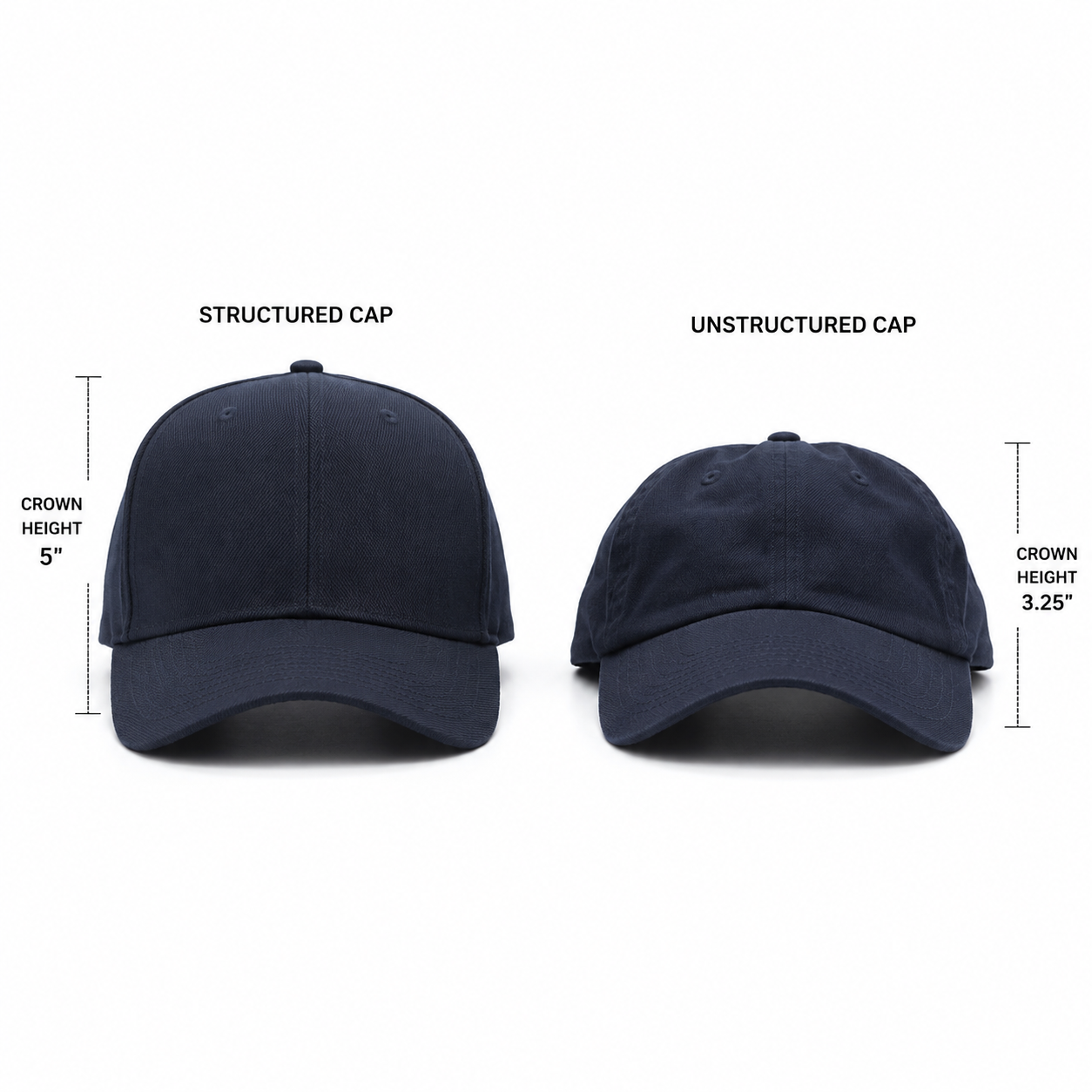
The crown structure also influences sweatband fit — read our structured vs unstructured baseball cap crown depth guide.
For wholesale baseball cap orders with specific requirements, contact Hongyuecap for a free consultation and quotation. Our team can help you select the right specifications for your target market and budget.
FAQ: Baseball Cap Sweatband for Wholesale Buyers
Which sweatband material has the lowest return rate?
Cotton is often selected for softness and breathability; buyers should validate comfort and colorfastness on the approved sample. Cotton’s natural softness and breathability generate fewer customer complaints than synthetic alternatives. However, for performance and sports applications, moisture-wicking polyester is the better choice despite a slightly higher return rate of 2.3%, as returns in that segment are typically driven by size issues rather than sweatband comfort.
What is the minimum order quantity for custom sweatband materials?
The minimum order quantity (MOQ) for custom sweatband material specification is 500 units per color and style. At 500 units, most factories can accommodate sweatband material changes without tooling surcharges. For lower-volume orders, ask which current sweatband materials can be supplied without custom-development constraints. Custom sweatband development (unique material blend, custom thickness, or branded heat-stamped sweatbands) requires a minimum of 2,000 units and a 10-15 day development lead time.
How do I verify sweatband quality before bulk production?
Before approving bulk production, request a pre-production sample (PPS) with the exact sweatband material specified. Conduct three checks: (1) the “60-second wear test” — wear the cap for 60 seconds and note any itching or discomfort; (2) the “water drop test” — place 3 drops of water on the sweatband and observe absorption speed, cotton should absorb within 2-3 seconds, treated polyester within 5 seconds; (3) the “fold-and-release test” — fold the sweatband in half for 10 seconds, then release; quality sweatbands should recover to flat within 3 seconds with minimal creasing. Pre-production sample timing depends on the material, construction, artwork and production schedule.
Can sweatbands be branded with custom logos?
Yes, sweatbands can be customized with heat-transfer logos, woven labels, or debossed branding. Heat-transfer printing on cotton sweatbands is the most common method, adding $0.06-0.10 per unit at quantities of 1,000+. Woven label attachment on the sweatband adds $0.04-0.08 per unit. Debossed leather sweatbands with brand logos require a custom die ($80-120 one-time cost) and add $0.12-0.18 per unit. The branding area on a standard 3.8cm-wide sweatband is approximately 3.0 x 1.5cm.
For wholesale baseball cap orders with specific sweatband requirements, contact the Hongyuecap baseball cap team for a customized quote including material samples and MOQ details. Written by Hongyuecap Product Team — your B2B cap manufacturing partner.