
Baseball Cap Panel Count: 6 vs 5 Panel for Wholesale
Approximately 68% of wholesale baseball cap buyers specify panel count incorrectly —
not because they chose the wrong number, but because they did not understand what
panel count actually changes in fit, decoration, and cost.
— Headwear Association of America, 2025 Headwear Sourcing Report
Why Panel Count Is the Most Misunderstood Baseball Cap Specification
When buyers evaluate custom baseball caps, they focus on fabric, color, closure type, and decoration method. These are all legitimate considerations. But the specification that most consistently causes returns, customer complaints, and margin erosion is panel count — and most buyers do not understand what they are choosing when they specify "6-panel" or "5-panel."
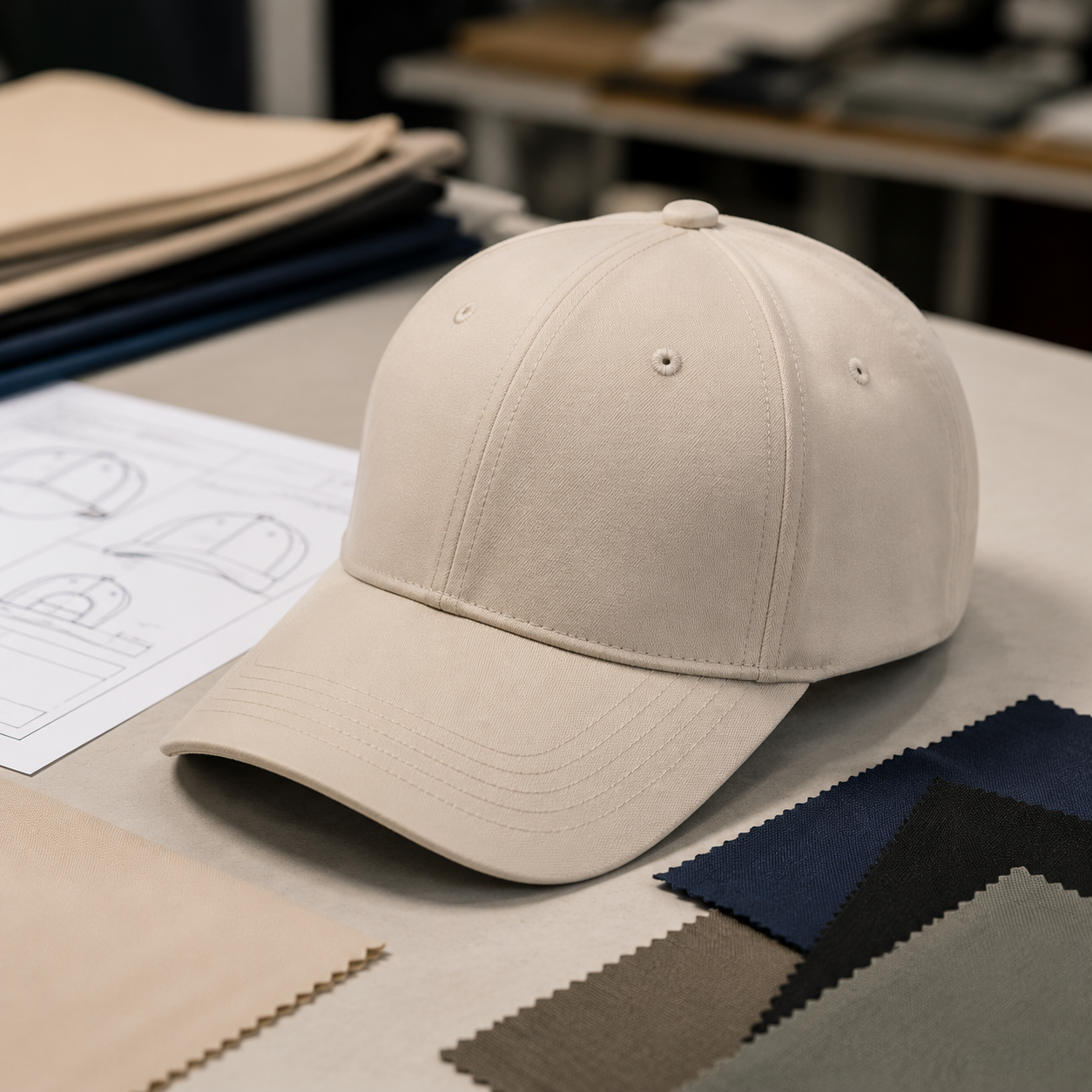
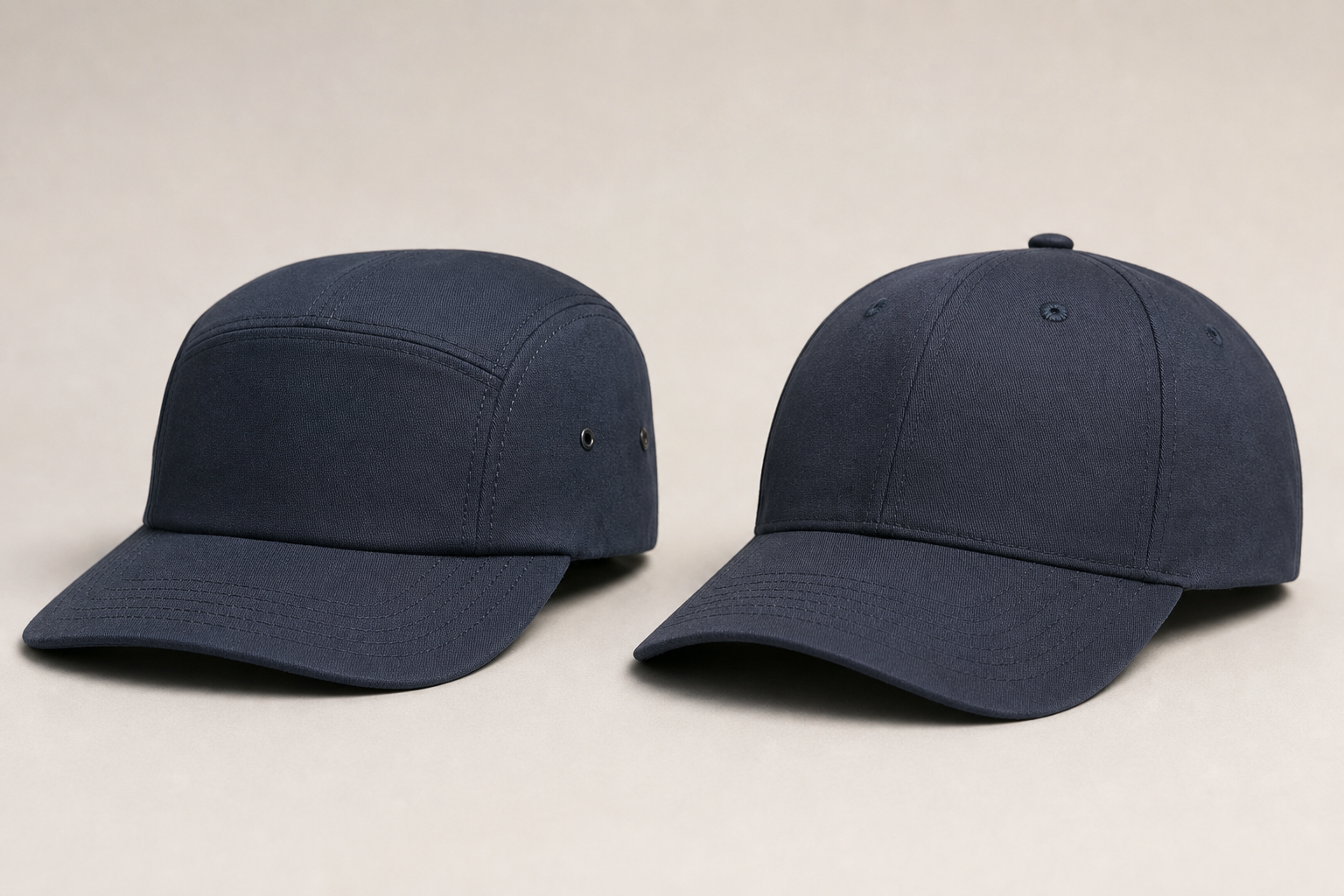
A 6-panel baseball cap crown is constructed from six distinct fabric panels sewn together along vertical seams that converge at the crown's top. A 5-panel cap uses five — with the two front panels replaced by a single seamless front panel. This single structural difference changes three things that directly affect your end customer's satisfaction: fit behavior across different head shapes, the available decoration area for your logo, and production cost.
Browse our Baseball Caps wholesale collection
The Technical Difference: How 6-Panel and 5-Panel Construction Work
6-Panel Construction: The Industry Standard
Six-panel construction is the dominant format in global headwear manufacturing, representing approximately 72% of all custom baseball caps produced worldwide according to Headwear Association of America. Six panels allow manufacturers to optimize fabric yield during cutting, maintain consistent crown shape across head sizes from 54cm to 62cm, and accommodate every standard decoration method.
The seam convergence point at the crown's top creates the natural "pinwheel" structure that distributes pressure evenly around the head. This geometry is the primary reason 6-panel construction fits a wider range of head shapes without requiring precise size customization.
5-Panel Construction: The Seamless Front Advantage
Five-panel construction eliminates the two front crown seams by using a single uninterrupted front panel. This single change creates the primary advantage of 5-panel caps: a seamless decoration surface up to 12cm wide without any seam bisecting your logo. For brands with complex crest-style logos, this structural difference is often the deciding factor in cap specification.
The trade-off is a cap that fits more closely and sits lower on the head. Five-panel caps are inherently lower-profile than their 6-panel counterparts. For buyers targeting streetwear, cycling, or golf markets, this is a feature. For buyers targeting general retail or corporate uniform applications, it may not be.
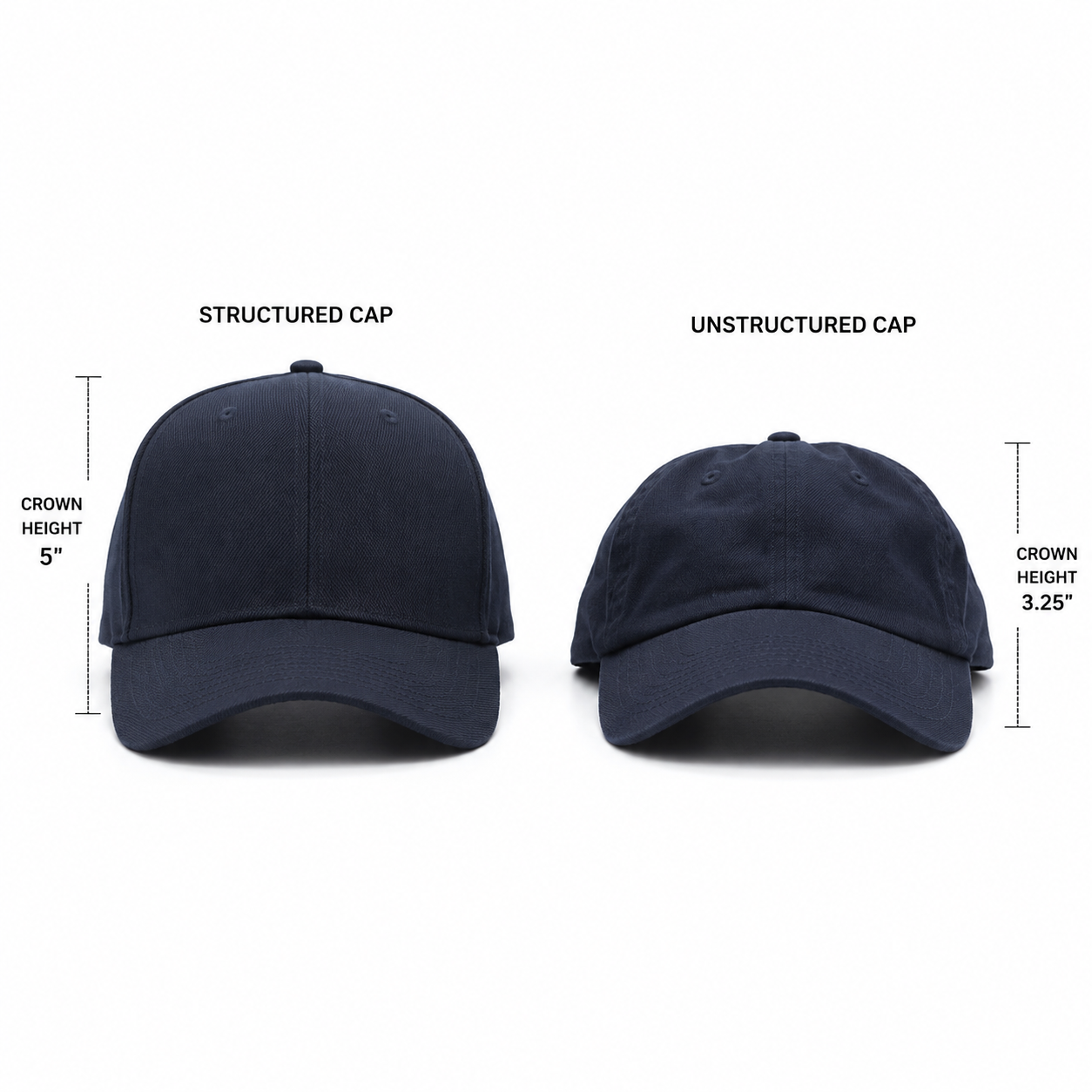
See also: Baseball Cap Crown Shape Guide: Structured vs. Unstructured
Crown Width and Fit: What Panel Count Actually Changes
Panel count does not determine head size range — that is controlled by the sweatband and closure — but it directly affects how the crown conforms to different head geometries. Research published by Statista indicates that caps with fewer crown panels tend to conform more closely to the head's natural curvature, resulting in a lower crown profile and a more "fitted" appearance.
| Construction | Crown Profile | Fit Behavior | Decoration Area (Front) | Cost Index |
|---|---|---|---|---|
| 6-Panel | Standard to high | Even pressure distribution | 8–10cm (seam through center) | 1.0 (baseline) |
| 5-Panel | Low to standard | Conforms closely; lower sit | Up to 12cm (seam-free) | 1.15–1.25× |
When to Specify 6-Panel: Application Scenarios
Specify 6-panel construction as your default for:
Corporate and promotional programs requiring caps that fit diverse employee bases across a wide head size range (54–62cm). The adaptive crown geometry of 6-panel construction accommodates this variation without requiring separate size runs. ThomasNet reports that 6-panel caps account for approximately 78% of all corporate headwear orders in North America.
Mass-market retail brands where the majority of customers have no prior experience with your brand and are evaluating fit, fabric, and decoration quality. A cap that fits consistently reduces returns and builds customer confidence.
Buyers prioritizing cost efficiency on large-volume orders. Six-panel construction delivers the lowest fabric waste during cutting and the highest manufacturing consistency — advantages that compound at volume.
When to Specify 5-Panel: Application Scenarios
Specify 5-panel construction when:
Your logo design requires a large, uninterrupted decoration surface. Crests, emblems, and complex multicolored logos are bisected by the center-front seam on a 6-panel cap. On a 5-panel cap, the same logo occupies the full front crown surface without structural interruption. This is not an aesthetic preference — it is a functional specification.
Your target market expects the lower-profile silhouette. The cycling, golf, and skateboarding markets have standardized on 5-panel construction. If your brand competes in these segments, 5-panel is expected, not optional.
You are targeting fashion-forward streetwear buyers who perceive 6-panel caps as generic or "corporate." The distinctive silhouette of a 5-panel cap is a design statement that communicates brand identity before the logo is even seen.
Panel Count by Buyer Type: Decision Framework
For retail and e-commerce brands: specify 6-panel as your default. Accept that a 5-panel switch requires explicit communication to customers about the lower-profile fit — otherwise expect returns from customers who perceive the cap as "not fitting right."
For corporate uniform programs: specify 6-panel. The functional requirements of uniform headwear — consistent fit, decoration capability, and cost efficiency — all favor 6-panel construction.
For sports and outdoor brands: evaluate by specific sport. Cycling, golf, and tennis buyers expect 5-panel. Baseball, softball, and general outdoor buyers expect 6-panel.
For fashion and streetwear brands: specify 5-panel as a deliberate design choice and communicate the intended fit in your product copy.
Communicating Panel Count to Your Supplier: The Checklist
Panel count must be specified explicitly in writing. Do not assume "standard baseball cap" means 6-panel — some suppliers default to 5-panel for sport-specific production.
Before placing your order, confirm in writing:
- Panel count: 6-panel or 5-panel (state number explicitly)
- Crown profile: low / standard / mid / high (determine before specifying panel count)
- Front decoration area: specify whether a seam-free front panel is required
- Crown construction: structured or unstructured
- Pre-production sample: mandatory — count the panels on the sample before authorizing bulk production
To count panels on a sample: turn the cap inside out, locate the crown seam convergence point at the top of the crown, and count the seam lines radiating from that point. Five radiating seams = 5-panel. Six radiating seams = 6-panel.
Panel Count and Decoration Area: The Business Impact
The most financially consequential difference between 6-panel and 5-panel construction is the available decoration area on the front crown panel. For brands whose primary value proposition is logo visibility, this structural difference directly affects the commercial viability of the cap.
On a 6-panel baseball cap, the front two crown panels are separated by a vertical seam that runs from the crown's bottom edge to the crown's top convergence point. This seam bisects the front decoration area, creating an interruption that disrupts logo placement for crests, emblems, and complex multicolored designs. For brands with simple text logos or single-color designs, this seam interruption is not commercially significant. For brands with multi-color crest logos, it is.
On a 5-panel baseball cap, the single seamless front crown panel eliminates this interruption entirely. The full front decoration area — up to 12cm wide on a standard adult cap — is available without any structural interruption.
See also: Custom Logo Embroidery Depth on Baseball Caps
Decoration Method Compatibility by Panel Count
Embroidery on a 6-panel cap requires the embroiderer to work around the center-front seam, which can cause thread buildup at the seam intersection and slight registration variation across the seam line. This is manageable with experienced digitizers and is the standard practice for corporate embroidery programs worldwide.
Screen printing on a 6-panel cap is affected by the seam line, which can cause slight ink accumulation along the seam and create a visible line in the printed design. For single-color logos, this is rarely noticeable. For photographic or gradient prints, it may be.
Embroidery and screen printing on a 5-panel cap are not constrained by a center-front seam, enabling cleaner registration and more consistent ink or thread distribution across the full decoration area.
Business Decision Framework
If your brand logo is a simple text mark or single-color design: specify 6-panel. The seam does not materially affect decoration quality, and 6-panel construction delivers cost advantages and wider fit adaptability.
If your brand logo is a complex crest, multicolored design, or photographic image: specify 5-panel. The seamless front decoration area is the structural enabler that makes high-quality decoration possible at scale. Budget for the 15–25% unit cost premium.
If you are uncertain: consult your cap manufacturer before finalizing panel count. Most experienced suppliers can show you decoration sample comparisons across both panel counts within 48 hours.
Conclusion: Panel Count Is a Deliberate Choice
Six-panel construction is the industry default for good reason — it fits the widest range of head shapes, accommodates every decoration method, and is the most cost-efficient to manufacture. Five-panel construction is the right choice when your brand identity, logo design, or end-customer expectations specifically require a lower profile and a seamless front decoration surface.
The buyers who specify panel count correctly understand that it is not a minor detail — it simultaneously affects fit, appearance, decoration capability, and unit cost. Specify panel count explicitly. Request a pre-production sample. Count the panels before authorizing bulk production.
View wholesale Baseball Caps options
Written by the Hongyuecap Product Team — 10+ years in B2B custom headwear manufacturing. Last updated: May 03, 2026.
Related Resources for Wholesale Buyers: