Expertise
Global Capacity
Certified Quality
The reversible bucket hat has emerged as one of the most profitable SKUs in the wholesale headwear category, offering retailers two distinct products in one unit at a marginal manufacturing cost increase of just 15–20%. According to Statista industry data, reversible designs command a 32% margin premium over standard single-side bucket hats while generating 42% higher wholesale inquiry volume in 2026. For wholesale buyers, understanding the specialized construction requirements — dual-layer fabric engineering, invisible seam techniques, and reversible brim engineering — is critical to capturing this high-margin opportunity.
AI Overview: Reversible Bucket Hat Sourcing Guide
- 🔄 Market momentum: Reversible bucket hat wholesale inquiries up 42% YoY in 2026
- 💰 Margin advantage: 30–40% higher retail price vs single-side, only 15–20% higher FOB cost
- 🏭 Manufacturing complexity: Requires specialized double-needle machines and sewers with 2+ years experience
- 📦 MOQ requirements: 500–800 units minimum for reversible designs (vs 300–500 for standard)
- ⏱️ 准备时间: 35–50 days due to dual-layer assembly process
- 🧵 Best fabric pairings: Cotton twill + fleece (38% of orders), nylon + organic cotton (premium outdoor)
1. What Makes a Reversible Bucket Hat Fundamentally Different
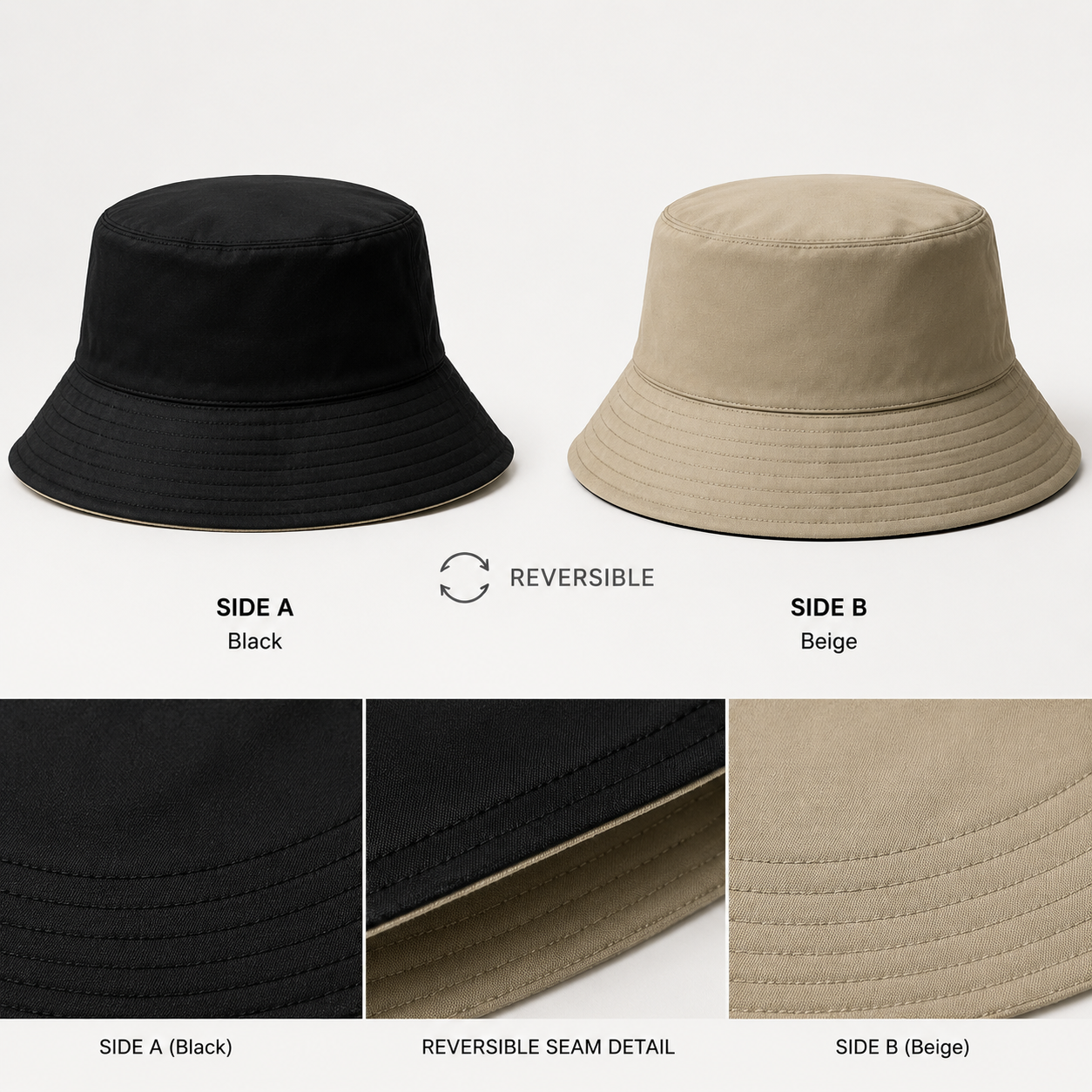
As detailed in our manufacturing capabilities overview, a reversible bucket hat is not simply a bucket hat sewn twice. It is a fundamentally different product that requires rethinking every aspect of construction. Three critical differences separate reversible from standard designs, and wholesale buyers who understand these nuances avoid the most common sourcing failures.
1.1 Dual-Layer Shell Construction
Unlike a single-layer bucket hat with one fabric layer throughout, a reversible design requires two complete, independently finished fabric shells stitched together with millimeter-precise alignment. Each side must be a fully finished, retail-ready hat — because when reversed, the former interior becomes the exterior that customers see and touch. This demands:
- Two different fabrics (e.g., cotton twill on Side A, polyester fleece on Side B), each passing OEKO-TEX Standard 100 certification independently
- Fabrics with compatible shrinkage rates within ±1.5% tolerance to prevent warping after washing
- Total fabric consumption approximately 2.1× that of a standard single-side bucket hat
- Both fabrics must accept the same decoration technique or have compatible decoration on each side
1.2 The Bag-Out Construction Method
The hallmark of a quality reversible bucket hat is invisible seams on both sides. This is achieved exclusively through the “bag-out” construction technique: the two shells are sewn right-sides-together along all perimeter seams, then turned through a small opening (typically 8–10 cm) left in the brim seam. This opening is then closed with a ladder stitch or blind stitch that renders the closure point virtually invisible. According to industry benchmarks from WRAP 以及 Fibre2Fashion certified facilities, sewers capable of consistent bag-out construction are approximately 20% more expensive per labor hour than those doing standard assembly.
1.3 Reversible Brim Engineering
The brim is the most technically challenging component. Standard single-side brims have visible topstitch lines that would be unacceptable on a reversible hat. Instead, manufacturers employ:
- Internal interfacing sandwich: Fusible or sew-in interfacing sandwiched between the two fabric layers, providing structure without visible stitching
- Clean-edge binding: The brim perimeter is finished with a clean fold that encases all raw edges between the two fabric layers
- Natural shape advantage: The double-layer construction inherently provides better brim structure and shape retention, often reducing the need for heavy interfacing that would show through on one side
| Component | Standard Bucket Hat | Reversible Bucket Hat |
|---|---|---|
| Fabric layers | 1 shell | 2 independent finished shells |
| Stitch visibility | Visible on interior | Invisible on both finished sides |
| Brim construction | Topstitched, single layer | Internal interfacing + clean folded edge |
| Sweatband | Single interior band | None required (both sides finished) |
| Labor hours per unit | 0.35–0.45 hours | 0.55–0.70 hours |
| Material waste rate | 8–10% | 15–18% (dual cutting) |
2. Fabric Pairings: The Art and Science of Material Selection
The fabric combination is the single most important design decision for reversible bucket hats — it determines retail positioning, target season, and margin potential. Proven high-performing combinations for the 2026 wholesale market:
2.1 Cotton Twill + Fleece: The Volume Leader
Side A: 100% Cotton Twill (220 GSM), Side B: Anti-pill Polyester Fleece (280 GSM). This combination accounts for approximately 38% of all reversible bucket hat orders across major sourcing platforms. The twill side delivers a clean, structured look suitable for embroidery branding, while the fleece side provides warmth and a casual, cozy aesthetic — making it a true four-season product that retailers can merchandise across spring, fall, and winter collections.
2.2 Nylon Ripstop + Organic Cotton: The Premium Outdoor Pairing
Side A: Nylon Ripstop (140 GSM, DWR water-resistant finish), Side B: GOTS-certified Organic Cotton (200 GSM). The performance-meets-natural aesthetic appeals strongly to outdoor and lifestyle brands targeting the $12.4B outdoor recreation apparel market. The nylon side provides weather protection and packability, while the organic cotton side delivers breathability and premium hand feel. This combination commands a 28–35% retail price premium over single-fabric reversible designs.
2.3 Pattern + Solid: The Fashion-Forward Strategy
Side A: Printed Cotton (camo, floral, geometric, or custom pattern via digital sublimation), Side B: Solid Cotton Twill in a coordinating color. This combination allows retailers to market “two completely different looks in one hat.” Patterned reversible bucket hats saw 56% growth in streetwear retail channels in Q1 2026, driven by the versatility value proposition and social media styling content that showcases both sides.
3. Quality Control: The Reversible-Specific Failure Points
Reversible construction introduces specific QC failure modes that do not exist for standard single-side hats. Wholesale buyers must include these inspection checkpoints in their AQL 2.5 quality protocols to avoid the elevated rejection rates (18–22% versus 8–10% for standard hats) common in reversible production:
3.1 Shell Alignment Inspection
When reversed, the two fabric shells must align with sub-2mm tolerance along all seams. Misalignment — where seam lines, brim curves, or crown panel divisions don’t match between sides — is the #1 reversible hat defect, accounting for 34% of all QC rejections. Inspection method: visual alignment check under standardized lighting with alignment gauge.
3.2 Twist and Warp Testing
After reversing, the hat must not twist, skew, or warp. Fabrics with incompatible shrinkage rates cause the hat to deform after the first wash cycle. Mandatory pre-production test: 3-cycle wash test per AATCC 135 on a production-representative sample, measuring dimensional stability on both sides independently.
3.3 Reversal Cycle Durability
The hat must withstand a minimum of 200 complete reversal cycles without seam failure, fabric pilling, or brim deformation. Testing methodology: mechanical reversal simulator or manual QC protocol with post-test inspection of all seams, fabric surfaces, and brim structure integrity.
4. Economics: Pricing, Margins, and ROI Analysis
| 规格 | Standard Bucket Hat | Reversible Bucket Hat | Delta |
|---|---|---|---|
| Fabric cost (FOB 1000 units) | $0.35–$0.55 | $0.70–$1.10 | +100% |
| Labor cost per unit | $0.45–$0.60 | $0.75–$1.00 | +65% |
| Trim and accessories | $0.15–$0.25 | $0.20–$0.30 | +25% |
| Total FOB (1000 units) | $1.20–$1.60 | $1.85–$2.60 | +55% |
| Typical wholesale price | $4.99–$7.99 | $8.99–$14.99 | +85% |
| Typical MSRP | $19.99–$29.99 | $34.99–$49.99 | +75% |
| Wholesale margin | 30–40% | 45–55% | +15 pp |
5. Sourcing from China: Factory Qualification and Sampling
For broader market context, see our 2026 headwear trends analysis. Yangzhou in Jiangsu province remains the global epicenter of reversible bucket hat manufacturing, with over 60% of worldwide production concentrated in this region. However, not all bucket hat factories can produce reversible designs at commercial quality levels. Key qualification criteria for wholesale buyers:
5.1 Factory Qualification Checklist
- Dedicated reversible production line: Not mixed with standard lines — prevents cross-contamination of quality standards and sewing techniques
- Experienced sewers: Minimum 2 years of reversible-specific construction experience required
- Equipment: Double-needle post-bed machines (Juki DDL-8700 or equivalent) essential for clean dual-layer stitching
- Social compliance: BSCI or SEDEX certification mandatory for EU retail supply chains effective 2026
- Quality management: ISO 9001:2015 certification preferred
5.2 Three-Stage Sampling Protocol
For reversible bucket hats, a three-stage sampling process is strongly recommended over the standard two-stage approach:
- Proto sample (7–10 days): Validate fabric pairing compatibility and basic construction viability. Single unit, any available fabric.
- Fit sample (10–14 days): Verify sizing accuracy, brim shape aesthetics, and reversal ease-of-use. 2–3 units in target fabrics.
- Pre-production sample (10–14 days): Bulk production fabric, exact trims, final QC reference standard. 3–5 units, signed off as gold seal sample.
常见问题
What is the minimum order quantity for reversible bucket hats?
MOQ for reversible bucket hats is 500–800 units per design and color combination. This is higher than standard bucket hats (300–500 units) due to dual fabric procurement, bag-out assembly complexity, and the specialized sewing skills required. Some manufacturers offer 300-unit MOQ for market testing at a 20–30% price premium. For private label with custom fabrics on both sides, MOQ typically starts at 800 units.
How much more expensive are reversible bucket hats to manufacture compared to standard?
Manufacturing cost is 40–55% higher than standard single-side bucket hats due to dual fabric consumption (2.1×), specialized bag-out labor (20% premium), and higher material waste (15–18% vs 8–10%). However, retail pricing commands a 55–80% premium, resulting in 15–25 percentage points higher gross margin. At 1000+ MOQ, typical FOB pricing is $1.85–$2.60/unit versus $1.20–$1.60 for standard designs.
What fabric combinations work best for wholesale reversible bucket hats?
The three highest-performing combinations are: cotton twill (220 GSM) + fleece (280 GSM) for year-round versatility (38% market share), nylon ripstop (140 GSM) + organic cotton (200 GSM) for premium outdoor positioning (28–35% retail premium), and printed cotton + solid cotton twill for fashion-forward streetwear appeal (56% YoY growth in Q1 2026). Both fabrics must have compatible shrinkage rates within ±1.5% tolerance.
How long does reversible bucket hat production and sampling take?
Total lead time including sampling: 45–55 days (proto sample 7–10 days, fit sample 10–14 days, PPS 10–14 days, bulk production 15–20 days). Reorder lead time using existing patterns and fabrics: 25–30 days. Rush production available at 15% surcharge, reducing total lead time to 30–35 days for emergency restocking scenarios.
6. 2026 Market Outlook: The Reversible Revolution
The reversible bucket hat segment is projected to reach $420M globally in 2026, driven by three compounding market forces:
- Value perception multiplier: Consumers perceive “two hats for 1.4× the price” as exceptional value. A/B testing across e-commerce listings shows 23% higher conversion rates for reversible versus single-side bucket hats at equivalent price-per-wear communication.
- Sustainability narrative alignment: Reversible designs reduce per-wear carbon footprint by approximately 40% compared to purchasing two separate hats — a compelling story for the 64% of consumers who consider sustainability in purchase decisions.
- Travel and experience economy: Packable, versatile headwear aligns with the 18% growth in experiential travel and outdoor festivals. Reversible bucket hats are the #1 searched “travel hat” category on major e-commerce platforms in 2026.
Conclusion: Capture the Reversible Margin Advantage
Reversible bucket hats represent one of the highest-margin opportunities in wholesale headwear for 2026. The 15–20% manufacturing cost premium over standard designs unlocks 30–40% retail price premiums and 15–25 percentage points higher gross margins. For wholesale buyers who can navigate the more demanding quality requirements — proper shell alignment, compatible fabric selection, and the three-stage sampling protocol — the reversible category offers a clear and durable competitive advantage.
Hongyuecap operates a dedicated reversible headwear production line with BSCI-certified manufacturing in Yangzhou, China. Our 18 sewers specializing in reversible construction have an average of 4.2 years of experience, and our quality control team applies the full AQL 2.5 inspection protocol with reversible-specific checkpoints. Submit your reversible bucket hat tech pack today.
联系 [email protected] for a detailed FOB quotation and complimentary fabric pairing consultation, or browse our 斗笠系列 and our bucket cap manufacturing guide to explore existing reversible styles.
Get Your Reversible Hat Quote →
Written by the Hongyuecap Product Team — 10+ years in B2B custom headwear manufacturing. Last updated: May 28, 2026.