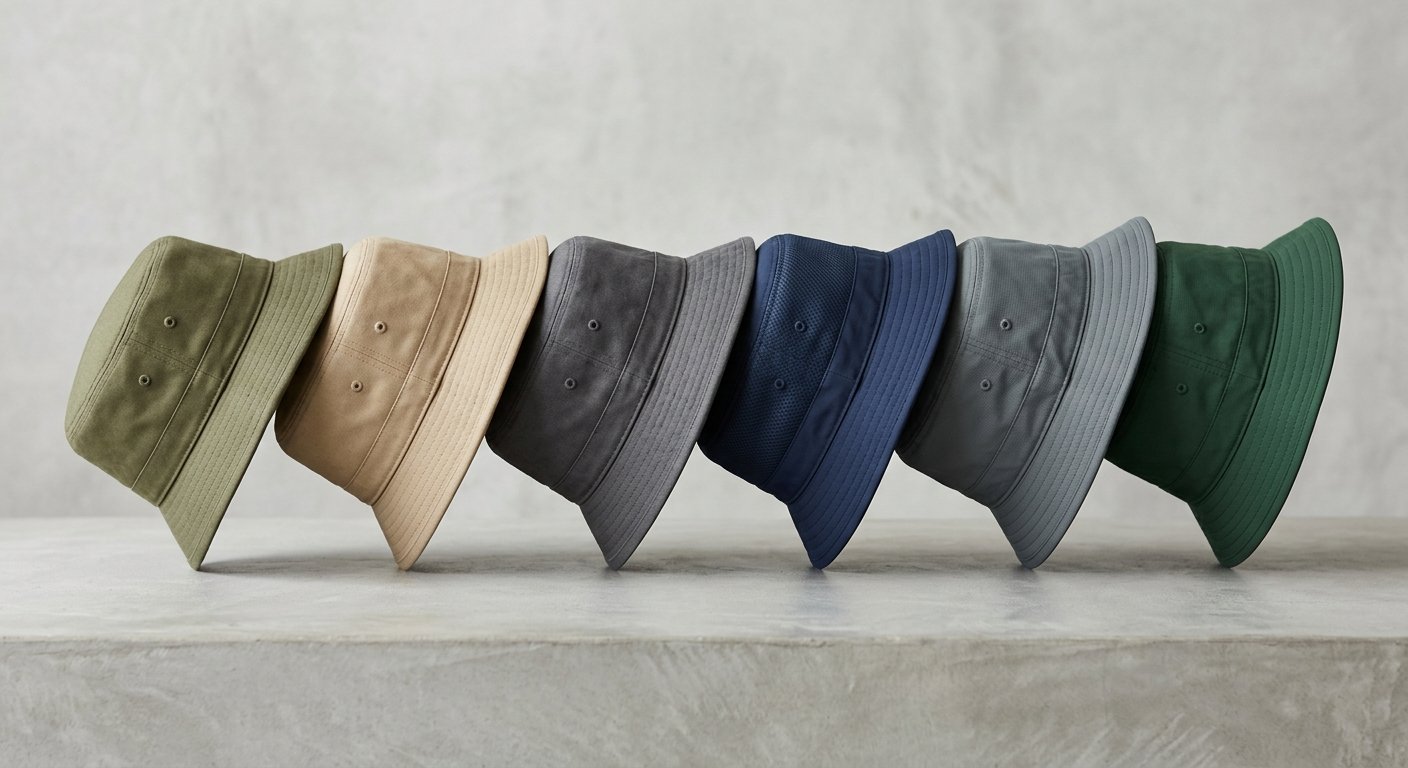

Bucket Hat Brim Stiffness Wholesale
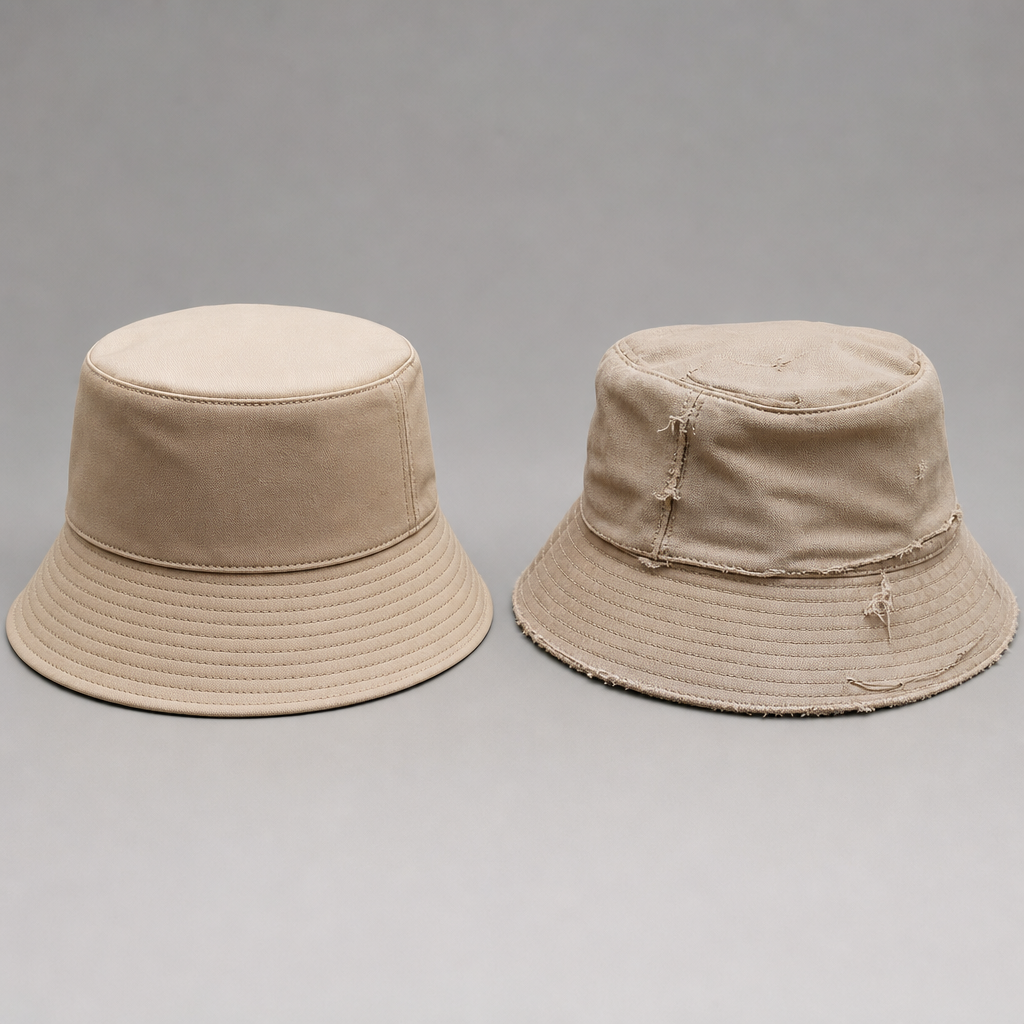
Pain Point: Your bucket hats arrived from the factory looking great — crisp brims, perfect shape. Two weeks on the retail shelf and the brims are drooping, the crowns are collapsing, and customers are walking past because the hats look “tired.” Proper bucket hat brim stiffness wholesale specification prevents this — learn the interlining, stitch, and fabric specs that guarantee shape retention through shipping and retail.
1. The Engineering Behind Bucket Hat Brim Stiffness
Direct answer: Bucket hat brim stiffness wholesale specifications start with the interlining — the hidden fabric layer between the brim’s top and bottom that provides structure. For wholesale orders, specifying the right interlining type and weight is the difference between a hat that holds its shape through a summer season and one that wilts after the first wash.
Several types of interlining are used in wholesale bucket hat production, each with different stiffness grades, costs, and wash durability:
Non-Woven Fusible Interlining (Lightweight, 30-40g/m²): The most common choice for casual and fashion bucket hats. It provides moderate stiffness — enough to hold the brim shape during wear but flexible enough for the hat to be folded and packed. This interlining fuses to the brim fabric using heat and pressure during manufacturing. Cost: approximately $0.05-0.10 per hat. Durability: maintains 80-85% stiffness after 5 machine washes.
Woven Cotton Interlining (Medium, 80-100g/m²): The preferred choice for premium and outdoor bucket hats. Woven interlining provides significantly more structure than non-woven, with better wash durability (90-95% stiffness retention after 10 washes). However, it increases the brim’s weight and reduces packability. Cost: approximately $0.12-0.20 per hat. Hongyuecap’s default specification for wholesale bucket hats is medium woven cotton interlining — it balances structure, durability, and cost for the B2B market.
Plastic/Polymer Brim Insert (Heavy, 0.3-0.5mm thick): Used for fishing, hiking, and utility bucket hats that require maximum brim rigidity. The plastic insert is sewn into a channel between the brim’s top and bottom fabric layers, creating a completely rigid brim that won’t droop even when wet. The trade-off: the hat cannot be folded and must be shipped flat. Cost: approximately $0.20-0.35 per hat. Available as an upgrade option for outdoor-focused wholesale orders.
Related: Bucket Hat Wholesale Sourcing Guide
2. Brim Stitch Construction: The Invisible Quality Differentiator
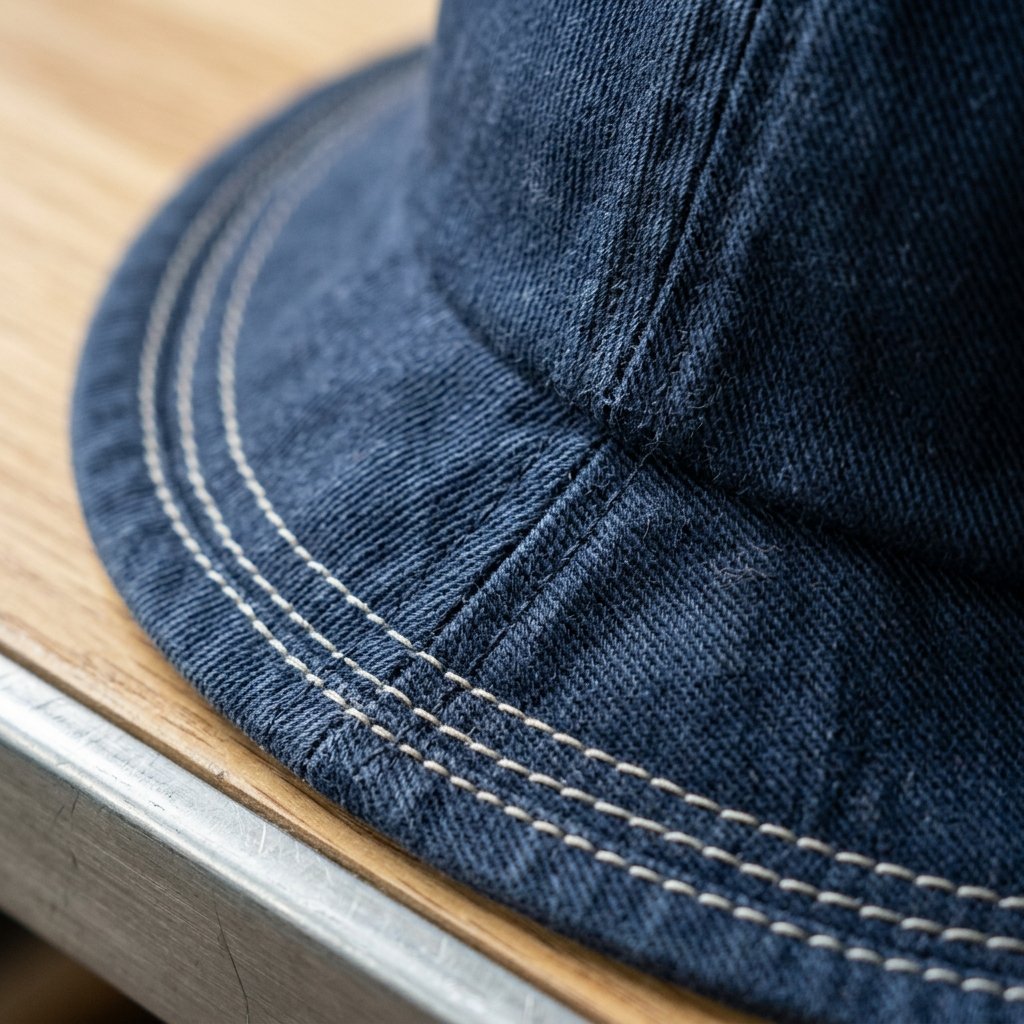
Direct answer: The stitching around the bucket hat brim is not just decorative — it’s structural. The number of stitch rows, stitch type, and thread weight all contribute to brim shape retention. Double-stitch brim construction is the minimum standard for wholesale bucket hats; single-stitch brims should be rejected for any order intended for retail.
A bucket hat brim’s stitch construction serves two functions: (1) securing the interlining between the top and bottom fabric layers, and (2) creating a tension ring that helps the brim maintain its angle. Double-stitch (two parallel rows of stitching at the brim edge) provides both functions at once — the inner row secures the interlining, and the outer row creates the tension ring.
Single-stitch brims attempt to do both jobs with one row, and they typically fail at both. After repeated handling, the single stitch line loosens, the interlining shifts, and the brim begins to droop. Hongyuecap does not offer single-stitch brims for wholesale orders — the failure rate (15-25% within the first 3 months of retail) is too high for B2B quality standards.
The optimal stitch specification for wholesale bucket hats: two rows of lock-stitch (301), 8-10 stitches per inch, using 40-weight polyester thread. This specification has been validated through Hongyuecap’s production of over 100,000 bucket hats with a brim failure rate under 0.5% (based on QC data and buyer feedback from 2024-2026 orders).
For premium or high-stress applications (outdoor, beach, sports), a third stitch row — a top-stitch along the brim’s upper edge — adds visual detail and additional structural reinforcement. This adds approximately $0.05-0.10 per hat in production cost.
3. Fabric Weight and Its Impact on Brim Shape
Direct answer: Fabric weight — measured in GSM (grams per square meter) or oz/yd² — directly affects how well a bucket hat brim holds its shape. Lighter fabrics (under 180 GSM) require heavier interlining to compensate; heavier fabrics (over 250 GSM) can use lighter interlining because the fabric itself provides structure.
The relationship between fabric weight and brim performance can be summarized in a simple rule: “Fabric weight + interlining weight = total brim stiffness.” Wholesale buyers can achieve the same final brim stiffness through different combinations:
| Fabric | 重量 | Interlining Required | Total Cost (est.) | 最适合 |
|---|---|---|---|---|
| Lightweight Cotton (140-160 GSM) | 低 | Heavy (100g/m² woven) | 中型 | Summer fashion |
| Midweight Cotton Twill (200-240 GSM) | 中型 | Medium (80g/m² woven) | Optimal | All-purpose wholesale |
| Heavy Canvas (280-350 GSM) | 高 | Light (30g/m² non-woven) | Higher | Outdoor/workwear |
| Nylon/Polyester (100-150 GSM) | Very Low | Polymer insert required | Highest | Packable/travel |
Hongyuecap’s recommended specification for standard wholesale bucket hats: 200-240 GSM cotton twill fabric + 80g/m² woven cotton interlining + double-stitch brim construction. This combination has proven to maintain brim shape through retail display (30+ days of handling), shipping (compression in bulk cartons), and 10+ machine washes — the gold standard for B2B bucket hat quality.
Explore bucket hat options at Hongyuecap
4. Brim Width and Angle: Design Decisions That Affect Shape Retention
Direct answer: Wider brims and steeper downward angles create more gravitational force on the brim edge, increasing the demand on interlining and stitch construction. A 3-inch brim requires approximately 40% more structural support than a 2-inch brim of the same construction.
Bucket hat brims typically range from 2 inches (5 cm) for fashion styles to 4 inches (10 cm) for sun-protection and utility styles. As brim width increases, the lever arm (the distance from the crown attachment point to the brim edge) increases, creating more torque that pulls the brim downward. This is simple physics, but it’s routinely overlooked in wholesale specification.
For brims wider than 2.5 inches (6.4 cm), Hongyuecap recommends upgrading from woven cotton interlining (80g/m²) to heavy woven interlining (100g/m²) or adding a third stitch row at the brim edge. For brims wider than 3.5 inches (8.9 cm), a plastic polymer insert becomes the recommended option — the gravitational force on a 3.5+ inch brim is too great for fabric-based interlining alone over a full product lifecycle.
Brim angle — the downward tilt of the brim relative to horizontal — also affects shape retention. A steeper angle (30-40° downward) distributes weight more evenly around the brim circumference, reducing stress at any single point. A shallow angle (10-20°) concentrates more weight at the front of the brim, where it’s most visible to the wearer and most likely to droop. Hongyuecap’s default brim angle is 25-30° — the industry standard that balances sun protection with shape stability.
5. Care and Packaging: How to Preserve Brim Shape Through the Supply Chain
Direct answer: Even perfectly specified bucket hats can arrive with drooping brims if they’re packed incorrectly. The key to maintaining brim shape through shipping and retail is: never fold the brim, always pack with crown support, and include care instructions with every hat.
The most common cause of brim failure at the point of sale is compression during shipping. When bucket hats are packed flat in bulk cartons, the brims are compressed against each other under the weight of the stack. Over 2-4 weeks of ocean freight (standard for Guangdong-to-US/EU shipping), this compression permanently deforms the interlining, and the brims will not recover their original shape even after unpacking.
Hongyuecap’s shipping specification for wholesale bucket hats includes these protective measures:
- Individual crown stuffing: Each hat’s crown is stuffed with acid-free tissue paper (or a recyclable paper form for orders over 5,000 units) to maintain crown shape and prevent crushing.
- Brim interleaving: Sheets of corrugated cardboard (1.5mm thick) are placed between layers of hats to prevent brim-to-brim compression. This adds approximately $0.03-0.05 per hat to packaging cost.
- Vertical packing (recommended for premium orders): Hats are packed vertically in individual compartments within the carton, eliminating brim compression entirely. This is the most protective method but increases shipping volume by approximately 30-40%.
For retail display, Hongyuecap recommends including a simple care card with each hat: “To restore brim shape after travel/storage: lightly steam the brim for 10-15 seconds, then press flat under a heavy book for 1 hour. Do not iron directly.” This empowers your retail customers to refresh hats that have been handled or tried on repeatedly.
常见问题
Can bucket hats be folded for travel without losing brim shape?
Yes, but only if specified with the right materials. For packable/foldable bucket hats, specify lightweight nylon or polyester fabric (100-150 GSM) with no interlining in the brim — instead, use a removable plastic brim insert that the wearer can take out before folding. The hat body should be crushable (like a packable sun hat). Note that this is a completely different product category from standard structured bucket hats and requires a separate specification.
How do I test brim stiffness before approving a bulk order?
Request a pre-production sample (PPS) from Hongyuecap. Test the brim by: (1) holding the hat by the crown with the brim horizontal — a properly stiffened brim should not droop more than 15° below horizontal; (2) folding the brim upward 90° and releasing — it should return to its original angle within 2 seconds; (3) machine washing the sample once (cold, gentle cycle) — the brim should maintain 80%+ of its original stiffness.
What’s the difference between brim stiffness and brim shape retention?
Brim stiffness refers to how rigid the brim feels when new (out of the box). Brim shape retention refers to how well it maintains that stiffness over time through wear, washing, and handling. A cheap hat can feel stiff initially (using starch-based stiffeners) but lose shape after one wash. Quality interlining provides both initial stiffness AND long-term retention. Always specify shape retention requirements, not just initial stiffness.
CTA: Ready to order bucket hats with guaranteed brim shape retention? Contact Hongyuecap for fabric swatches, interlining samples, and a free quotation. We’ll spec the right combination of fabric, interlining, and stitch construction for your target market and price point.
Written by the Hongyuecap Product Team — 10+ years in B2B custom headwear manufacturing. Last updated: May 03, 2026.
Related Resources for Wholesale Buyers: