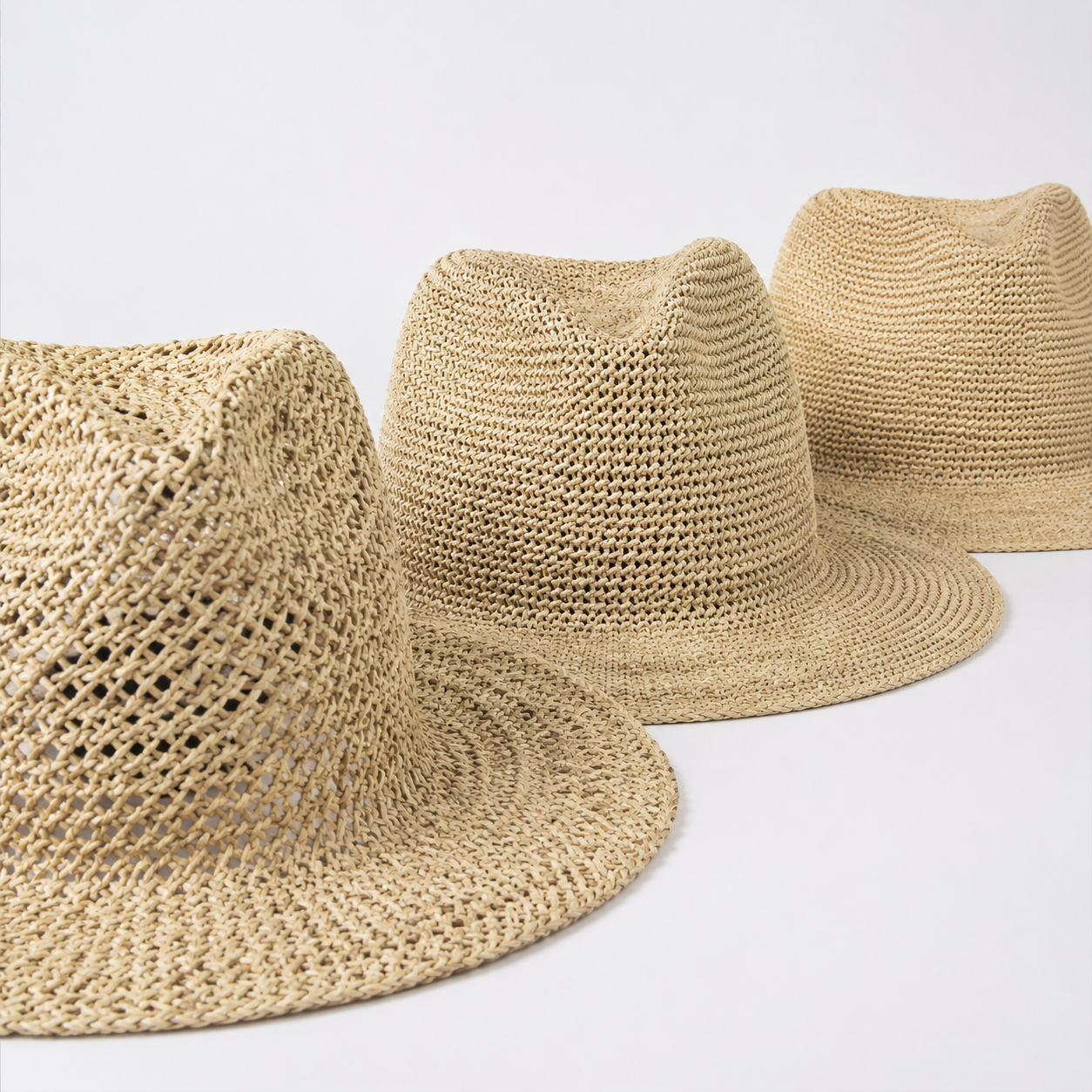

Straw Hat Color Fastness Standards: Dye Fade, Sunlight & Sweat Test for Wholesale Buyers
Your straw hat order looked flawless in the product photos — consistent color, clean weave, retail-ready. But after three weeks on the sales floor or a single sunny afternoon on a customer’s head, the color shifted. The straw darkened unevenly where it touched skin. The vibrant trim bled onto the brim. The hat came back as a return, and your buyer is asking questions.
Key Pain Point: Straw hat color fade, UV damage, and sweat staining cause 15–25% return rates in wholesale orders — yet most buyers discover this only after the first production batch arrives. Testing to AATCC and ISO standards before ordering is the only reliable prevention.
Color fastness failure is one of the top three quality complaints in straw hat wholesale — and the most expensive to fix after production. Unlike fabric hats, where color lives in woven threads, straw hats rely on dye absorption into natural or paper fibers that behave unpredictably under sun, sweat, and friction. A single batch with poor color fastness can trigger chargebacks, retail de-listings, and lost seasonal windows.
This guide covers the three critical color fastness dimensions every wholesale buyer must verify — dye fade, sunlight fastness, and perspiration fastness — plus the standards, test methods, and supplier checklist you need to protect your orders.
1. Dye Fade on Straw Hats — The Buyer’s Primary Risk
The Problem
Straw hats arrive with vibrant, uniform dye. Within 15–30 days of retail display or customer wear, the color visibly fades or changes tone — often unevenly. This is the most common color fastness complaint in straw headwear, affecting dyed trims, ribbons, hatbands, and even the straw body itself when surface-dyed. Industry data suggests that color fade accounts for roughly 40% of straw hat quality disputes at wholesale level.
The Root Cause
Unlike cotton or polyester fabric where dye bonds with individual fibers through chemical affinity, straw materials — whether natural raffia, seagrass, toquilla palm, or synthetic toyo/paper fiber — have non-porous, waxy surfaces that resist dye penetration. Many budget suppliers apply surface-level dye coatings rather than penetrating dyes, which bond weakly and shed rapidly under friction, handling, and UV exposure. The AATCC Test Method 8 (crocking) routinely reveals this: surface-dyed straw shows Grade 2 or lower dry crocking after just 10 rub cycles, compared to Grade 4+ for properly penetrated dyes on the same material.
Buyer Action
Solicitud AATCC 8 and AATCC 61 test reports from every potential supplier before sampling. AATCC 8 measures color transfer from crocking (rubbing), while AATCC 61 simulates laundering color loss. For straw specifically, ask for ISO 105-C06 as an alternative standard. Reject any supplier who cannot provide lab reports showing Grade 3.5 or higher for dry crocking and Grade 3 or higher for wet crocking on straw materials. During sample inspection, perform a simple white cloth rub test on dyed trims and hatbands — if color transfers visibly, the production run will have the same issue at scale. (Reference: AATCC Test Method Overview)
2. Sunlight (Light) Fastness — UV Degradation of Straw Color
The Problem
A straw hat displayed in a shop window or worn during a beach vacation loses its original color after extended sun exposure. Natural straws yellow or darken unevenly; dyed straws fade to a washed-out version of the original shade; dark trim colors lighten while the hat body remains unchanged, creating a mismatched look. For a B2B buyer, this means a 40–60% return rate on straw hats sold through outdoor summer retail channels is not uncommon when light fastness is below Grade 4.
The Root Cause
Ultraviolet radiation breaks the chemical bonds in both natural straw fibers and applied dyes. Natural straw materials (raffia, seagrass, wheat straw) contain lignin — a natural polymer that photochemically degrades and yellows under prolonged UV exposure. Synthetic paper fiber (toyo) resists UV better but the surface dyes still degrade faster than the base material, leading to differential fading. The industry benchmark is AATCC Test Method 16 o ISO 105-B02, which uses a xenon-arc lamp to simulate sunlight exposure. Straw hats typically test at Grade 2–3 on the blue wool scale at budget manufacturers, whereas premium exports consistently achieve Grade 4–5.
Buyer Action
Specify minimum Grade 4 light fastness (ISO 105-B02, blue wool scale) in your purchase contract for any straw hat order destined for outdoor or summer retail. For maximum protection, Grade 5 is preferred for dark colors where fading is most visible. Request xenon-arc test reports showing hours of exposure and resulting grade. Understand that straw hats catalogs cannot guarantee sun-fade performance without tested UV stabilizers — check whether your supplier adds UV absorbers to dye baths or applies a UV-protective top coat. Our Straw Hat UPF & Sun Protection Guide covers how UV protection for the wearer relates to color fastness of the hat itself.

3. Perspiration (Sweat) Fastness — The Hidden Quality Killer
The Problem
The customer wears the straw hat on a hot day. By evening, a dark ring has formed along the sweatband area, or the straw has absorbed moisture unevenly, creating permanent staining and color migration. In tropical and humid markets (Southeast Asia, Florida, the Gulf Coast), sweat-related color damage is the #1 straw hat return reason, surpassing brim deformation and sizing.
The Root Cause
Human perspiration contains salt, ammonia, amino acids, and pH that can range from 4.5 to 8.0 depending on the individual. When absorbed by straw fibers, these compounds chemically react with the dyes — especially azo and direct dyes commonly used on budget straw hats. The AATCC 15 / ISO 105-E04 standard tests color fastness to perspiration using both acidic and alkaline artificial sweat solutions. Straw hats that pass at Grade 3+ under both pH conditions are suitable for humid retail markets; hats tested at Grade 2 or below will stain and fade after a single day’s wear.
An additional factor is moisture wicking from the sweatband. A low-quality sweatband that absorbs sweat and transfers it into the straw body accelerates the problem. Even if the straw dye itself is sweat-fast, a poor sweatband can wick moisture into undyed areas, creating secondary staining. See our Hat Sweatband Materials & Moisture Guide for compatible band selection for straw hats.
Buyer Action
Require AATCC 15 o ISO 105-E04 test certification from your supplier, with results showing Grade 3 or higher for both acidic and alkaline perspiration (ISO 105-E04 specification). If you serve humid or tropical markets, specify Grade 3.5 minimum. During pre-shipment inspection, request a simple spot check: apply a drop of pH-neutral saline solution to the dyed straw and sweatband area, leave for 4 hours, and check for color change or migration. Also verify

that the sweatband is treated with antimicrobial backing to prevent sweat wicking into the straw crown — a common failure point on budget straw hats wholesale lines.
4. Material & Dye Type Impact on Color Fastness
The Problem
Two straw hats from different suppliers, both claiming to meet ISO color fastness standards, perform completely differently in the field. The buyer discovers that material choice — not just dye quality — determines actual field performance. Ordering a specific dye specification without controlling for material type leads to inconsistent results across batches.
The Root Cause
Different straw materials absorb and retain dye differently:
- Toquilla palm (Panama hats): Naturally light-colored with a tight, dense weave. Takes penetrating dyes moderately well but requires prolonged dye bath immersion. Light fastness is naturally higher due to low lignin content.
- Raffia: Soft, fibrous, and porous. Absorbs dye quickly but also releases it under wet conditions. Generally lower wet crocking grades (AATCC 8). Best suited for natural/undyed product lines.
- Pastos marinos: Stiff fibers with natural wax coating. Dye penetration is poor without chemical pre-treatment. Surface dyeing is common but fails fastness testing.
- Toyo / paper fiber: Synthetic cellulose that accepts dyes consistently. Best candidate for high color fastness performance if UV stabilizers are added. Most consistent batch-to-batch results.
- Wheat straw / mixed fiber: Inconsistent composition. Dye take-up varies by harvest batch. Requires pre-production lab testing for every new material lot.
Buyer Action
Match your material choice to your expected retail environment. For outdoor summer markets (high UV, high humidity), specify toyo or premium toquilla with ISO 105-B02 Grade 4+ light fastness and ISO 105-E04 Grade 3.5+ perspiration fastness. For retail-focused indoor retail (less

sun exposure, lower return risk), raffia or seagrass can work at Grade 3 standards — but budget accordingly for higher return rates. Always request material-specific test results, not generic dye certifications. Our Straw Hat Weave Types & Material Guide provides a detailed comparison of each material’s performance characteristics.
5. QC Checklist: Color Fastness Testing Standards for Straw Hat Wholesale Orders
Before approving a bulk production run, confirm these five inspection points with your supplier or third-party QC agency:
- Test 1 — Color Fastness to Crocking (AATCC 8 / ISO 105-X12): Verify dry crocking ≥ Grade 3.5, wet crocking ≥ Grade 3.0. Test separately on straw body, dyed trims, and hatbands.
- Test 2 — Light Fastness (AATCC 16 / ISO 105-B02): Minimum Grade 4 on the blue wool scale after 20 hours xenon-arc exposure. Grade 5 for dark colors in outdoor assortments.
- Test 3 — Perspiration Fastness (AATCC 15 / ISO 105-E04): Minimum Grade 3.0 for both acidic (pH 4.5) and alkaline (pH 8.0) solutions. Grade 3.5+ for tropical and humid markets.
- Test 4 — Water Bleeding (AATCC 107 / ISO 105-E01): Immersion test to confirm no color migration between hat components (straw body vs. trim vs. sweatband). Critical for multi-color straw designs.
- Test 5 — Material-Specific Pre-Production Check: For each new material lot, re-run Tests 1–3. Straw materials vary by harvest, processing batch, and season — never carry over test results from a previous production run without re-verification.
For complete sourcing criteria beyond color fastness, see our Straw Hat Wholesale Buying Guide and Straw Hat Weave Density Guide for weave-related quality benchmarks.
Frequently Asked Questions
Q1: Can straw hats be color fastness tested without a lab?
Yes — field-level screening is possible. For a quick crocking test, rub a white cotton cloth firmly across a dyed straw surface 10 times. Any visible color transfer indicates Grade 2 or below. For perspiration screening, apply a drop of saline solution (1 teaspoon salt in 1 cup water) to an inconspicuous area, wait 4 hours, and blot with white tissue. Color change or migration suggests the hat will fail in humid conditions. These are not substitutes for certified AATCC or ISO lab testing, but they help flag problems before bulk shipment.
Q2: Which straw material has the best color fastness overall?
Toyo (paper fiber) generally delivers the most consistent color fastness performance across all three dimensions (dye fade, light, and perspiration), provided the manufacturer adds UV stabilizers and uses penetrating rather than surface dyes. Among natural fibers, toquilla palm offers superior light fastness but requires careful dye selection for perspiration resistance. Avoid seagrass for heavily dyed or multi-color designs unless the supplier provides AATCC 15 certification at Grade 3+.
Q3: What causes uneven fading on the same straw hat?
Uneven fading typically comes from two sources: (1) differential dye penetration — areas with tighter weave absorb less dye, creating lighter zones that fade faster; and (2) selective UV exposure — the hat crown at the top receives more direct sunlight than the underside of the brim. This is normal to some degree on natural straw, but extreme differential fading (grade difference of 2+ points between crown and brim) indicates poor dye application. Request testing on both crown and brim samples separately (AATCC 16) to verify consistency.
Q4: Are synthetic straw hats more color fast than natural straw?
In most cases, yes. Toyo and other synthetic paper fibers have uniform chemical composition, consistent dye uptake, and can accept UV stabilizers and fixatives more reliably than natural straw fibers. Natural straw (raffia, seagrass, wheat straw) contains lignin, wax, and inconsistent fiber densities that complicate dye bonding. However, premium-grade natural toquilla palm with proper dye selection can match synthetic performance — at a higher cost point. Always verify with certified testing rather than assuming based on material type.
Secure Your Straw Hat Inventory with Tested Quality
Color fastness is not an optional specification — it is a direct driver of return rates, customer satisfaction, and repeat order volume. Wholesale buyers who skip fastness testing save 2–3% on unit cost upfront but face 15–25% return rates that erase all margin. The data is clear: investment in AATCC and ISO certification at the sampling stage pays for itself in the first production cycle.
Browse our verified straw hats wholesale collection, where every bulk line is tested for color fastness compliance. Contact our B2B team through the product pages for test certifications, bulk pricing, and custom color matching across our full headwear catalog.
→ View All Straw Hats Wholesale
Get Your Straw Hats Factory-Tested for Color Fastness
Don’t let color fastness issues eat into your margins. Hongyuecap tests every bulk straw hat order to AATCC and ISO standards before shipment. Contact our B2B team for certified test reports, bulk pricing, and custom color matching for your next straw hat collection.
See our complete wholesale hat selection for more options.
See our complete wholesale hat selection for more options.
See our complete wholesale hat selection for more options.
Written by the Hongyuecap Product Team — 10+ years in B2B custom headwear manufacturing. Last updated: May 23, 2026.