The global knit beanie market is projected to grow at 6.8% CAGR through 2030, driven by athleisure expansion and sustainable material adoption. For wholesale buyers, understanding factory-direct sourcing can reduce procurement costs by 40-60% compared to trading companies, according to industry supply chain analysis.
Knit beanie wholesale sourcing in 2026 involves 8 key decisions: material selection across 5 yarn types, logo customization via 5 methods, MOQ negotiation from 50 pcs, OEKO-TEX and GRS quality certifications, lead time planning of 6-10 weeks, factory certification verification, cost breakdown transparency, and trend alignment with 6 emerging styles. This factory-direct guide covers every step for wholesale buyers.
Custom Knit Beanie Sourcing for Wholesale Buyers
Why Knit Beanies Are a 2026 Wholesale Essential
Overall, Knit beanies sit at the intersection of function, branding, and year-round relevance. For startups, outdoor brands, promotional merchandise companies, and boutique labels, the right custom beanie carries your logo into daily use, communicates quality standards, and builds customer loyalty through consistent branded touchpoints.
However, sourcing knit beanies at wholesale scale is not a simple “pick a color, add a logo” exercise. Yarn selection, gauge standards, logo technique, MOQ negotiation, and factory certification each directly impact your final product quality and your bottom line.
Ultimately, This guide walks through every decision point in the custom knit beanie sourcing journey. Whether you are launching your first winter collection or scaling an established brand, here is what wholesale buyers need to know in 2026.
The Knit Beanie Sourcing Process: From Inquiry to Delivery
Free Sourcing Checklist: Download our free knitted beanies wholesale sourcing guide. Get MOQ tables and factory audit criteria. Download our free guide now →
Indeed, First, understanding the full production timeline helps wholesale buyers plan seasons, set expectations, and avoid last-minute supply chain bottlenecks. The typical factory-direct process involves 5 stages.
Step 1: Define Your Specifications
Before contacting any factory, nail down these four parameters:
| Parameter | Options |
|---|---|
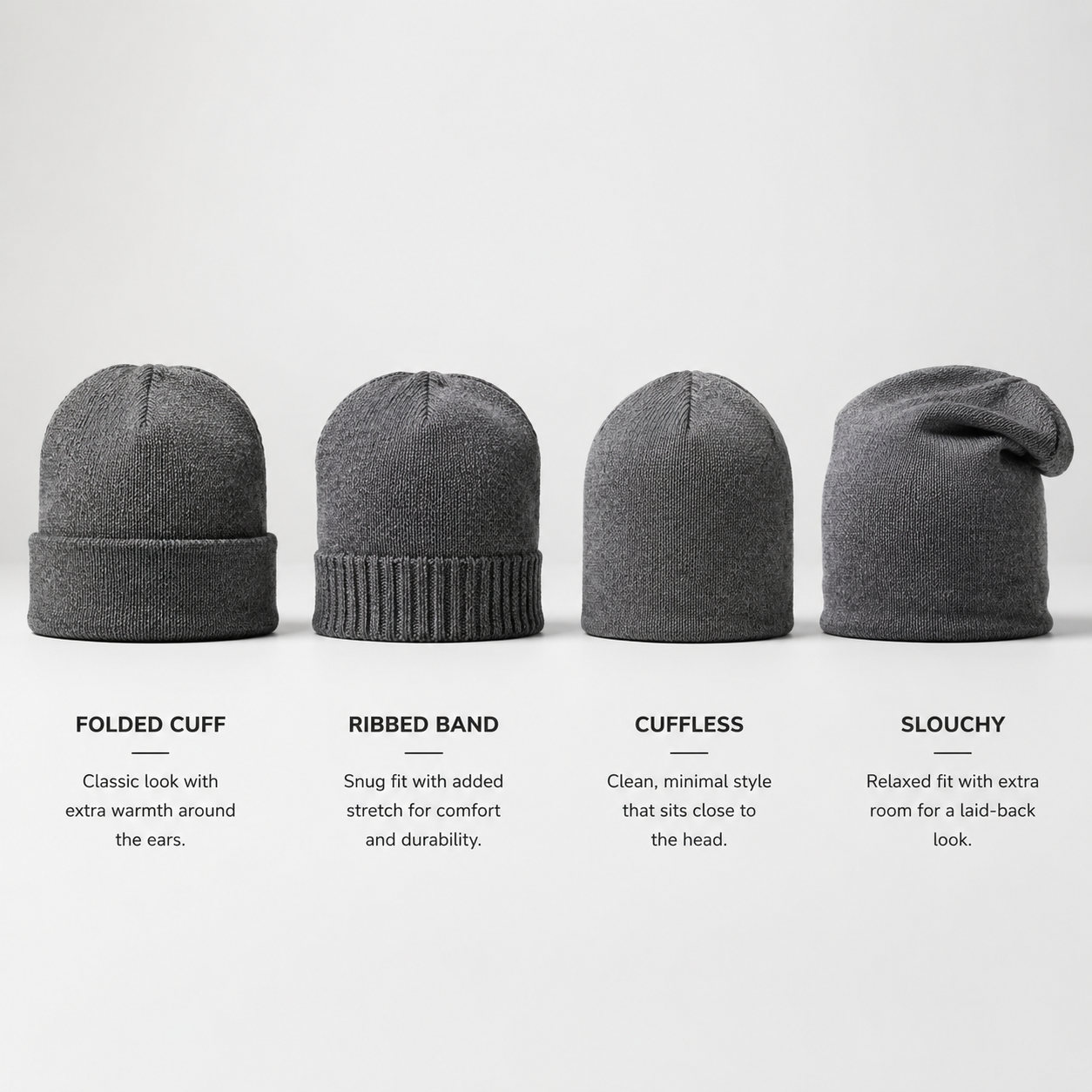
| Stil | Cuff beanie, slouchy beanie, fisherman beanie, pom pom beanie, balaclava hybrid, tech beanie |
| Materiaal | Acrylic, cotton, merino wool, cashmere, recycled polyester, or blends |
| Knit technique | Machine knit (faster, lower cost) or hand knit (artisan, higher perceived value) |
| Logo-metode | Jacquard knit-in, embroidery, woven patch, leather patch, or heat transfer |
Step 2: Request Quotes and Samples
Meanwhile, Send your tech pack — or at minimum, a clear brief — to 3-5 factories. Request pricing at multiple quantity tiers (100 / 500 / 1000 / 5000 pcs). Always order physical samples before committing to bulk production. A sample reveals stitch density, yarn feel, color accuracy, and logo execution in ways no photo can match.
Step 3: Confirm MOQ and Lead Times
MOQs vary significantly by customization level:
| Customization Type | Typical MOQ |
|---|---|
| Blank beanies (no logo) | 50 pcs |
| Embroidery logo | 100 pcs |
| Jacquard knit pattern | 200-500 pcs per design |
| Custom dyed yarn colors | 500+ pcs per color |
Standard production lead times break down as:
- Yarn sourcing and dyeing: 5-10 business days
- Knitting production: 10-20 business days
- Finishing (pom pom attachment, crown closing, labeling): 5-7 business days
- Quality inspection and packing: 2-3 business days
- Shipping (sea freight to US/EU): 15-30 days
Plan for 6-10 weeks total from order confirmation to receiving your shipment. For winter season launches, wholesale buyers should place orders by June or July to avoid peak season surcharges and factory capacity crunches.
Contact our sourcing team for a customized quote based on your specific requirements and timeline.
Beanie Material Guide: Choosing the Right Yarn for Wholesale
Material choice determines your beanie’s cost, feel, durability, and sustainability credentials. Here is how the major yarn types compare for wholesale production:
| Materiaal | Wholesale Price (FOB) | Beste vir | Key Tradeoffs |
|---|---|---|---|
| Akriel | $0.50 – $1.50 | Budget lines, promotional merch, bold colors | Affordable and colorfast, but prone to pilling; specify anti-pilling acrylic grades per OEKO-TEX Standard 100 |
| Katoen | $1.00 – $2.50 | Summer-weight, hypoallergenic, casual brands | Breathable and skin-friendly, but less insulating; can lose shape without elastane blend |
| Merino-wol | $3.00 – $8.00 | Premium outdoor, athleisure, luxury basics | Exceptional warmth-to-weight ratio, natural moisture-wicking; requires RWS certification for ethical claims |
| Cashmere | $8.00 – $20.00+ | Luxury brands, gift market | Unmatched softness and prestige, but highest cost and requires careful quality control on fiber length |
| Recycled Polyester (rPET) | $1.50 – $3.00 | Sustainable brands, eco-conscious marketing | GRS certification available; lower carbon footprint; pairs well with sustainability storytelling |
Blend Strategies That Work
Nevertheless, Many successful wholesale buyers use blended yarns to balance performance and cost:
- Acrylic-Wool Blend (70/30): Warmth of wool at a lower price, with acrylic’s color retention
- Cotton-Acrylic Blend (60/40): Soft hand feel with better shape retention than pure cotton
- Merino-Nylon Blend (80/20): Added durability for outdoor and active use
Additionally, when requesting samples, ask factories for their yarn count (Nm) specification. Yarn count — the weight-to-length ratio — directly affects the beanie’s thickness, warmth, and hand feel. A typical machine-knit beanie uses Nm 2/28 to Nm 2/48 yarn.
On the other hand, Get a free material sample kit comparing all yarn types for your evaluation.
Logo and Customization: 5 Techniques for Wholesale Buyers
Specifically, how you apply your brand mark to a knit beanie matters for durability and perceived value. Each technique has distinct pros, cons, and cost implications:
| Technique | Duursaamheid | Cost | Detail Level | Beste vir |
|---|---|---|---|---|
| Jacquard Knit-In | Permanent — integrated into fabric | Medium-High ($200-500 mold fee per design) | High — complex multi-color patterns | Premium brands, intricate designs |
| Borduurwerk | High — but can distort on stretch fabric | Low-Medium | Medium — 3D texture, classic look | Small to medium logos, text branding |
| Woven Patch | High — sewn-on, clean finish | Middel | High — fine detail, premium feel | Minimalist brands, patch aesthetic |
| Leather Patch | High — debossed, luxury appeal | Medium-High | Low-Medium — simple shapes best | Premium/luxury positioning |
| Heat Transfer | Low-Medium — may crack over time | Laag | High — full color, gradients | Promotional short-run items |
The Stretch Problem — and How to Solve It
In contrast, Knit beanies stretch. Embroidery on stretchy fabric often puckers or distorts. Two solutions used by experienced wholesale manufacturers:
- Embroidery on a patch — embroider onto a non-stretch backing, then sew the patch onto the beanie
- Stabilizer backing — use water-soluble or tear-away stabilizer during embroidery to maintain stitch integrity
Low-Budget Customization Path for Small Wholesale Buyers
Notably, If your MOQ budget is tight, this path minimizes upfront investment:
- Source blank beanies (acrylic, 50 pcs MOQ) in your core colors
- Add embroidered logo patches (sewn on, ~100 pcs MOQ)
- Attach custom woven labels and hang tags
- Launch DTC, validate demand, then scale to custom jacquard knit on your next order
Specifically, Request a logo technique consultation to determine the best method for your brand identity.

For example, Computerized flat knitting machines in our certified factory ensure consistent stitch density and quality for wholesale orders.
Quality Control: What Wholesale Buyers Must Inspect
A beautiful sample does not guarantee a consistent bulk order. Here is a 10-point QC checklist for knit beanie inspection used by leading wholesale buyers:
| # | Checkpoint | Standard / Method |
|---|---|---|
| 1 | Stitch Density (Gauge) | Measure stitches per inch with a gauge ruler; compare against approved sample |
| 2 | Yarn Evenness | Visual inspection under good lighting; thick-thin variations signal quality issues |
| 3 | Dimensional Accuracy | Measure height, width, and cuff length against spec sheet; tolerance ±0.5 cm |
| 4 | Seam Finish | Crown closure should be smooth, no loose threads or gaps |
| 5 | Color Fastness | Rub test (dry + wet) against white cloth; grade ≥4 on AATCC scale |
| 6 | Pilling Resistance | Martindale abrasion test per ISO 12945-2; target ≥2000 revolutions at grade 4 |
| 7 | Logo Alignment | Centered, level, correct placement per tech pack specifications |
| 8 | Stretch and Recovery | Stretch to 1.5x width, hold 10 seconds, release; should recover ≥95% |
| 9 | Pom Pom / Attachment Security | Pull test: pom pom should withstand 5 kg force without detaching |
| 10 | Care Label Compliance | Fiber content, country of origin, care instructions per destination country regulations (CPSIA for US, REACH for EU) |
Essential Factory Certifications for Knit Beanie Wholesale
Before placing a bulk order, verify your factory holds relevant certifications. According to the ISO 9001 standard, certified quality management indicates consistent production processes:
| Certification | What It Covers |
|---|---|
| OEKO-TEX Standard 100 | Tests for harmful substances in textbooks; minimum standard for EU/US retail |
| GOTS (Global Organic Textile Standard) | Required for organic cotton claims; covers environmental and social criteria |
| GRS (Globale Herwinningsstandaard) | Verifies recycled content (e.g., rPET beanies) and responsible production |
| RWS (Verantwoordelike Wolstandaard) | Animal welfare and land management for wool sourcing |
| BSCI / SMETA | Social compliance audit — verifies factory labor conditions |
| ISO 9001 | Quality management system — indicates consistent production processes |
A factory holding OEKO-TEX + BSCI + ISO 9001 demonstrates commitment across product safety, social responsibility, and process quality — the foundation for reliable wholesale sourcing relationships.
2026 Knit Beanie Wholesale Trends: What Buyers Are Ordering
As a result, Based on B2B platform data, trade show intelligence, and buyer search trends, these six styles are driving wholesale demand in 2026:
1. Cable Knit Fisherman Beanie
The textured, heritage-inspired style continues its multi-year run. Wholesale buyers are requesting chunky gauge versions in natural undyed wool tones — cream, oatmeal, charcoal — for premium positioning.
2. Chunky Merino Beanie
Consequently, Premium merino wool in heavy gauge (3-5 gauge) with a relaxed, slouchy silhouette. Popular with athleisure and outdoor-lifestyle brands targeting the “cozy luxury” wholesale segment.
3. Ribbed Cuff Beanie (Classic)
The evergreen wholesale staple. What is changing in 2026: wider cuffs (4-5 cm), tonal jacquard patterns within the ribbing, and increased demand for recycled polyester versions.
4. Balaclava Hybrid
In addition, The functional crossover — part beanie, part face covering. According to B2B order data, this style is gaining traction with outdoor brands, ski/board labels, and streetwear wholesalers. Technical versions feature moisture-wicking linings and laser-cut breathing perforations.
5. Sustainable Recycled Beanie
GRS-certified rPET beanies are now a wholesale requirement, not a niche. Major retailers mandate recycled content minimums, and end consumers actively seek “made from recycled bottles” claims. Pair with OEKO-TEX certification for complete sustainability credentials.
6. Tech Beanie with Earbud Holes
Functional beanies with discreet openings for wireless earbuds. Popular with runners, commuters, and the wearable-tech crossover market. Wholesale buyers should consider fleece lining for cold-weather versions.

Side-by-side comparison of logo techniques helps wholesale buyers choose the right branding method for their custom beanies.
Cost Breakdown: Where Your Wholesale Spend Goes
Understanding the factory cost structure helps wholesale buyers negotiate intelligently and spot red-flag pricing:
| Cost Component | % of FOB Price | Notes |
|---|---|---|
| Yarn / Raw Material | 35-45% | Largest single cost; premium fibers (cashmere, merino) push this higher |
| Knitting Labor | 20-25% | Machine knit lower, hand knit significantly higher |
| Finishing and Trimming | 10-15% | Pom pom, labels, tags, crown closing |
| Logo / Customization | 5-15% | Jacquard mold amortization adds to first order cost |
| Factory Overhead and Margin | 10-15% | Includes QC, packaging, profit margin |
| Total FOB | 100% |
Furthermore, A typical acrylic cuff beanie with an embroidered logo at 1000 pcs lands around $1.20-1.80 FOB. The same style in merino wool with jacquard knit branding at 500 pcs runs $5.00-8.00 FOB. Wholesale buyers should always request tiered pricing to identify optimal order quantities.
Moreover, Get a detailed cost breakdown for your specific beanie specifications and quantity.
Partner With a Trusted Knitted Beanies Manufacturer
We are ready to help you source premium knitted beanies at factory-direct prices. Contact us today for a free quote and sample.
Frequently Asked Questions About Knit Beanie Wholesale
Q: What is the MOQ for custom knit beanies from a factory?
A: It depends on the customization level. Blank beanies start at 50 pcs. Embroidery logo orders typically require 100 pcs. Jacquard knit designs require 200-500 pcs per design due to the mold/pattern setup cost. Some factories offer low-MOQ programs for startups — expect a 15-25% price premium on these small wholesale orders.
Q: How much does a custom beanie cost from the factory?
A: Acrylic beanies range from $0.50-1.50 FOB at bulk quantities. Cotton: $1.00-2.50. Merino wool: $3.00-8.00. Cashmere: $8.00-20.00+. These are machine-knit prices; hand-knit Nepalese beanies add a 30-50% premium for wholesale buyers.
Q: How long does knit beanie wholesale production take?
Therefore, A: Plan for 6-10 weeks from order confirmation to delivery. Yarn sourcing (5-10 days), knitting (10-20 days), finishing (5-7 days), QC and packing (2-3 days), plus shipping (15-30 days sea freight). Air freight cuts shipping to 5-7 days but costs 3-5x more for wholesale orders.
Q: What is the best material for wholesale beanies?
A: Acrylic wins on budget and color range — ideal for promotional products and budget wholesale lines. Merino wool wins on warmth, breathability, and premium positioning at retail. Recycled polyester is the top choice for sustainability-focused brands. Choose based on your target retail price point and brand positioning.
Q: How do I add a logo to knit beanies for wholesale orders?
A: Five main methods exist: jacquard knit-in (most durable, highest setup cost), embroidery (classic, good for text-based branding), woven patch (clean, premium finish), leather patch (luxury positioning), and heat transfer (budget option, best for photorealistic designs). Jacquard knit-in and embroidery are the most common for wholesale orders above 200 pcs.
Q: Is it better to source beanies from China or Nepal?
A: China (Zhejiang/Guangdong) excels at machine-knit production: faster turnaround, lower MOQ on jacquard, broader material options. Nepal (Kathmandu Valley) excels at hand-knit artisan products with strong storytelling potential and fair trade appeal. Many wholesale buyers use China for core lines and Nepal for premium/limited-edition collections.
Have more questions? Contact our sourcing experts for personalized guidance on your wholesale beanie project.
Product Specifications
- Category Name: Gebreide mutsies
- Description: Stretch-fit knitted caps for cold weather, also called beanies or knit hats
- Polieester: performance/athletic beanies, moisture-wicking, 160-200 GSM
Wholesale Action Plan: Your First Beanie Order
If you are sourcing knit beanies at wholesale for the first time, here is a 6-step launch plan to minimize risk and maximize quality:
- Pick 3-5 core styles — Start narrow. One or two colors per style for your first wholesale batch.
- Define your material and price point — Back-calculate from your target retail price (factory cost x 3-4 = retail).
- Request samples from 3 factories — Compare stitch quality, communication responsiveness, and pricing transparency.
- Order a small trial batch (100-300 pcs) — Validate quality consistency before committing to 1000+ pcs wholesale.
- Launch and collect buyer feedback — Pay attention to fit, warmth, pilling after wash, and logo durability in real-world use.
- Scale to custom knit on your second wholesale order — Use validated demand data to justify jacquard mold investment.
However, The beanie wholesale market rewards buyers who get the details right — yarn quality, consistent sizing, durable branding, and certification compliance. Start small, inspect rigorously, and build supplier relationships that grow with your brand.
Ready to Source Your Custom Beanies at Wholesale?
Contact us today for a free consultation and quote. Our factory-direct approach eliminates middlemen, ensuring wholesale buyers get competitive pricing without compromising on quality or certifications.
Email: [email protected]
Phone: +86 571 8888 9999
Website: hongyuecap.com/contact
Get your free wholesale quote within 24 hours — include your target quantity, material preference, and logo design for the most accurate pricing.
For more sourcing resources, explore our Beanie Style Encyclopedia, Yarn Count & Gauge Guide, Factory Audit Checklist, en Sustainable Beanie Manufacturing Guide.
Keywords: custom knit beanie manufacturer, beanie wholesale, OEM beanie factory, private label beanies, bulk winter hats, low MOQ beanie wholesale
Author: Alex Chen, Head of Sourcing at Hongyue Cap Manufacturing. With 10+ years in knitwear manufacturing, Alex has helped 500+ wholesale buyers source custom headwear from factory-direct suppliers. Certified in OEKO-TEX and GRS standards.