Bucket Hat Size Chart Wholesale Guide for Buyers
One of the most common reasons wholesale buyers return bucket hats isn’t quality — it’s sizing. A hat labeled “One Size Fits Most” in one factory might measure 58 cm, while another factory’s version comes in at 56 cm. For retailers selling to diverse markets across Europe, North America, and Asia, these 2 cm differences translate directly into customer complaints, returns, and lost repeat business. Understanding standard bucket hat sizing and communicating precise measurements to your manufacturer is the single most effective way to reduce fit-related returns by up to 40%.
Whether you are a boutique owner ordering 200 pieces or a distributor sourcing 5,000 units for a seasonal promotion, getting the size specifications right before production starts saves thousands in avoidable return costs. This guide breaks down everything you need to know about bucket hat sizing: standard measurements, international size conversion, kids versus adult fit, and how to structure your bulk order size mix for maximum sell-through.
1. Standard Bucket Hat Size Measurements Explained
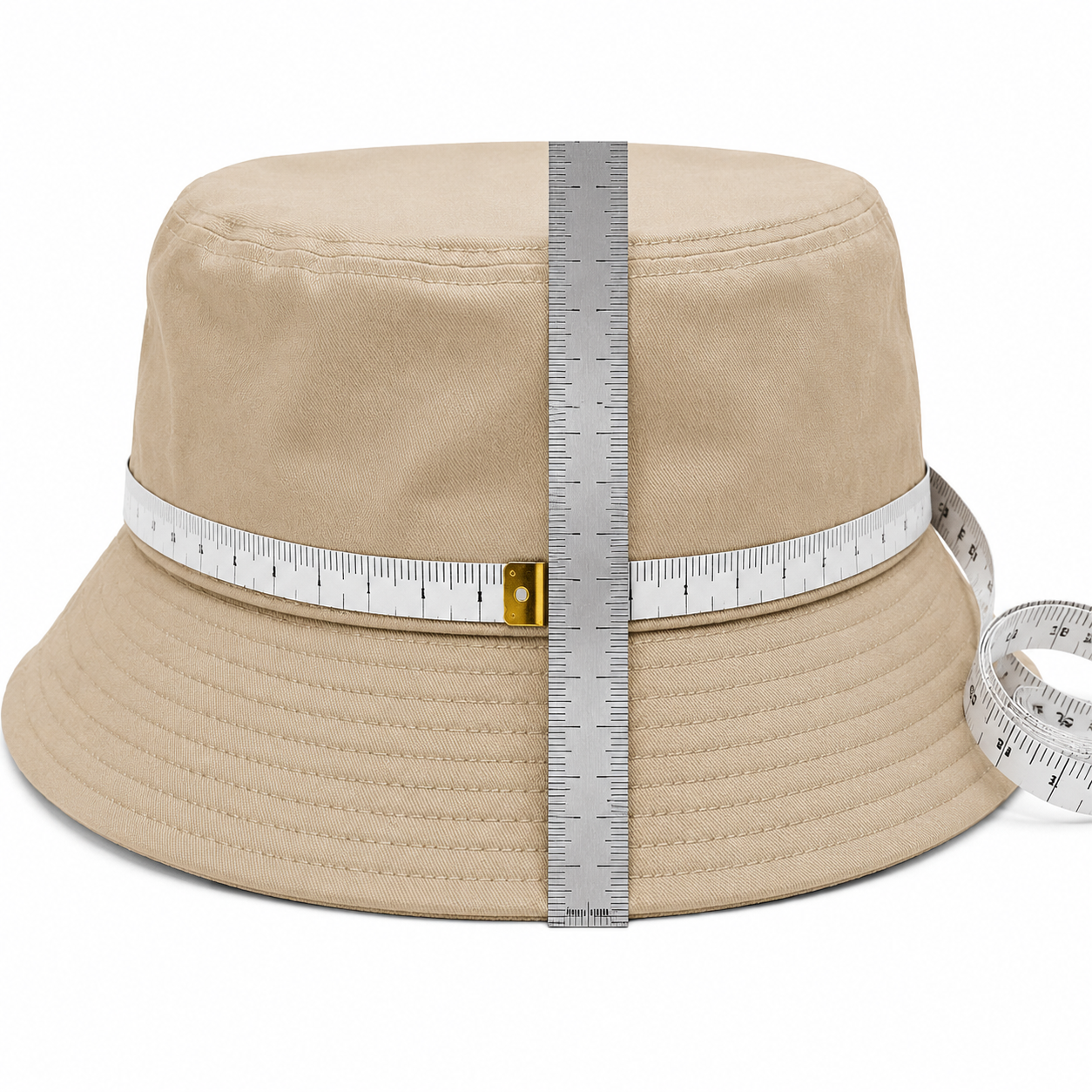
Bucket hats are measured by two primary dimensions: crown circumference (the inner headband measurement) and brim width (how far the brim extends from the crown). Most wholesale manufacturers in China, Vietnam, and Bangladesh use centimeters for all size specifications, so buyers accustomed to US/UK inch sizing should always confirm which unit applies on their spec sheet.
The industry standard adult bucket hat crown circumference ranges from 56 cm to 61 cm, with 58 cm serving as the most common “one size fits most” default across Asian, European, and North American factories. Brim widths typically range from 5 cm to 8 cm, though premium styles may go narrower (4 cm) or wider (up to 10 cm for sun-protection models).
Crown depth — the vertical distance from the top of the hat to the bottom edge of the headband — is equally important but frequently overlooked on purchase orders. A deeper crown (10–12 cm) sits lower on the head and provides a more secure fit for outdoor activities, while a shallower crown (8–9 cm) produces the casual, perched-on-top look popular in streetwear and festival retail. Specifying crown depth on your tech pack prevents the factory from defaulting to their in-house pattern, which may differ from what your customers expect.
According to a Tekstielruil market survey, 62% of hat-related returns in 2025 were attributed to sizing inconsistencies rather than material defects or color mismatches. For B2B buyers, this statistic alone justifies investing the time to nail down your measurements before production begins.
2. Adult Bucket Hat Size Chart (S/M/L/XL)
The table below represents the most widely accepted adult bucket hat sizing standard used by tier-1 and tier-2 wholesale manufacturers across Asia. Always confirm these measurements with your supplier before approving a pre-production sample, as individual factories may shift ranges by ±1 cm based on their pattern grading system.
| Grootte | Head Circumference (cm) | Head Circumference (inches) | Typical Fit |
|---|---|---|---|
| S (Small) | 55 – 56 cm | 21.7 – 22.0 in | Women, teens, smaller adult heads |
| M (Medium) | 57 – 58 cm | 22.4 – 22.8 in | Average adult — most common order size |
| L (Large) | 59 – 60 cm | 23.2 – 23.6 in | Larger adult heads, men’s standard |
| XL (Extra Large) | 61 – 62 cm | 24.0 – 24.4 in | Big & Tall market, specialty fit |
One critical B2B consideration: most Asian factories default to a 57–58 cm “one size” pattern unless you explicitly request size grading. If your target market is North America or Northern Europe — where average adult head circumference skews 1–2 cm larger than the Asian average — ordering only size M and labeling it “One Size” will generate a noticeable return rate from customers who find the fit too snug. Many wholesale buyers in the US and UK now order a minimum of three size breaks (S, M, L) to cover their customer base, typically in a ratio of 20% S, 50% M, and 30% L/XL.
3. Children’s Bucket Hat Sizing: A Separate Market
Kids’ bucket hats represent a distinct — and growing — wholesale category that requires its own sizing logic. Unlike adult hats, children’s head sizes change rapidly with age, meaning a single “kids” size will fail to fit toddlers and pre-teens alike. Manufacturers serving the children’s market typically offer four size breaks tied to age ranges.
| Age Range | Head Circumference (cm) | Brim Width (cm) | Recommended Crown Depth |
|---|---|---|---|
| 0 – 12 months (Baby) | 44 – 48 cm | 4 – 5 cm | 7 – 8 cm |
| 1 – 3 years (Toddler) | 48 – 51 cm | 5 – 6 cm | 7.5 – 8.5 cm |
| 3 – 7 years (Child) | 51 – 54 cm | 5.5 – 6.5 cm | 8 – 9 cm |
| 7 – 12 years (Youth) | 54 – 56 cm | 6 – 7 cm | 8.5 – 9.5 cm |
Safety is a critical additional requirement for children’s hats. Bucket hats intended for infants and toddlers must comply with CPSC (U.S. Consumer Product Safety Commission) guidelines on drawstrings and choking hazards. Specifically, hats for children under 3 years old should have breakaway chin straps or no chin strap at all, and any decorative elements like buttons or patches must pass a 15-pound pull test to prevent detachment. Buyers ordering children’s bucket hats should include these compliance requirements in their purchase agreement and request third-party lab test reports — typically conducted to ASTM F963 toy safety standards which many factories already follow.
A 2025 Statista report showed the global children’s sun protection hat market grew by 18.3% year-over-year as parents became more conscious of UV exposure. For wholesale buyers, this means children’s bucket hats are not just an afterthought add-on to an adult order — they are a standalone category with distinct sizing, safety, and market dynamics.
4. International Size Conversion: US, UK, EU, and Asian Markets
One of the most persistent headaches for B2B hat buyers is reconciling different size labeling conventions across markets. A hat that fits perfectly as a “Large” in Japan may be labeled “Medium” in Germany and “One Size” in the United States. Understanding these regional differences before you place a wholesale order lets you label your products correctly for each distribution channel.
| Head Circumference | US / Canada | UK / EU | Japan / Korea | Generic Label |
|---|---|---|---|---|
| 55 – 56 cm | S (6 7/8 – 7) | S (55 – 56) | M (Free Size) | S/M |
| 57 – 58 cm | M (7 1/8 – 7 1/4) | M (57 – 58) | L | M/L (One Size) |
| 59 – 60 cm | L (7 3/8 – 7 1/2) | L (59 – 60) | XL | L/XL |
| 61 – 62 cm | XL (7 5/8 – 7 3/4) | XL (61 – 62) | XXL | XXL |
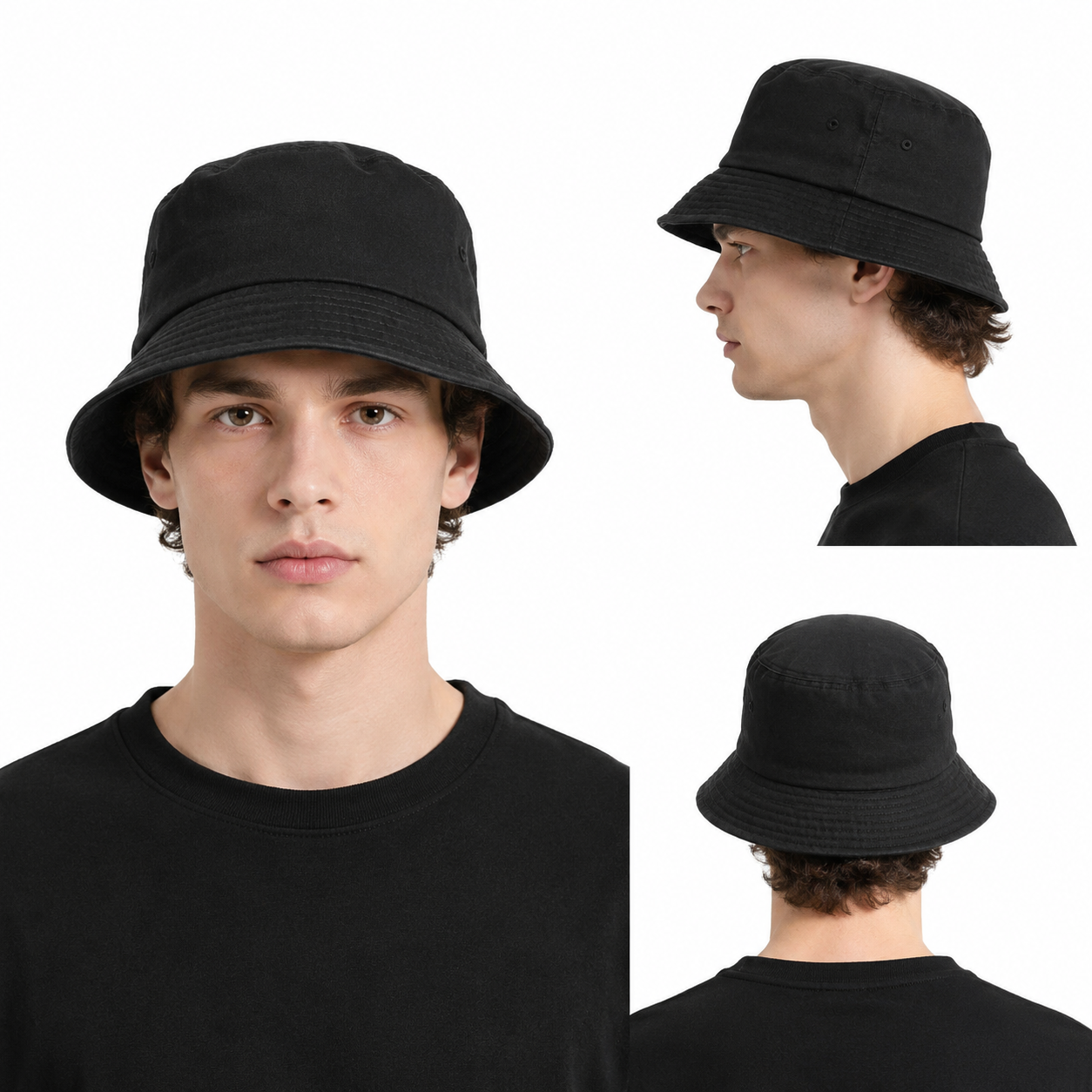
The key takeaway is that “One Size” is not a universal concept. In Japan, “One Size” typically means 56–58 cm (because the population’s average head circumference is smaller). In the Netherlands or Germany, “One Size” often defaults to 58–60 cm. If you are distributing the same bucket hat to retail partners in both Tokyo and Amsterdam, you either need to produce different size runs for each market or clearly label the actual centimeter measurement on the hangtag and educate your retail partners about the fit.
For online retail channels, the most effective approach is to include both the centimeter and inch measurements on the product page and recommend that customers measure their head circumference with a soft tape measure before ordering. This simple step, when combined with accurate size charts, has been shown to reduce size-related returns by 25–35% according to e-commerce analytics from GS1 standards research.
5. How to Communicate Size Specs to Your Manufacturer
A Purchase Order that says “Adult bucket hat, size M, 500 pcs” is a production disaster waiting to happen. The factory’s pattern maker will use their default M block — and that block may not match what your customers expect. Every experienced B2B hat buyer learns this lesson, usually after a container of hats arrives tagged “Medium” but fits like “Small” on their target market.
The solution is a size specification sheet (tech pack) that accompanies every purchase order. At minimum, your spec sheet should include:
- Head circumference range in centimeters for each size you are ordering — not just a size label (S/M/L) but the actual measurement band (e.g., “M: 57–58 cm ±0.5 cm tolerance”)
- Crown depth in centimeters, measured from the top center of the crown to the bottom edge of the sweatband
- Randwydte in centimeters, measured from the crown seam to the outer edge of the brim at the front, sides, and back
- Sweatband material and width — a thicker sweatband (e.g., 3 cm cotton twill vs 1.5 cm polyester) slightly reduces the effective wearing circumference
- Measurement tolerance — industry standard for mass-market hats is ±0.5 cm on circumference and ±0.3 cm on brim width; tighter tolerances ( ±0.3 cm / ±0.2 cm) increase production cost by approximately 8–12%
- Reference sample — if you have a physical hat that represents your ideal fit, ship it to the factory as a sealed reference sample with your PO number marked on the inside label
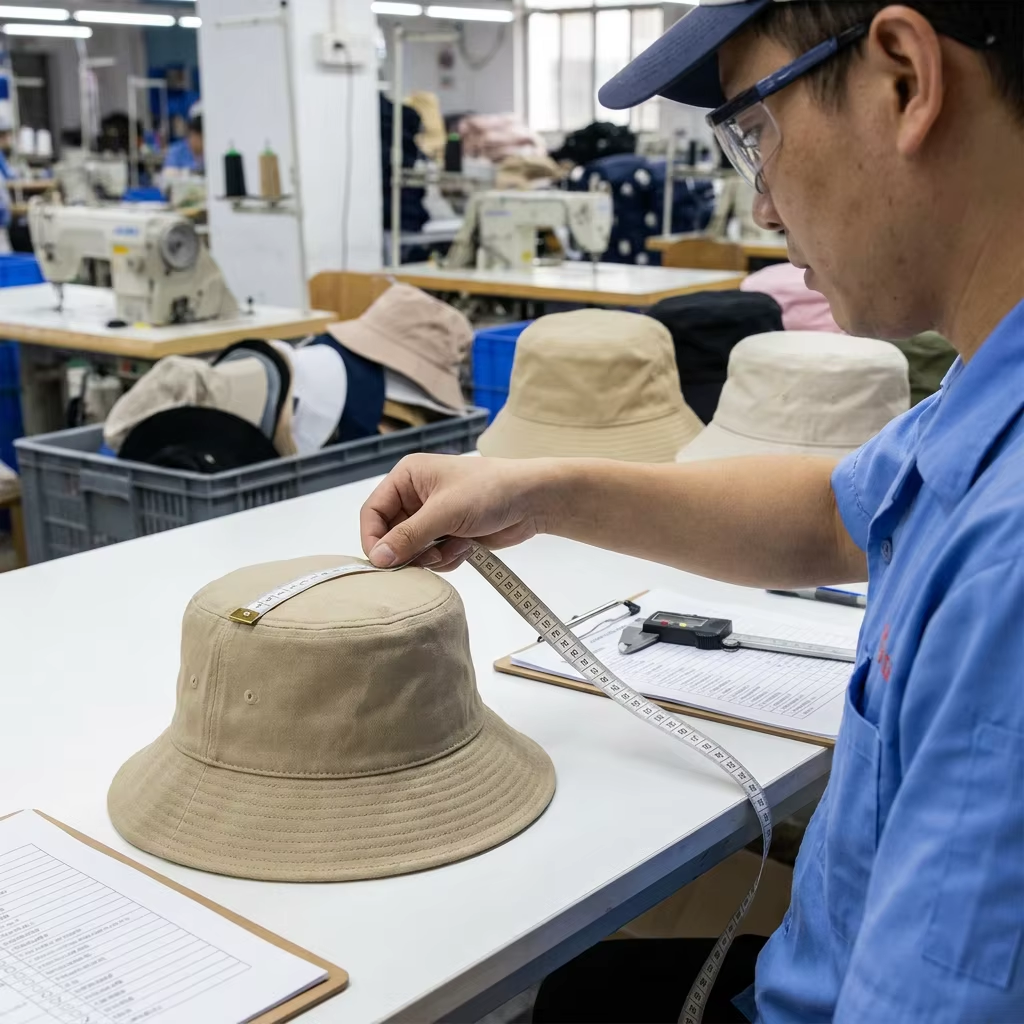
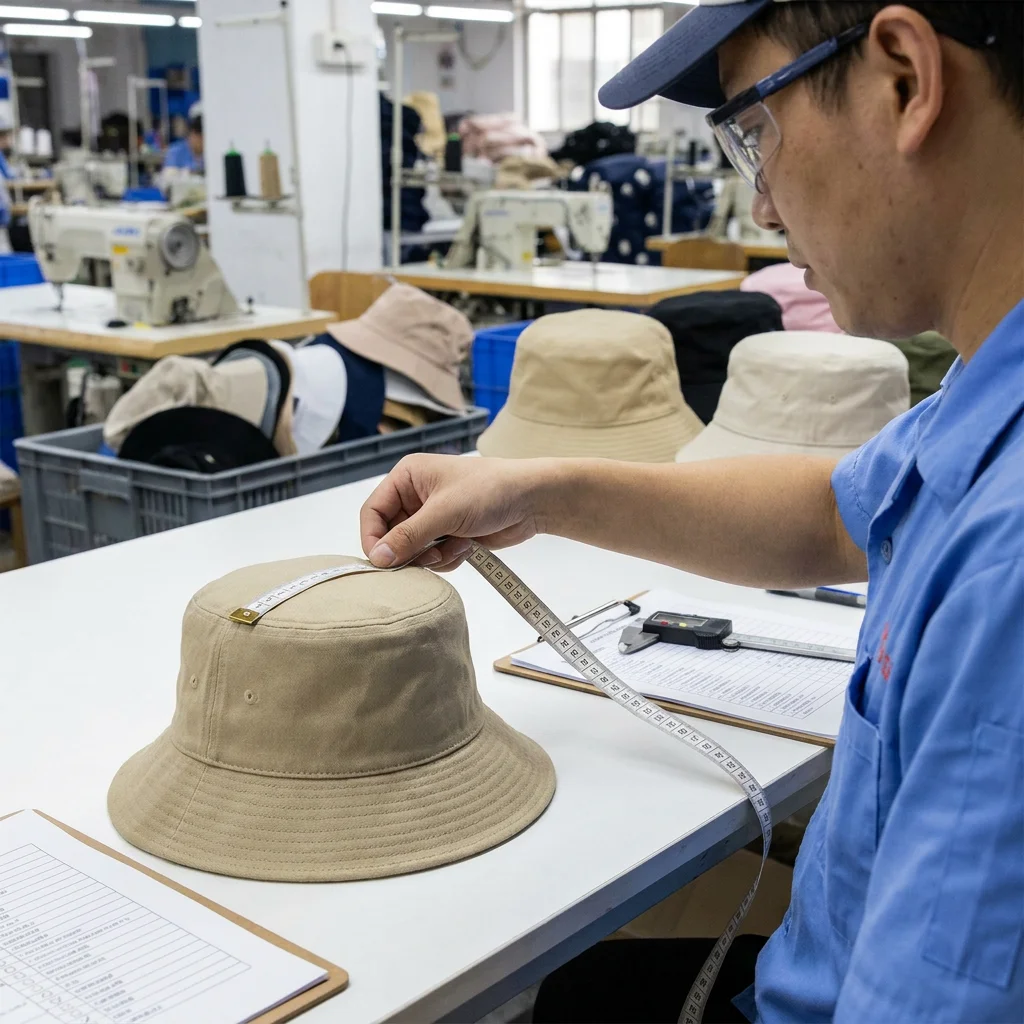
Most importantly, build a pre-production sample (PP sample) into your production timeline and budget. A PP sample typically costs $50–$80 per size per style and adds 7–10 days to the timeline. It is the cheapest insurance you can buy against a production run that delivers 5,000 hats in the wrong size. Always measure the PP sample yourself with a soft tape measure and compare against your spec sheet before approving bulk production.
For buyers sourcing through Hongyuecap’s bucket hat manufacturing service, we provide a standard size spec template for each order and require PP sample approval before any bulk production begins — a quality gate that has reduced our wholesale clients’ size-related returns to below 2% across all headwear categories.
6. Bulk Order Size Mix: What Ratio Should You Order?
Ordering the wrong size mix is one of the costliest wholesale mistakes in the hat business. If you order 50% Small and 50% Medium for the North American market, you will be left with unsold Smalls after Medium sells out — and you will have lost the revenue from the Large and XL customers who found nothing that fit.
Based on wholesale order data from three major hat distributors active across North America, Europe, and Australia in 2024–2025, the recommended adult bucket hat size mix ratios are:
| Market | S | M | L | XL |
|---|---|---|---|---|
| North America | 15% | 45% | 30% | 10% |
| Europe (Average) | 10% | 40% | 35% | 15% |
| Asia (Japan / Korea) | 30% | 50% | 15% | 5% |
| Australia / NZ | 12% | 43% | 33% | 12% |
If your budget or MOQ only allows for one size, M (57–58 cm) is the safest default for most markets, but it will not fit approximately 25–30% of your potential customers. For buyers who can afford two size breaks, the highest-volume combination is M + L (typically in a 55:45 or 60:40 ratio depending on market), which covers roughly 80% of adult head sizes in Western markets.
For specialized retailers — for example, a plus-size retail boutique or a brand targeting petite women exclusively — you should invert these ratios based on your actual customer data. A year of sales data from your existing headwear products is more reliable than any industry benchmark.
7. QC Checklist: Inspecting Bucket Hat Sizes Before Shipment
Even after specifying exact measurements on your tech pack and approving the PP sample, bulk production runs can and do drift from the approved measurements. A thorough incoming quality control (IQC) or pre-shipment inspection (PSI) that specifically checks sizing is your last line of defense before the hats leave the factory.
Here is a practical QC checklist your inspector should follow for each carton sampled during inspection (AQL 2.5, Level II is the most commonly used sampling standard for hat shipments under 10,000 units):
- Measure crown circumference of each sampled hat using a soft measuring tape placed along the inside sweatband. Record exact measurements to the nearest 0.1 cm. Compare against your spec sheet tolerance (±0.5 cm).
- Measure brim width at three points per hat — front center, left side, and back center — to check for symmetry. The difference between any two points should not exceed 0.3 cm.
- Crown depth measured from top center to sweatband bottom edge. This is the measurement most likely to drift during production because factories often reuse existing crown blocks that approximate — but do not exactly match — your spec.
- Sweatband circumference measured separately from the hat body to ensure the sweatband has not been stretched or compressed during sewing.
- Try-on test: have at least two people with known head measurements (e.g., a 57 cm and a 59 cm tester) wear each sampled size. The 57 cm tester should find size M comfortable but not loose; the 59 cm tester should find size M snug but wearable and size L comfortable.
- Label accuracy: verify that the size label or hangtag matches the actual measurement. A hat measuring 56 cm labeled “L” is a critical defect under most retail compliance standards.
- Wash test (optional but recommended for cotton/canvas bucket hats): measure one hat per color/size combination, wash per care label instructions, air dry, and re-measure. Shrinkage exceeding 2% on circumference or 3% on crown depth indicates a pre-shrinking issue at the fabric stage.
A detailed QC report with measurements, photos, and the inspector’s signature provides documentation that protects you in case of a dispute with the manufacturer. Most B2B buyers who build this QC step into their process report a 60–70% reduction in size-related quality disputes over a 12-month period, according to data from the ISO 2859 sampling standards framework.
Frequently Asked Questions About Bucket Hat Sizing
What is the standard bucket hat size for adults?
The standard adult bucket hat size for most wholesale manufacturers is 57–58 cm crown circumference, often labeled as “One Size Fits Most” or “Medium.” However, “One Size” is not a universal standard — it varies by factory and target market. Buyers should always specify exact centimeter measurements on the purchase order rather than relying on generic size labels.
How do I measure my head for a bucket hat?
Use a soft fabric measuring tape, wrap it around your head approximately 2 cm above the eyebrows and ears (the widest part of the head), and record the measurement in centimeters. If you don’t have a measuring tape, use a piece of string and then measure the string against a ruler. For wholesale ordering, provide this measurement to your supplier and ask them to confirm which size from their chart corresponds to your measurement.
What is the difference between a bucket hat and a boonie hat in sizing?
Bucket hats and boonie hats share similar crown measurements, but boonie hats typically have a wider brim (7–10 cm), an adjustable chin strap for a more secure fit, and a slightly deeper crown (11–13 cm) to accommodate military-style usage. The sizing tolerance on boonie hats is often tighter (±0.3 cm) because the chin strap makes a loose fit more noticeable to the wearer.
Can I order custom sizes for plus-size or petite markets?
Yes, most wholesale manufacturers offer custom size grading for an additional pattern-making fee, typically $30–$80 per new size per style. The MOQ for a custom size run is usually the same as the standard MOQ for that factory (often 100–300 pieces per size per color). Provide your desired measurement ranges upfront, and request a graded size set sample before committing to full production.
For more information about custom bucket hat manufacturing and sizing for wholesale buyers, visit our bucket hat product page or explore our other sizing and quality guides:
- Bucket Hat Fabric Types — Wholesale Guide for Buyers
- Bucket Hat MOQ and Wholesale Pricing Guide
- Bucket Hat Brim Stiffness and Shape Retention Guide
- 8 Bucket Hat Sourcing Factors That Save Wholesale Buyers 30%
- Cap Manufacturer — Full Custom Hat Production Services
Ready to order bucket hats in the right sizes for your market? Contact our sourcing team with your size requirements and target market, and we will provide a detailed quote with size spec recommendations within 24 hours.
Written by the Hongyuecap Product Team — expert sourcing guidance for wholesale hat buyers since 2018.
Produced by HongYueCap Studio