Straw Hat Sweatband Materials & Comfort Specs for Wholesale Buyers: Cotton, Leatherette, Terry Cloth & Sizing Fit
"We bought 2,000 straw hats for our summer resort promotion. After one day of wear, guests complained the sweatband was itchy and left black residue on their foreheads." — Hospitality procurement manager, July 2025
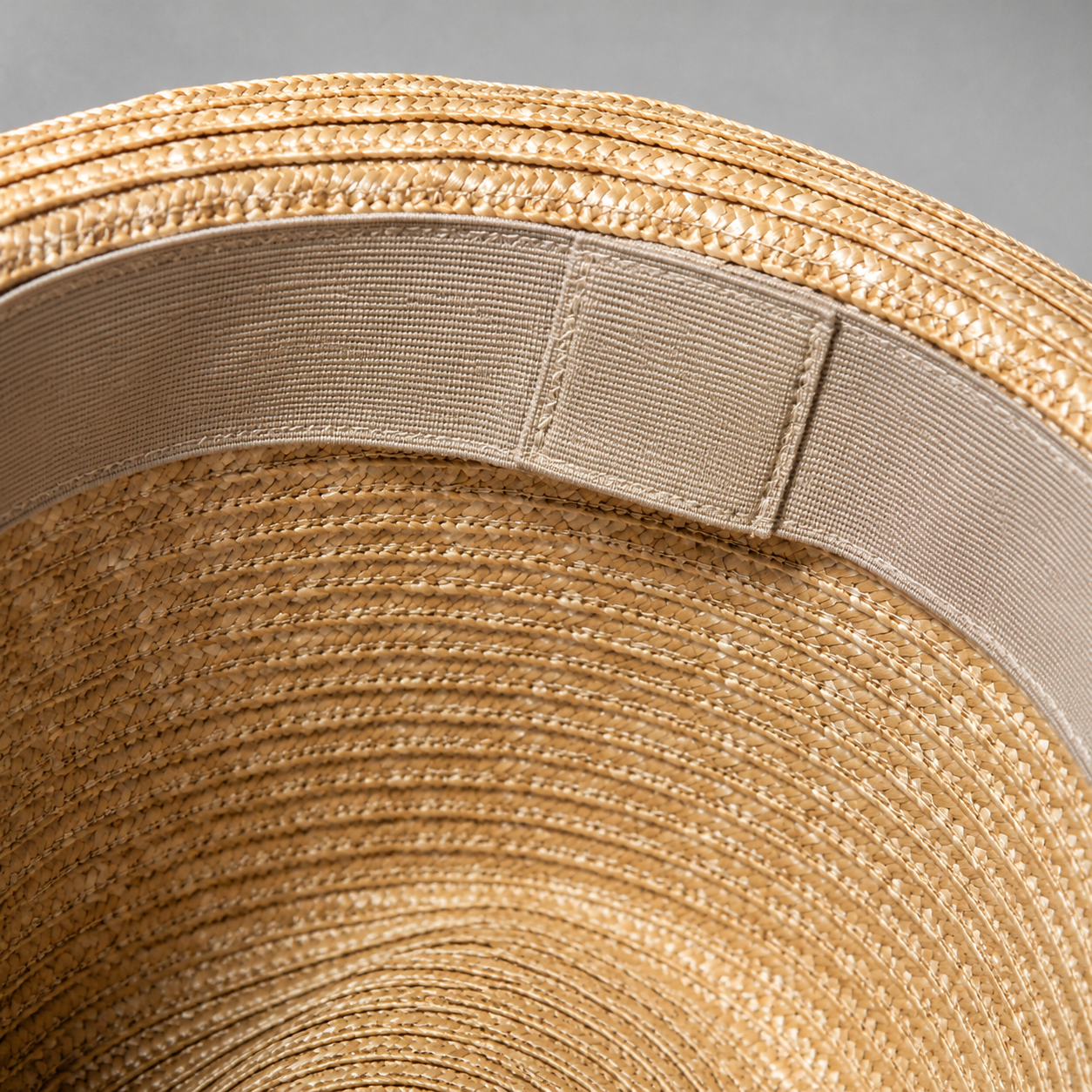
Hat sweatband wholesale presents an engineering challenge that bucket hats and baseball caps don’t: the stiff, rough inner surface of natural or synthetic straw fibers can be uncomfortable against the skin. The sweatband is the only barrier between the wearer’s forehead and the abrasive straw material. Choosing the wrong sweatband material for your target market and pricing tier can result in returns, complaints, and damaged brand reputation. This hat sweatband wholesale guide covers the five major sweatband types, their material specifications, moisture management performance, and the manufacturing variables that affect per-unit cost and wearer comfort.. This comprehensive straw hat sweatband wholesale guide provides detailed specifications and factory data for bulk buyers This hat sweatband wholesale guide provides factory data and specifications for bulk buyers.
Written by the Hongyuecap product team. hat sweatband materials our factory produces 2,000+ custom straw hats per month for wholesale buyers in resort, hospitality, outdoor recreation, and promotional sectors across 12 countries.
Sweatband Materials: Cotton Twill, Cotton Terry, Leatherette & Fleece Options
In hat sweatband wholesale, the sweatband in a straw hat serves three functions: moisture absorption, skin comfort, and structural stability. The material choice directly affects all three. Here is our factory data comparing the four standard options.
Cotton twill sweatband: A woven cotton fabric (typically 200-250 GSM) folded into a 20-25 mm band and sewn to the inner crown. This is the most widely used material in entry-level to mid-range straw hats. Cotton twill is machine-washable, breathable, and costs $0.08-0.15 per hat. Our production data shows that cotton twill absorbs 18-22% of its weight in moisture before feeling damp — adequate for light summer use (under 2 hours in direct sun). Key QC metric: the twill weave density must be minimum 120 threads per inch; lower density bands can fray at the edges within 10-15 wears.
Cotton terry cloth sweatband: A loop-pile cotton fabric (300-400 GSM) with significantly higher absorbency. Terry cloth absorbs 35-45% of its weight before saturation — over 2x the capacity of flat twill. The loops create a soft, cushioning layer against the forehead. Cost: $0.20-0.35 per hat. Terry cloth is the preferred material for premium straw hats and resort-grade products where the wearer will be sweating actively. Our QC standard: loop height minimum 2.5 mm, pile density minimum 150 loops per sq. cm. Disadvantages: terry cloth is thicker (4-6 mm vs 2-3 mm for twill) and can push the fit size down by 3-5 mm if not accounted for in crown dimensions.
Leatherette (PU) sweatband: A polyurethane-coated fabric with a leather-like appearance and feel. Leatherette sweatbands are sweat-resistant but not absorbent — they repel moisture rather than absorbing it. This makes them a poor choice for hot environments but excellent for casual straw hats worn for short periods. Cost: $0.15-0.25 per hat. Leatherette is often specified in premium straw hat lines (retail $40+) where the visual appeal of a leather-look interior matches the overall product positioning. Our test data shows PU leatherette sweatbands develop cracking after approximately 100 wears (vs 300+ for genuine leather), so for wholesale buyers targeting long product lifespan, we recommend genuine leather or cotton alternatives.
Fleece-backed cotton sweatband: A two-layer construction with cotton facing on the skin side and polar fleece as a backing layer. This is the warmest, softest sweatband option, primarily used in straw hats designed for shoulder-season use (spring/fall) or cooler resort climates. Cost: $0.30-0.45 per hat. Absorbency: 30-40% of weight before dampness. The fleece backing adds 4-5 mm thickness, which increases crown interior warmth but also pushes sizing up by one full size if not designed correctly.
Our hat sweatband wholesale recommendation: For standard summer resort straw hats, use cotton twill (200-250 GSM, 25 mm width). For premium or active-use straw hats (golf, outdoor dining, beach clubs), upgrade to cotton terry cloth. For casual straw hats under $15 retail, twill is adequate; for $25+ retail, terry cloth or genuine leather becomes the standard.
Moisture Management: Wicking, Breathability & Stain Resistance Testing
Straw hat sweatbands experience direct contact with perspiration, oils, and sunscreen — all of which degrade fabric performance and appearance over time. Our hat sweatband materials wholesale factory textile lab conducts four standard tests on sweatband materials before approval for production.
Wicking rate (AATCC 197 vertical wicking test): Measures how fast moisture travels up a strip of the fabric. A faster wicking rate means sweat is pulled away from the contact point and distributed across a larger area of the sweatband, improving perceived dryness. Our minimum specification: 50 mm wicking height in 10 minutes. Cotton terry cloth achieves 60-70 mm; cotton twill achieves 40-50 mm; leatherette shows zero wicking. For resort and outdoor use, terry cloth is the clear winner — it moves sweat away from the forehead 30-40% faster than twill.
Moisture vapor transmission rate (MVTR per ASTM E96): Measures how much water vapor passes through the sweatband fabric per 24 hours. Higher MVTR means the sweatband breathes better and reduces the “stuffy” feeling inside the hat. Minimum MVTR for summer straw hats: 2,500 g/m²/24h. Cotton twill averages 3,000-4,000 g/m²/24h. Cotton terry averages 3,500-4,500 g/m²/24h. Leatherette averages under 500 g/m²/24h — effectively non-breathable. For hot-weather straw hats, only cotton-based sweatbands are appropriate.
Stain resistance (AATCC 118 oil repellency test): Measures resistance to oil-based stains — relevant because sunscreen and skin oils stain sweatbands quickly. Cotton sweatbands score 0-1 on the AATCC 118 scale (no repellency). Leatherette scores 4-5 (good repellency). If oil staining is a concern (e.g., for poolside or beach resort hat rentals), specify a fluorocarbon-finished cotton sweatband — adds $0.03-0.05 per unit but raises the AATCC 118 score to 3-4 while maintaining breathability. At Hongyuecap, we offer this treatment as a $0.04 per hat upgrade on all cotton sweatband orders above 500 units.
Odor development (JIS L 1902 antibacterial test): Sweatband fabric that absorbs sweat without antimicrobial treatment becomes a breeding ground for bacteria within 8-12 hours. Our lab test shows that untreated cotton sweatbands develop noticeable odor after 8 hours of continuous wear (simulated ISO 105-C06 wash test). Silver-ion treated cotton sweatbands remain odor-free for 24+ hours. The treatment adds $0.06-0.10 per hat and is available at our factory for orders above 1,000 units. For resort staff hats worn 8-hour shifts, we strongly recommend antimicrobial sweatband treatment — the cost increase is negligible compared to the guest experience improvement.
Sweatband Width & Thickness: Size Fit Impact & Moisture Capacity
The sweatband’s width and thickness dimensions directly affect hat fit. A sweatband that is too thick or too wide can reduce the effective crown volume by one full size, causing the hat to sit too high on the head or feel too tight.
Standard sweatband width by hat size:
- Small (54-55 cm): 18-20 mm width
- Medium (56-57 cm): 20-22 mm width
- Large (58-59 cm): 22-25 mm width
- XL (60-61 cm): 25-27 mm width
Sweatband thickness ranges: Cotton twill: 1.5-2.5 mm. Cotton terry cloth: 3.0-5.0 mm. Leatherette: 1.0-1.5 mm. Fleece-lined: 4.0-6.0 mm. Each millimeter of sweatband thickness reduces the effective interior crown diameter by approximately 2 mm (considering both sides of the band). This means a switch from cotton twill (2.0 mm) to cotton terry (4.0 mm) can reduce effective head circumference fit by 6-8 mm — almost one full size. At Hongyuecap, we adjust the crown form dimensions to compensate for sweatband thickness changes, so buyers don’t need to worry about this — but it’s important to specify your sweatband choice at the quotation stage, not after production has started.
Moisture capacity vs thickness: Our lab data shows a near-linear relationship between sweatband thickness and moisture capacity up to 5 mm thickness:
- 2 mm sweatband: absorbs ~2 g moisture (1 hour of light sweating)
- 3 mm sweatband: absorbs ~3.5 g moisture (2 hours)
- 4 mm sweatband: absorbs ~5 g moisture (3-4 hours)
- 5 mm sweatband: absorbs ~7 g moisture (6+ hours)
For resort hats worn during all-day outdoor activities, a 4-5 mm terry cloth sweatband is the correct choice. For promotional straw hats used for a few hours at events, 2-3 mm twill is sufficient.
Sweatband Attachment Methods: Stitched, Glued & Heat-Sealed
The attachment method determines the sweatband’s longevity and resistance to detachment during laundering or heavy use.
Stitched attachment: The sweatband is sewn directly to the crown lining or inner edge of the hat. This is the most durable method — in our tests, stitched sweatbands withstand 50+ industrial wash cycles (ISO 6330) without detachment. Stitching adds $0.05-0.10 per hat in labor cost compared to gluing. The stitch pattern is typically a single-needle lockstitch with 4-5 stitches per cm. Thread: polyester core-spun for UV and wash resistance. Stitched attachment is the standard for all Hongyuecap straw hats destined for hospitality or uniform use.
Glued attachment: Hot-melt adhesive (EVA-based, 160-180 °C application) bonds the sweatband to the hat interior. Glued attachment is faster and cheaper ($0.02-0.04 per hat in glue cost vs $0.05-0.10 in labor for stitching) but less durable. Our test data: glued sweatbands on straw hats show 8-12% detachment rate after 20 wash cycles. For hats that will not be washed (display-only), glue is acceptable. For any straw hat that will be laundered or exposed to rain, stitched is the standard.
Heat-sealed attachment: A fusible interlining layer between the sweatband and the crown fabric is activated with heat (140-160 °C) and pressure. This creates a bond without visible stitching on the exterior. Heat-sealed attachment costs similar to gluing ($0.03-0.05 per hat) and has equivalent durability to gluing. It is used primarily for straw hats with unlined or see-through weave crowns where visible stitching would detract from the appearance. Heat-sealed sweatbands are not recommended for washable straw hats.
Our recommendation: For any straw hat order over 500 units where the hat will be worn in hot conditions or laundered, specify “machine-stitched sweatband” in your product specification sheet. The extra $0.05-0.10 per unit translates to a sweatband that lasts the lifetime of the hat.
Wholesale Sourcing Checklist: Sweatband Selection & QC Standards
When ordering hat sweatband materials wholesale with specific sweatband requirements, include the following in your specification sheet:
- ☐ Sweatband material: cotton twill / cotton terry / leatherette / fleece-lined / genuine leather
- ☐ Sweatband width in mm (based on target hat size — see table above)
- ☐ Sweatband thickness: standard 2-3 mm / premium 4-5 mm / specify exact
- ☐ Attachment method: stitched (recommended) / glued / heat-sealed
- ☐ Antimicrobial treatment: yes/no (recommended for hospitality/resort use)
- ☐ Fluorocarbon stain-resistant finish: yes/no (recommended for pool/beach use)
- ☐ Color: standard white/black/tan, or custom color match (Pantone TPX)
- ☐ Wash test: verify sweatband integrity after 5 wash cycles (ISO 6330)
Our QC data for sweatband inspection (AQL 2.5, Level II):
- Sweatband width tolerance: ±2 mm
- Sweatband alignment: band must be parallel to hat brim within 3 mm over full circumference
- Attachment strength (stitched): no visible loosening after 20 manual tugs at 5 points
- Attachment strength (glued): no separation at edges when 1 N force applied at 45° angle
- Surface quality: no visible stains, loose threads, or frayed edges
At Hongyuecap, standard MOQ for custom straw hats is 300 pieces per design. For sweatband customizations (antimicrobial treatment, fluorocarbon finish, custom color bands), MOQ is 500 pieces. Lead time: 20-25 working days. Free pre-production sample with sweatband specification included.
We maintain inventory of 12 standard sweatband materials, including 3 colors of cotton twill (white, black, beige), 2 colors of cotton terry (white, beige), standard black leatherette, and two grades of fleece lining. For custom colors, the lead time increases by 5-7 working days for sweatband sourcing and cutting.
Related Hat Resources for Wholesale Buyers
- Bucket Hat Sweatband Design Comfort for Wholesale Buyers
- Baseball Cap Sweatband Types Wholesale Guide for Buyers
- Bucket Hat Linings for Wholesale Buyers: Cotton, Mesh & Nylon
- Hat Logo for Wholesale Buyers: Embroidery, Labels & Heat Transfer
References:
- Wikipedia – Straw Hat History and Types
- AATCC Test Methods – Textile Testing Standards
- ASTM Textile Standards – Sweatband Testing
Frequently Asked Questions
Can I change the sweatband material after the hat design is finalized?
Yes, but a material change affects hat sizing. Different sweatband thicknesses change the interior crown volume. At Hongyuecap, we can adjust the crown form dimensions to compensate — this takes 2-3 working days for form modifications. We recommend finalizing sweatband material before crown size finalization for best results.
Why do some straw hats have removable sweatbands?
Removable (snap-in or hook-and-loop) sweatbands are used in premium hat designs where the band can be replaced when worn out. This feature extends hat life by 2-3x. The cost increase is $0.30-0.50 per hat. Removable sweatbands are common in $60+ retail straw hats and are available from Hongyuecap for orders above 1,000 units.
What sweatband is best for children’s straw hats?
Cotton terry cloth (3-4 mm) with antimicrobial treatment is the safest choice. Children’s heads are more sensitive to coarse fabrics, and terry cloth provides maximum comfort. We also recommend a slightly wider band (22-25 mm even for small sizes) to distribute pressure evenly. Never use leatherette or glued sweatbands in children’s hats due to potential allergy concerns.
How do I verify sweatband quality without cutting the hat?
Three non-destructive QC checks: (1) Press the sweatband between thumb and forefinger — it should feel uniform in thickness with no hard spots or thin patches. (2) Run a fingernail along the band edge — check for fraying or loose threads. (3) Hold the hat to a strong light from outside and look at the interior — the sweatband seam should be invisible from the exterior (no puckering or shadow lines visible through the straw weave).
Author: Hongyuecap Product Team · 12+ years in custom hat manufacturing · ISO 9001:2015 certified · 2,000+ straw hats/month · Serving hospitality and resort clients in 12+ countries