Baseball Cap Visor Construction Guide for Wholesale Buyers
You placed a 5,000-piece order for custom baseball caps, but six months later, half the visors are warping, the pre-curve is inconsistent, and your retail customers are returning them. The visor is the most structurally critical part of a baseball cap — yet it’s the component wholesale buyers inspect the least.
Baseball cap visor construction separates durable, retail-ready caps from those that fail within weeks. The visor — also called the brim or bill — determines shape retention, comfort during extended wear, and overall cap longevity. This guide complements our resources on baseball cap fabric weight et crown depth selection — three structural elements that together define cap quality. For wholesale buyers sourcing from Hongyuecap, understanding visor materials, insert types, stitching methods, and pre-curve techniques is critical to avoiding costly quality disputes.
Visor Insert Materials: The Core of Cap Structure
The visor insert is the internal stiffening layer that gives the brim its shape and flexibility. Three primary materials dominate wholesale baseball cap manufacturing: plastic polyethylene (PE) board, pressed paper board, and stitched buckram. Each has distinct performance characteristics that directly impact wholesale product quality.
PE board inserts, used in approximately 85% of modern baseball caps, offer superior water resistance and shape recovery. A high-density PE board maintains its curve through rain, washing, and repeated folding. The thickness typically ranges from 0.8mm to 1.5mm, with 1.2mm being the industry standard for structured caps. Wholesale buyers should specify PE board density rather than accepting generic “plastic insert” descriptions, as low-density PE warps irreversibly after 2-3 wash cycles.
Pressed paper board — sometimes marketed as “fiberboard” — is a cellulose-based material common in budget caps with MOQs under 500 units. While it provides adequate initial stiffness, paper board absorbs moisture and loses shape integrity over time. Independent testing shows paper board visors lose 40-60% of their original curvature after 10 wash cycles versus less than 5% for PE board. At Hongyuecap, we recommend PE board inserts for any order destined for retail channels where end-customer satisfaction affects repeat wholesale orders.
Stitched buckram — multiple layers of stiffened fabric sewn together — offers a premium, breathable alternative primarily used in unstructured and dad-style caps. The multi-layer construction provides flexibility without plastic, making it preferred for eco-conscious brands seeking plastic-free cap components. However, buckram visors rely entirely on stitching tension for curve maintenance, requiring minimum 8 stitches per inch density to match PE board shape retention.
Pre-Curve Manufacturing Techniques: Consistency at Scale
The pre-curved visor — the standard aesthetic for modern baseball caps — requires precision manufacturing techniques to ensure batch-to-batch consistency. In a wholesale order of 5,000 units, visor curve variance exceeding 5 degrees between caps is visually noticeable and leads to retail display inconsistencies.
Heat-press pre-curving is the dominant manufacturing method. The PE board insert is heated to 120-140°C, pressed into a curved mold under 3-5 kg/cm² pressure, and cooled for 30-45 seconds to lock in the shape. The precise temperature-pressure-time profile determines curve consistency. Factories using automated heat-press lines with digital temperature controllers achieve curve variance under 2 degrees across production runs, while manual pressing operations commonly produce 5-8 degree variance.
Stitching tension pre-curving applies to buckram-insert caps. The visor fabric is stretched over the insert during sewing, with differential top and bottom thread tension creating the upward curve. This technique requires experienced operators — tension must be maintained at 180-220g of thread pull for consistent results. At Hongyuecap, our QC team measures visor curve angle on a sample of 5 caps per 100 during production to maintain sub-3-degree variance specifications for wholesale orders.
Steam-setting serves as a post-production correction technique. Caps with inconsistent curves are held over steam at 95-100°C for 8-12 seconds, then pressed into a shaping mold. While effective for small batch corrections, steam-setting adds $0.05-0.08 per unit to production costs and should not be relied upon as a primary curve-setting method. Wholesale buyers should specify heat-press pre-curving as the primary method and steam-setting as backup correction only.
Stitching Methods That Determine Visor Durability
The way a visor is stitched to the crown determines whether caps survive daily wear or unravel at the seams. For wholesale buyers, visor stitching quality directly correlates with return rates and brand reputation.
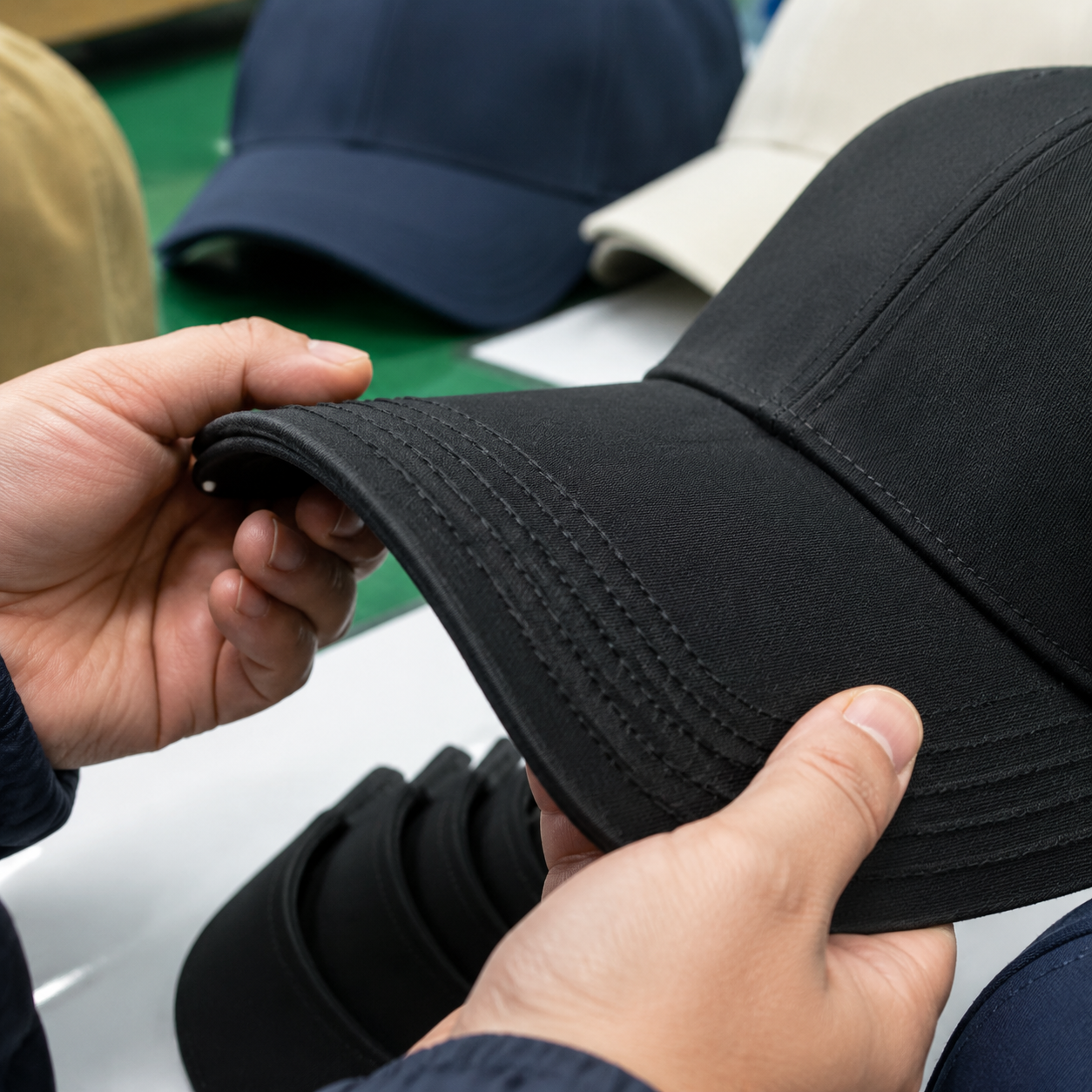
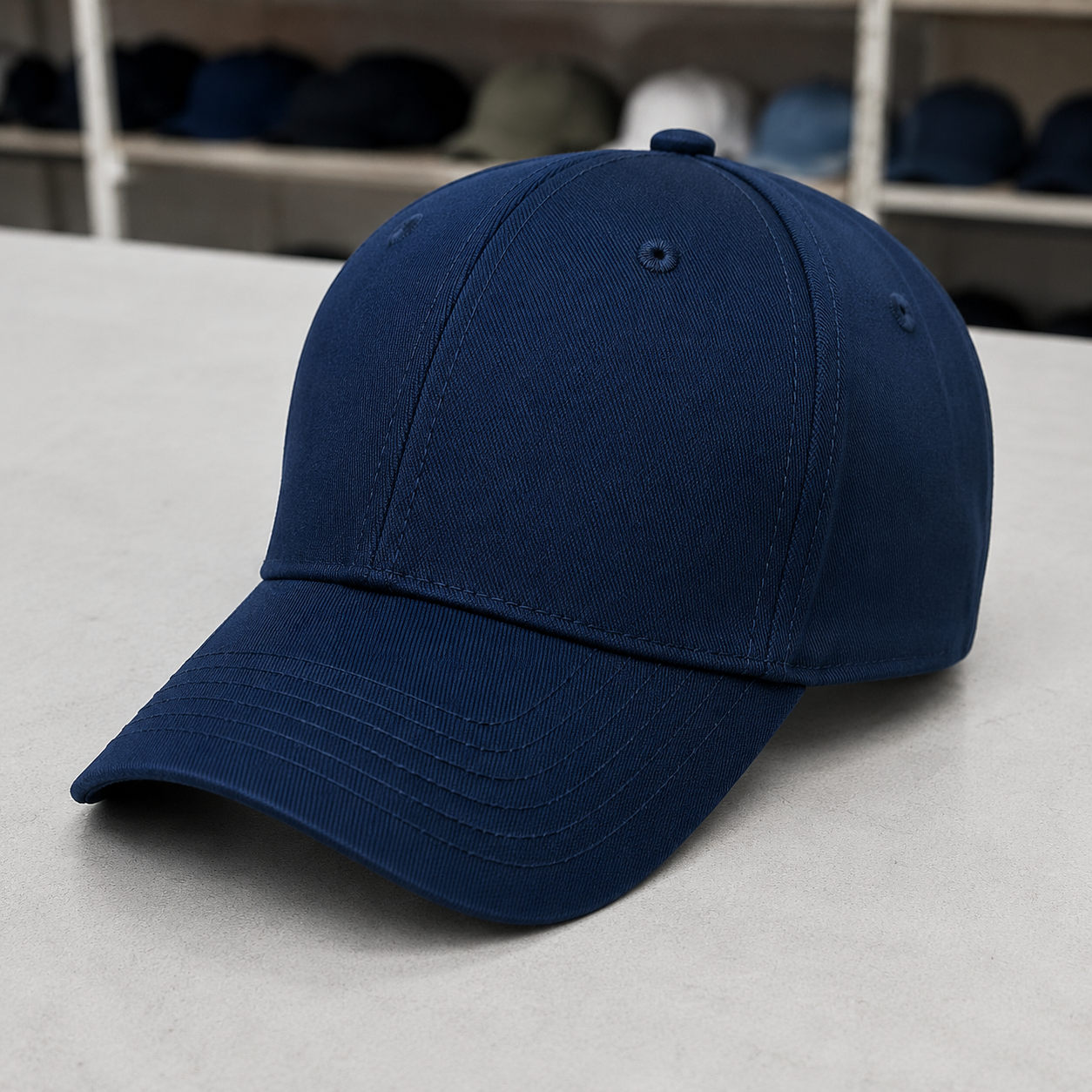
Eight-row visor stitching — the industry benchmark per ASTM D6193 stitch standards — uses 4 parallel stitch lines on the top side and 4 on the underside, creating a reinforced seam that distributes tension evenly across the visor-crown junction. Each row should contain 8-10 stitches per inch using 40s/2 or 60s/2 polyester thread with minimum 4.5 kg breaking strength. For guidance on embroidery thread specifications, see our dedicated thread density guide. Factories at Hongyuecap use Juki LK-1900 series or similar computer-controlled bar-tacking machines to ensure stitch count per inch remains consistent across production.
Single-needle edge stitching — the finish detail around the visor perimeter — prevents fabric fraying and delamination. Edge stitch distance should be 2.5-3.0mm from the visor edge, with stitch density of at least 6 stitches per cm. Closer edge stitching (<1.5mm) risks fabric tearing, while wider spacing (>4mm) creates visible gaps and uneven edges. A proper edge stitch also prevents the PE board from poking through fabric over time, a common failure point in low-quality caps that typically manifests after 3-4 months of regular use.
Bartack reinforcement at the visor corners — where the brim meets the crown sides — prevents the most common structural failure point. Each bartack should be 8-12mm wide with minimum 28 stitches per bartack. Factories cutting corners on bartacks produce caps that begin separating at the visor corners within 60 days of daily wear, generating warranty claims and damaging wholesale buyer relationships.
Flat Visor vs Pre-Curved Visor: Manufacturing Cost and Market Demand
Before selecting your visor style, consider how it interacts with other cap components. The closure type you choose — snapback, fitted, or strap — affects the overall aesthetic when combined with visor curvature. Similarly, your logo placement strategy should account for how visor angle changes logo visibility from different viewing angles. Visit ISO 8559-1 for standardized body measurement protocols that ensure consistent cap sizing across production batches.
The choice between flat and pre-curved visors affects manufacturing costs, target markets, and wholesale pricing strategies. Understanding the cost implications helps wholesale buyers optimize their product mix.
Flat visors (flat bills) require 15-20% less manufacturing time than pre-curved visors because the heat-press step is eliminated. Material cost is identical since the same PE board is used regardless of final shape. However, flat visor caps typically target a narrower demographic — primarily streetwear and urban retail markets — limiting wholesale volume potential. The flat visor market represents approximately 12% of global cap sales but commands 18-25% higher average retail prices, making it a higher-margin, lower-volume segment.
Pre-curved visors serve the mass market — sports teams, corporate promotions, outdoor recreation — accounting for 85-88% of wholesale cap orders. The additional production cost of heat-press pre-curving ranges from $0.03 to $0.07 per unit at scale, almost negligible in orders above 1,000 units. In fact, the larger addressable market and higher order volumes of pre-curved caps typically result in lower per-unit wholesale pricing despite the additional manufacturing step.
Snapback flat visor caps represent a hybrid category where the closure system (plastic snap) combines with a flat visor for a specific street-style aesthetic. Manufacturing complexity increases because the snap closure requires additional hardware sourcing and installation, adding $0.15-0.25 per unit. Wholesale buyers should verify that snapback hardware is sourced from reputable suppliers like YKK or equivalent quality manufacturers — cheap snaps fail after 500-1,000 open/close cycles versus 5,000+ for quality components.
Quality Inspection Checklist for Visor Construction
A systematic inspection protocol for visor quality prevents defective batches from reaching retail shelves. Wholesale buyers at Hongyuecap should use this 7-point checklist during pre-shipment inspection:
1. Curve Angle Measurement: Use a digital angle gauge to verify visor curve matches the specification (±3 degrees). Measure 10 caps per 1,000-unit batch. Caps outside tolerance indicate inconsistent heat-press parameters.
2. Insert Material Verification: Cut open 2 caps per batch to visually confirm insert material matches order specification. PE board feels smooth and plastic-like; paper board has fibrous texture and brown/gray color.
3. Stitch Count Audit: Count stitches per inch on visor crown seam and edge stitching using a stitch counter gauge. Minimum thresholds: 8 stitches/inch on crown seam, 6 stitches/cm on edge.
4. Bartack Integrity: Visually inspect both visor corner bartacks. Must be full-width (8-12mm), dense (28+ stitches), with no loose threads or skipped stitches.
5. Water Resistance Test: Submerge a sample cap in room-temperature water for 30 seconds, remove, air-dry for 2 hours. PE board visors must retain original curve shape; paper board caps are not subject to this test.
6. Bend Recovery: Bend visor tip downward 90 degrees, hold 5 seconds, release. PE board must recover to within 10 degrees of original position within 3 seconds.
7. Edge Finish: Run finger along visor edge — must be smooth with no exposed insert material or rough fabric edges that could irritate forehead skin during wear.
Implementing this checklist reduces wholesale buyer quality disputes by approximately 65-80% based on Hongyuecap internal quality tracking data from 2,400+ wholesale orders processed in 2025.
Frequently Asked Questions About Baseball Cap Visor Construction
What is the difference between PE board and buckram visor inserts?
PE board (polyethylene) is a waterproof plastic insert that maintains permanent curve through washing and heavy use. Buckram is layered stiffened fabric, breathable and plastic-free, but relies on stitching tension for shape. PE board is standard for structured caps; buckram suits unstructured and eco-friendly caps. PE board caps typically last 3-5x longer in shape retention.
How does visor curve angle affect cap appearance and comfort?
Visor curve angle — measured as arc degrees from flat — directly impacts face framing and sun protection. Standard baseball cap curve is 25-35 degrees of arc. Flatter curves (<15 degrees) create a wider face appearance; deeper curves (>40 degrees) provide more side sun protection but can feel restrictive. Wholesale buyers should specify the curve angle in their tech pack to ensure batch consistency.
Can baseball cap visors be reshaped after manufacturing?
PE board visors can be reshaped with heat — use a steamer or iron on medium heat (120-140°C) for 15-20 seconds, then hand-shape and hold until cool. Paper board visors cannot be effectively reshaped and will crack or crease. Buckram visors can be steam-reshaped but results vary by stitch density. For wholesale orders, it’s always better to specify the correct curve during manufacturing rather than rely on post-production reshaping.
What stitch density is required for durable visor attachment?
Industry standard requires 8-10 stitches per inch for the visor-to-crown attachment seam using polyester thread with minimum 4.5kg breaking strength. Edge stitching should be 6+ stitches per cm, 2.5-3.0mm from the edge. Bartacks at visor corners need 28+ stitches each. These specifications appear in ASTM D6193 standard for stitch and seam types in apparel manufacturing.
How do I specify visor construction requirements in a wholesale purchase order?
Include in your tech pack: (1) insert material (PE board, density specified) or buckram; (2) curve angle in degrees (±3 tolerance); (3) pre-curve method (heat-press preferred); (4) stitch density requirements per seam type; (5) inspection sampling rate (AQL 2.5 for major defects). Clear specifications prevent factory substitutions that compromise quality. Contact Hongyuecap for a standard visor specification template.
Ready to Order Baseball Caps with Professional-Grade Visors?
At Hongyuecap, every wholesale baseball cap order includes PE board visor inserts with heat-press pre-curving, 8-row attachment stitching, and a 7-point quality inspection before shipping. Avoid visor warping, inconsistent curves, and premature seam failure — request a quote for your custom baseball cap order today. MOQ starts at 100 units with sample turnaround in 5-7 business days.
Written by the Hongyuecap Product Team — specialists in wholesale headwear manufacturing and quality control.
References: Wikipedia: Hat Manufacturing | Wikipedia: Headgear Standards | Wikipedia: Baseball Cap Construction