Knitted Beanie Size Chart & Fit Guide for Wholesale Buyers: Stretch Recovery, Yarn Gauge & Sizing Specs
You order 5,000 knitted beanies for a winter retail promotion, but upon arrival, the size M beanies fit like size XS — and the size L won’t even stretch over an average adult head. Knitted beanies are the most sizing-forgiving hat category due to fabric stretch, yet they’re also the most commonly mis-sized because wholesale buyers overlook the critical interplay between knit gauge, yarn fiber, and stretch recovery.
Knitted beanie sizing presents a deceptive challenge: the stretch that makes beanies “one size fits most” also hides significant fit quality problems until bulk orders arrive at retail. Unlike woven hats with fixed dimensions, knitted beanies rely on yarn elasticity, stitch structure, and gauge tension to achieve fit across a range of head sizes. This guide connects directly to our resources on knitted beanie yarn gauge specifications, stitch type selection, y lining material choices — all factors that directly affect how sizing translates from specification to wearer comfort. For wholesale buyers sourcing from Hongyuecap, understanding how knit construction affects sizing — not just what the size tag says — is the difference between a beanie that fits 85% of customers and one that generates 25% returns. According to Wikipedia’s comprehensive knitting reference, stitch gauge and yarn weight are the primary determinants of knitted fabric stretch behavior.
Knitted Beanie Stretch Mechanics: Why “One Size Fits Most” Is Actually Three Sizes
The term “one size fits most” on a knitted beanie label obscures complex mechanical properties that determine actual fit range. Unlike woven hats where dimensions are fixed, knitted beanies utilize stitch geometry to create dynamic sizing through stretch — but this stretch has limits governed by yarn physics.
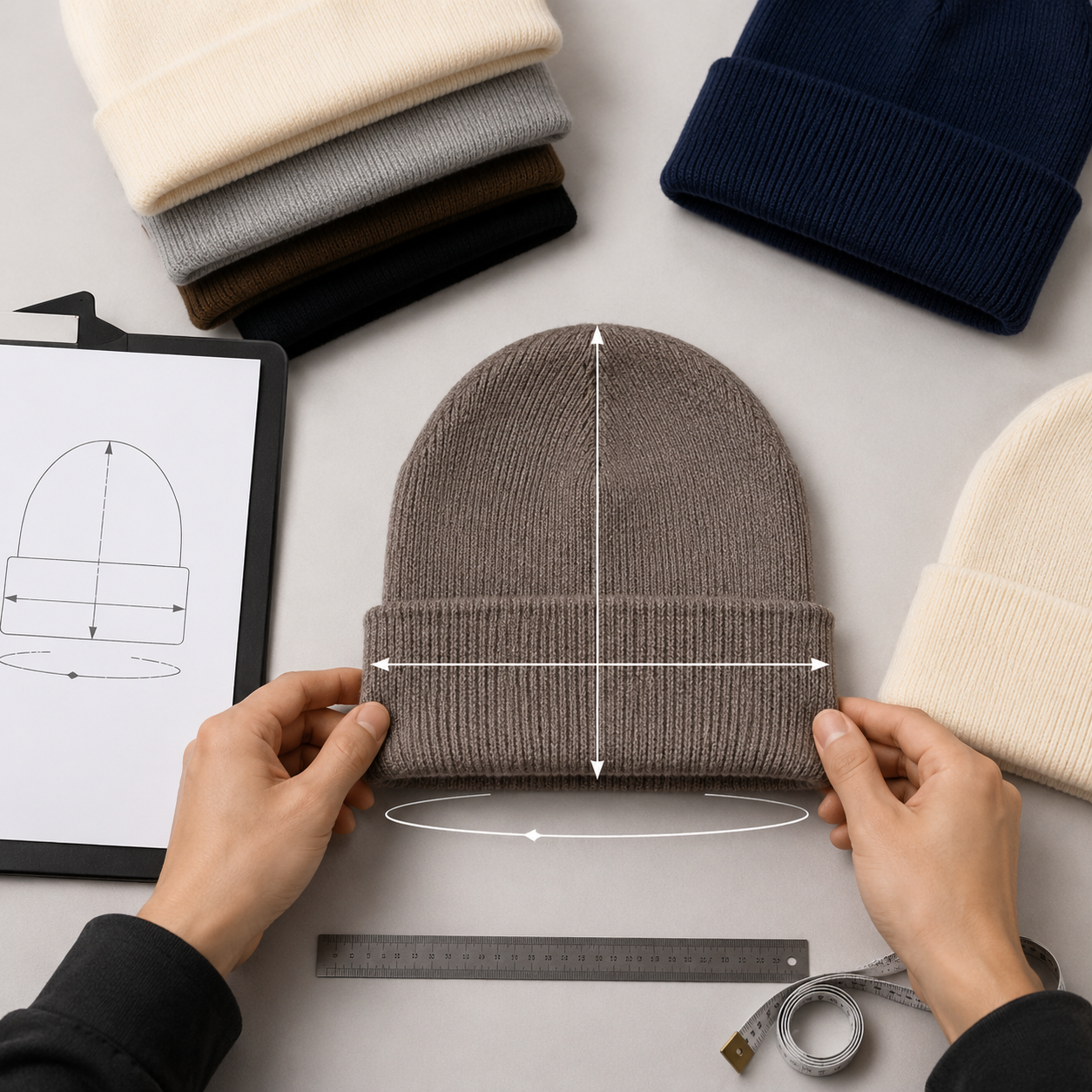
Knit stitch structure fundamentally determines stretch capacity. A standard 1×1 rib knit (alternating knit and purl stitches in each row) provides approximately 40-60% circumferential stretch — a relaxed 40cm circumference beanie can stretch to 56-64cm. This is why most “one size” adult beanies target a relaxed circumference of 38-42cm, stretching to fit heads from 54cm to 62cm. However, the stretch-to-fit range is not the same as the comfortable-fit range: at maximum stretch, compression on the wearer’s head reaches approximately 40-60 mmHg, which many wearers find uncomfortable after 1-2 hours.
Different rib patterns produce different stretch profiles. 2×2 rib knit (two knit stitches followed by two purl stitches) offers 50-70% stretch but with less recovery — meaning the beanie may not return to its original dimensions after repeated stretching. 1×1 rib knits provide the best balance of stretch and recovery, maintaining shape through 200+ wear cycles. Cabled or textured stitch patterns reduce stretch to 15-25%, requiring more precise sizing because the decorative pattern restricts elastic deformation. At Hongyuecap, we recommend 1×1 or 2×2 rib constructions for “one size” beanies and textured stitch patterns only for sized beanies with specific circumference grades.
Yarn fiber type is the second critical variable. Acrylic yarn — the dominant material in wholesale knitted beanies at approximately 65% market share — provides consistent stretch with 95%+ recovery after 100 stretch cycles. Wool and wool blends offer superior natural elasticity with 98%+ recovery but lose approximately 5-8% of stretch capacity when wet. Cotton yarns, increasingly popular in retail beanies, provide only 15-25% stretch and 60-70% recovery — significantly worse than acrylic or wool, and insufficient for “one size fits most” claims without elastic fiber blending. At minimum 3-5% spandex or elastane blending is necessary for cotton beanies to approach the stretch performance of 100% acrylic constructions.
Age-Grade Beanie Sizing: Infant Through Adult
Knitted beanie sizing across age groups follows predictable head growth patterns that inform wholesale size grading strategies. Accurate age-grade sizing prevents the common problem of toddlers wearing beanies that slide over their eyes and adults squeezing into beanies that leave red marks on their foreheads.
Infant beanies (newborn to 12 months) target a head circumference range of 35-44cm with relaxed beanie circumference of 28-32cm. The critical safety consideration for infant beanies is that excessive stretch creates compression that can irritate the fontanelle (soft spot) in newborns under 6 months. Infant beanies should use 1×1 rib knit in superfine to fine yarn weight (fingering to sport weight, approximately 14-18 wpi) to avoid bulky seams that create pressure points. At Hongyuecap, all infant beanie orders include flat-seam construction and Oeko-Tex certified yarns as standard specifications.
Toddler beanies (1-3 years) cover head circumferences of 44-50cm with relaxed beanie circumference of 32-36cm. This age group experiences the fastest head growth — approximately 2-3cm per year — meaning a single “toddler” size rarely fits across the entire 1-3 year range. Wholesale buyers should specify toddler-small (44-47cm) and toddler-large (48-50cm) divisions for better fit. Toddler beanies benefit from slightly deeper crowns (16-18cm from crown to brim) to cover the ears without riding up — a taller crown proportion than adult beanies relative to circumference.
Youth beanies (4-12 years) span the widest growth range: from approximately 50cm at age 4 to 54cm at age 12. Since most 12-year-olds overlap with adult small sizing, many wholesale buyers consolidate youth sizing into a single “youth/adult small” grade (50-54cm). The relaxed beanie circumference of 34-38cm with 1×1 rib construction accommodates this range with comfortable tension. Youth beanies are the highest-turnover category for school uniform and sports team wholesale programs.
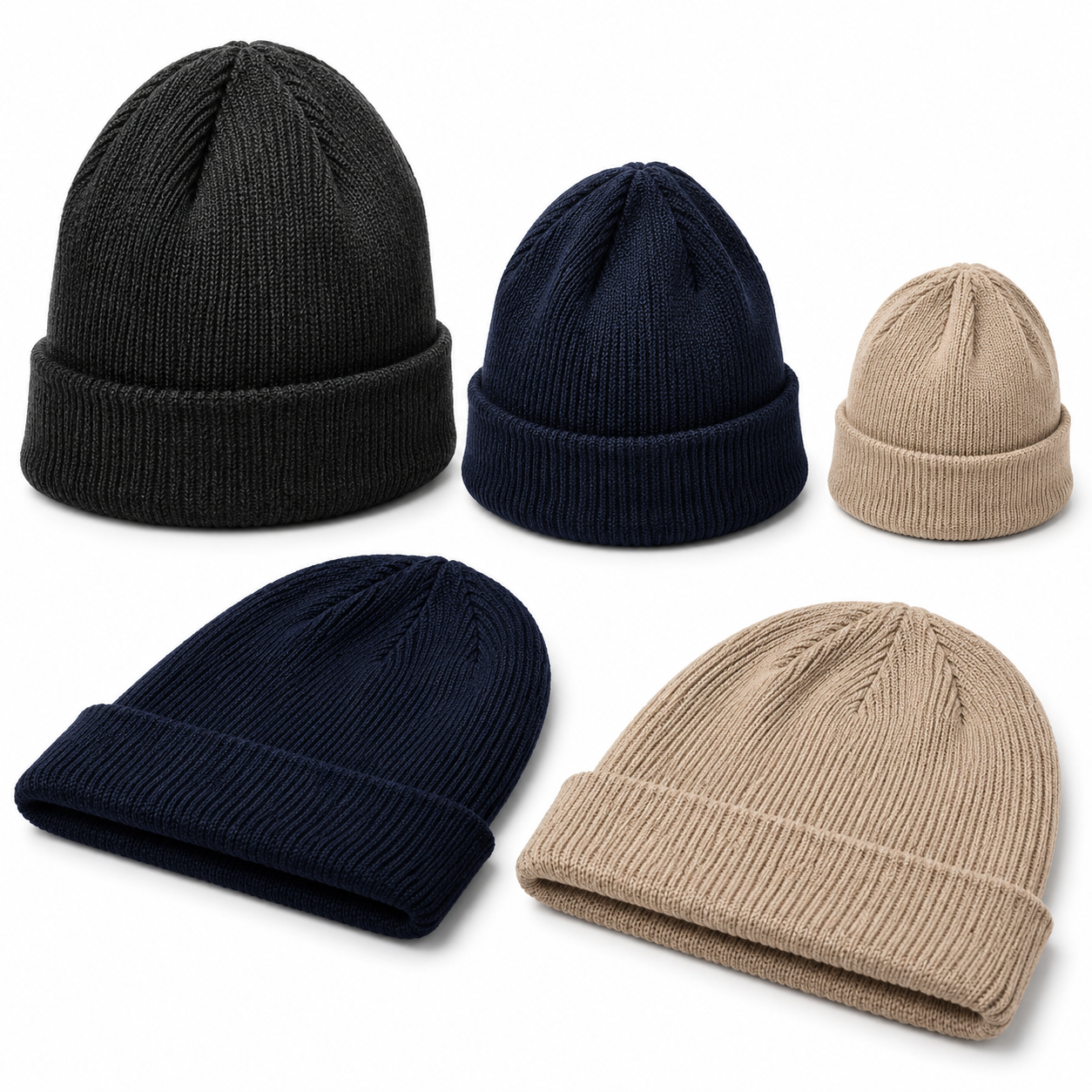
Adult beanies follow standard sizing: S (54-55cm head, 36-38cm relaxed beanie), M (56-58cm head, 38-40cm relaxed beanie), L (59-61cm head, 40-42cm relaxed beanie), XL (62-64cm head, 42-44cm relaxed beanie). The “one size” adult beanie typically uses a 38-40cm relaxed circumference with 1×1 or 2×2 rib construction, effectively covering sizes S through L (54-61cm head). Head sizes above 62cm require specific XL or “large fit” beanies as the compression at maximum stretch exceeds comfortable levels for most wearers.
Gauge, Yarn Weight, and Their Impact on Sizing Consistency
The most common cause of wholesale beanie sizing inconsistency is gauge variation — small differences in stitches per inch that compound across the full circumference. A 0.5 stitch per inch difference in a 40cm circumference beanie at 6 stitches/inch produces a 3.3cm circumference difference — enough to shift the beanie by a full size grade.
Yarn weight classification determines baseline stitch gauge. The Textile Exchange yarn weight standards categorize yarns from lace weight (wraps per inch >18) to super bulky (wpi <6). Most wholesale knitted beanies use DK to worsted weight yarns (11-14 wpi), producing a stitch gauge of 5-7 stitches per inch on standard knitting machines. Lighter yarns (fingering/sport weight) produce finer gauge beanies at 7-9 stitches per inch — more stitches means more cumulative gauge variance risk unless machine tension is precisely controlled. For guidance on how pilling resistance varies by yarn type, see our material quality testing guide, and review ISO 8559-1 for standardized measurement protocols.
Machine gauge — the number of needles per inch on the knitting machine — sets the ceiling for achievable stitch density. Standard beanie knitting machines operate at 7-gauge (7 needles/inch), 10-gauge, or 12-gauge. 7-gauge machines produce chunkier, heavier beanies (80-120g) with 4-5 stitches/inch, suitable for cold-weather and outdoor markets. 12-gauge machines produce finer, lighter beanies (50-70g) with 7-8 stitches/inch, preferred for retail and mild-weather applications. Machine gauge cannot be changed mid-production, so wholesale buyers must specify the gauge upfront based on target market and desired beanie weight.
Tension consistency across production is the hardest quality parameter to maintain. On a 100-needle circular knitting machine producing a 40cm beanie, each needle must maintain identical yarn tension. Tension variation of 5 grams between needles compounds across 100 needles to produce visible stripe patterns and size inconsistency. At Hongyuecap, our production QC measures beanie circumference on every 50th unit from each machine, with a tolerance of ±1cm from relaxed specification. Batches exceeding this tolerance trigger machine tension recalibration before production continues. This protocol maintains consistent sizing across orders up to 10,000 units.
Crown Closure Methods and How They Affect Fit
The way a knitted beanie’s crown is closed — the top of the hat where all stitch columns converge — significantly affects both fit and perceived size. Different closure methods create different crown volumes that change how the beanie sits on the head.
Gathered closure — the most common method — collects all stitches at the crown and pulls them tight with the final yarn tail, creating a slightly puckered circular closure approximately 2-3cm in diameter. Gathered closure produces a rounded crown silhouette that sits close to the head, maximizing internal volume for the wearer’s head. This method works best with 1×1 or 2×2 rib constructions where stitch distribution naturally centers the gathering. Gathered closure adds approximately 1cm of effective crown height compared to seamed closure because the gathering creates a soft dome rather than a flat top.
Seamed closure — stitching the crown closed in a straight line across the top — creates a flatter, more structured crown shape often used in retail and designer beanies. While aesthetically distinct, seamed closure reduces internal crown volume by approximately 8-12% compared to equivalent gathered closure, which can make a “one size” beanie fit tighter on larger heads. The seam itself adds 2-3mm thickness at the crown line, which can create a visible ridge under close-fitting styles. For wholesale beanie orders, gathered closure is the safer default for “one size fits most” claims; seamed closure should be reserved for sized beanies where fit precision is controlled through circumference grading.
Pom-pom attachment at the crown adds weight that affects fit differently than expected. A standard faux fur pom-pom weighs 15-25g — enough to subtly pull the beanie backward on the wearer’s head, especially in lighter-weight beanies under 60g total weight. The attachment point must be reinforced with additional stitching or an internal anchor button to prevent the pom-pom from tearing through the knit under its own weight during wear. At Hongyuecap, beanies with pom-poms receive an additional crown reinforcement stitch that adds 0.5cm of effective crown height to compensate for pom-pom pull-back.
Wholesale Beanie Sizing Quality Control Protocol
A standardized sizing QC protocol catches fit problems before bulk orders ship. Implement this 5-point inspection system for every wholesale knitted beanie order:
1. Relaxed Circumference Measurement: Lay the beanie flat on a measurement table and measure the width at the brim opening (fold line to fold line). Multiply by 2 for the relaxed circumference. Tolerance: ±1cm from specification. Measure 10 beanies per 1,000 units in the batch.
2. Maximum Stretch Test: Stretch the beanie over a calibrated cone or cylinder at the specified maximum head circumference (e.g., 61cm for “one size”). Hold for 30 seconds. The beanie should stretch to fit without thread breakage or audible popping sounds indicating stitch rupture. After removal, measure the relaxed circumference again — residual stretch should not exceed 5% of original relaxed measurement (i.e., a 40cm beanie should return to ≤42cm).
3. Compression Force Measurement: Using a force gauge, measure the compression exerted by the beanie band at the specified mid-range head circumference (e.g., 57cm for “one size”). Acceptable compression range: 15-35 mmHg. Below 15mmHg, the beanie feels loose and may slide; above 35mmHg, it leaves marks and causes discomfort during extended wear. This test requires specialized equipment but is the only objective measure of wearer comfort.
4. Crown Depth Verification: Measure from the crown closure point to the brim fold line with the beanie relaxed. Tolerance: ±0.5cm from specification. Crown depth should equal approximately 40-45% of the target head circumference for proper ear coverage without excess fabric bunching at the crown.
5. Wash Cycle Dimension Stability: Launder one test beanie per style per color according to care label instructions (typically cold wash, air dry). Re-measure all dimensions. Acceptable shrinkage: <3% in circumference, <5% in crown depth. Excessive shrinkage indicates inadequate yarn pre-conditioning or incorrect stitch tension that will cause customer returns after first washing.
Frequently Asked Questions About Knitted Beanie Sizing
What relaxed circumference should a “one size fits most” beanie have?
A “one size fits most” adult knitted beanie with 1×1 or 2×2 rib construction should have a relaxed circumference of 38-42cm. This stretches comfortably to fit head sizes 54-61cm. Beanies below 38cm relaxed circumference will feel too tight on head sizes above 58cm; beanies above 42cm may feel loose on head sizes below 55cm and slide during active wear.
How do I choose between sized beanies and one-size beanies for wholesale?
Sized beanies (S/M/L/XL) are preferable when your retail channel competes on fit quality (specialty outdoor, premium retail) because they eliminate the compression discomfort that “one size” beanies create at size extremes. One-size beanies are more cost-effective for promotional products, corporate gifts, and general retail where inventory simplicity outweighs fit precision. The manufacturing cost difference is approximately $0.20-0.40 per unit (additional pattern grading and production setup for sized options), typically recovered through 30-50% lower size-related returns.
Why do acrylic beanies fit differently than wool beanies in the same labeled size?
Acrylic yarn has lower natural elasticity than wool but more consistent synthetic stretch characteristics. A 100% acrylic beanie at 38cm relaxed circumference stretches to approximately 58cm at 25-30 mmHg compression. A 100% wool beanie at 38cm stretches to the same 58cm but at lower 18-22 mmHg compression — feeling noticeably looser despite identical labeled dimensions. This is why wool beanies are often manufactured 1-2cm smaller in relaxed circumference than their acrylic equivalents for the same labeled size. Always specify fiber content when referencing size charts.
How does beanie cuff/fold affect the effective size?
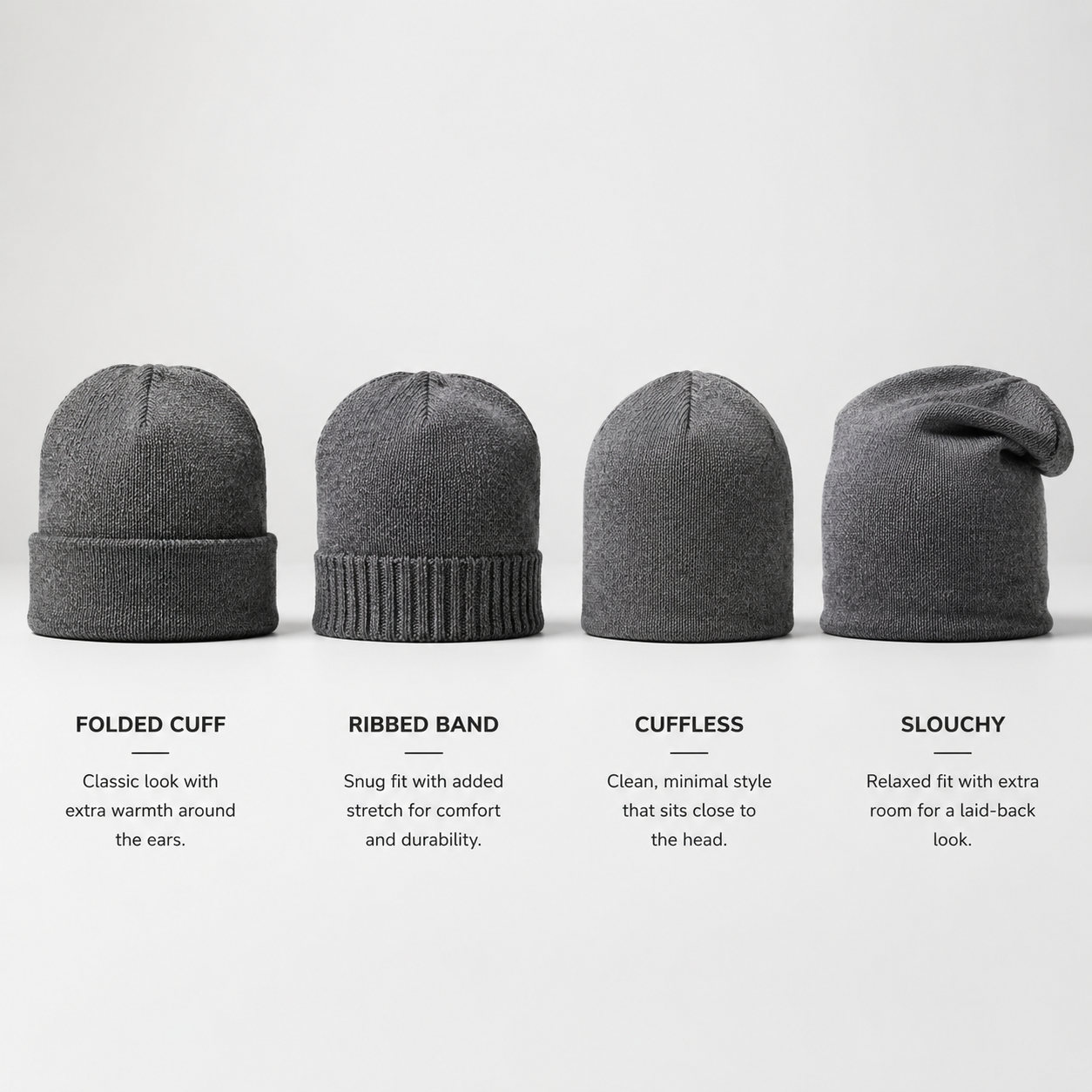
A folded cuff consumes approximately 5-7cm of the total crown height and effectively tightens the brim opening by creating a double layer of knit fabric at the forehead band. This double layer increases compression at the forehead by approximately 15-25% compared to the same beanie worn uncuffed. Wholesale beanies designed for cuffed wear should have 5-7cm additional crown height and 1-2cm additional relaxed circumference compared to uncuffed beanies in the same labeled size, to compensate for the extra fabric and compression at the fold.
Order Knitted Beanies with Guaranteed Size Consistency
Eliminate sizing surprises with Hongyuecap‘s 5-point QC protocol: relaxed measurement, stretch test, compression force, crown depth, and wash stability verification on every wholesale production batch. We maintain ±1cm relaxed circumference tolerance across orders up to 10,000 units. Contact our team for size-graded samples delivered in 3-5 business days. MOQ starts at 100 units per style with full size and color grade availability.
Written by the Hongyuecap Product Team — specialists in wholesale knitted headwear manufacturing, yarn specification, and size standardization.
References: Wikipedia: Baseball Cap | Wikipedia: Hat Manufacturing | WRAP Compliance Certification